How Digital Design and Simulation for Smart Production Lines Prepares Automation Engineers
Digital design and simulation for smart production lines gives automation engineers a structured, risk-free environment to build, test, and refine complex manufacturing systems before a single physical component is installed. Rather than discovering costly errors on the shop floor, engineers can run thousands of virtual iterations—validating PLC logic, robot trajectories, AGV routing, and MES data flows—all within a high-fidelity simulation model. According to VDI 3633 and ISO 23247 standards, properly validated simulation models reduce physical commissioning time by 30–40%, making this skill one of the most in-demand competencies across modern smart factory operations.
Understanding Digital Design and Simulation in Smart Production Lines
What the Technology Actually Does
Discrete Event Simulation (DES), 3D CAD modeling, and digital twin technology are at the heart of production line simulation. They are used to mimic how manufacturing really works. Without touching the hardware, engineers can test the flow of materials, the order of tools, and the reasoning of the system. Platforms like Siemens Plant Simulation, Dassault Systèmes DELMIA, and PTC Vuforia all have their own modeling environments that are best for different levels of production.
Why Digital Twins Change the Equation
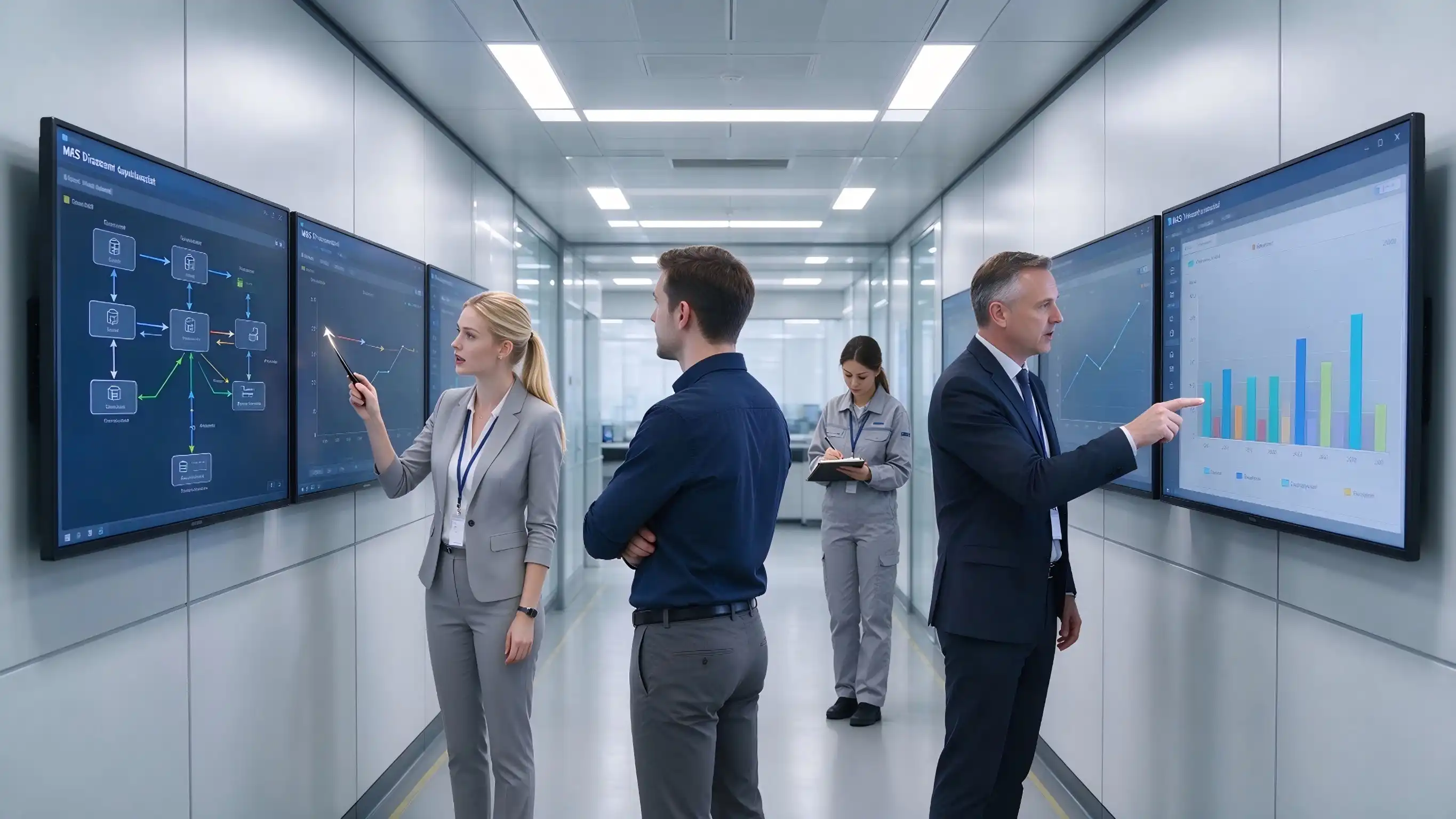
A digital twin is more than just a 3D picture. It is a live model that is kept in sync with real-time OPC-UA or MQTT feeds from real equipment. This means that engineers can keep an eye on the status of production, guess what maintenance will be needed, and run "what-if" scenarios all at the same time. The reference architecture for manufacturing digital twins is set by ISO 23247, which gives institutions and factories a clear baseline for compliance.
The Industry 4.0 Connection
Smart manufacturing needs engineers who know how to combine PLC signals, SCADA data, MES production orders, and robotic kinematics into a single system. This kind of cross-domain understanding is built through simulation training, which prepares engineers not only for one machine but for the whole intelligent production environment.
Limitations of Traditional Production Line Design and How Digital Approaches Overcome Them
The Hidden Costs of Physical Prototyping
In the old way of designing lines, things are done by making mock-ups, studying time by hand, and ordering by trial and error. Finding a single mistake in the layout after the fact can take weeks of work and cost a lot of money. According to studies released in the International Journal of Advanced Manufacturing Technology, design changes made near the end of a project can cost up to 70% of the total budget.
Shifting Validation to Virtual Environments
Moving validation upstream into a virtual environment with digital design and simulation for smart production lines lets engineering teams find places where materials are getting stuck, robots that can't reach each other, and problems with PLC ladder logic before they buy them. For example, AGV routing simulations have cut down on buffer sizing mistakes in high-mix, low-volume electronics manufacturing by finding path conflicts that physical tests would have missed.
Real-World Productivity Gains
Teams that use virtual commissioning (VC) workflows often say that control logic validation has better latency of less than one millisecond. Over 200 robots work in small spaces in automotive body-in-white welding cells that use simulation-based collision detection to make sure there is no interference during line startup. These results are not just theories; they are based on real-world examples from the AutomationML and ISO 10303 (STEP) interface standards.
Key Components of Digital Design and Simulation Solutions for Smart Production Lines
Software Capabilities That Matter
Kinematic modeling of 6-axis robots, PLC Hardware-in-the-Loop (HIL) testing, and statistical output validation using methods like the Chi-squared test to make sure that simulation patterns match production data from the past are all things that good simulation software should be able to do. Standard protocols, such as PROFINET, EtherNet/IP, and Modbus TCP, must be supported and Siemens TIA Portal must be integrated in multi-vendor factory settings.
When procurement teams choose a simulation tool, these are the main technology needs they should look at:
- PLC and HMI compatibility: The platform must support Siemens, Mitsubishi, and Inovance PLC protocols natively, with the ability to map TCP signals and I/O configurations directly into the simulation model.
- MES and SCADA integration: Real production scenarios require bidirectional data exchange with MES systems. Platforms that support OPC-UA ensure the simulation can transition into a live digital twin tied to actual shop floor data.
- AI and vision system support: Modern smart lines integrate machine vision for defect detection and sorting. Simulation environments that accommodate AI model deployment and camera parameter configuration reflect actual production demands far more accurately.
These features directly show if a simulation platform can really be used as a training tool for real workplace conditions, or if it will just stay a PC exercise that has nothing to do with real life.
Vendor Landscape at a Glance
Siemens DELMIA/Tecnomatix is used for process simulation and robot offline programming in a lot of heavy and automotive industries. Lifecycle management and collaborative design are two areas where Dassault Systèmes' 3DEXPERIENCE platform really shines. IoT connectivity and real-time analytics dashboards are two things that PTC's ThingWorx does really well. Each one meets the needs of an institution or business in a different way, and when making a procurement choice, integration depth should be given more weight than name recognition alone.
ECR Academy's Integrated Training Platform
The "Digital design and simulation for smart production lines" course at ECR Academy uses a modular virtual simulation and hardware training platform that lets you program PLCs through the Siemens TIA Portal, program industrial robots both online and offline, use AI vision recognition, set up MES, and sync your digital twins. The platform can be used both online and offline, so it can be used by both vocational schools and enterprise training centers. It doesn't require complicated software installation.
Best Practices for Automation Engineers to Implement Digital Design and Simulation
Start with Bottleneck Identification
Before you choose a simulation tool, you should make a map of the current production workflow to see where delays, quality problems, and equipment conflicts happen most often. Simulation is most useful when it's used to solve a known problem, not when it's used to model everything at once.
Invest in Structured Skill Development
It is required that tech teams improve their skills in digital design and simulation for smart production lines. As part of the ASME V&V 40 protocols, computer models must pass both Verification (does the model act as coded?) and Validation (does the model match reality?) checks. If engineers don't learn how to do model fidelity assessment, they will make results that look good but aren't dependable. The teachers at ECR Academy come from both working in the field and doing research in academia. They teach in a structured way that goes from basic digital twin configuration to full system integration and fault diagnosis.
Measure What Matters
Keep an eye on key performance indicators (KPIs), such as the difference in flow between virtual and real production, less time spent on physical setup, and rework events before the line starts up. Based on real-life examples, a simulation program that is well-implemented can usually give a 200% ROI through reduced labor costs and faster cycle times.
Future Trends and the Evolving Role of Automation Engineers in Smart Production
AI-Driven Predictive Simulation
When AI is added to simulation, it goes from being a tool for the planning part to an ongoing advantage for operations. Predictive models can now show when equipment is breaking down before the MTBF limits are met. This gives repair teams time to take action. Engineers who know how to set up and understand these simulation outputs that are enhanced by AI will have a big advantage in the job market.
Augmented Reality and Hybrid Workflows
As we speak, AR overlays are starting to connect real and virtual commissioning environments. When an engineer puts on AR glasses, the digital twin model appears on top of the real equipment. This lets them check the wiring, sensor placement, and robot reach in real time. This mixed work flow is already used in pharmaceutical safe packaging lines, where the need for a sterile setting makes physical trial and error too dangerous.
Lifelong Learning as a Career Strategy
Automation engineering isn't the same thing it used to be. Engineers with certifications in digital twin application, AI vision systems, and MES integration, such as the Industrial Software Engineer and Digital Twin Engineer 1+X certificates, can expect their careers to grow in the manufacturing and education sectors over the long term.
Conclusion
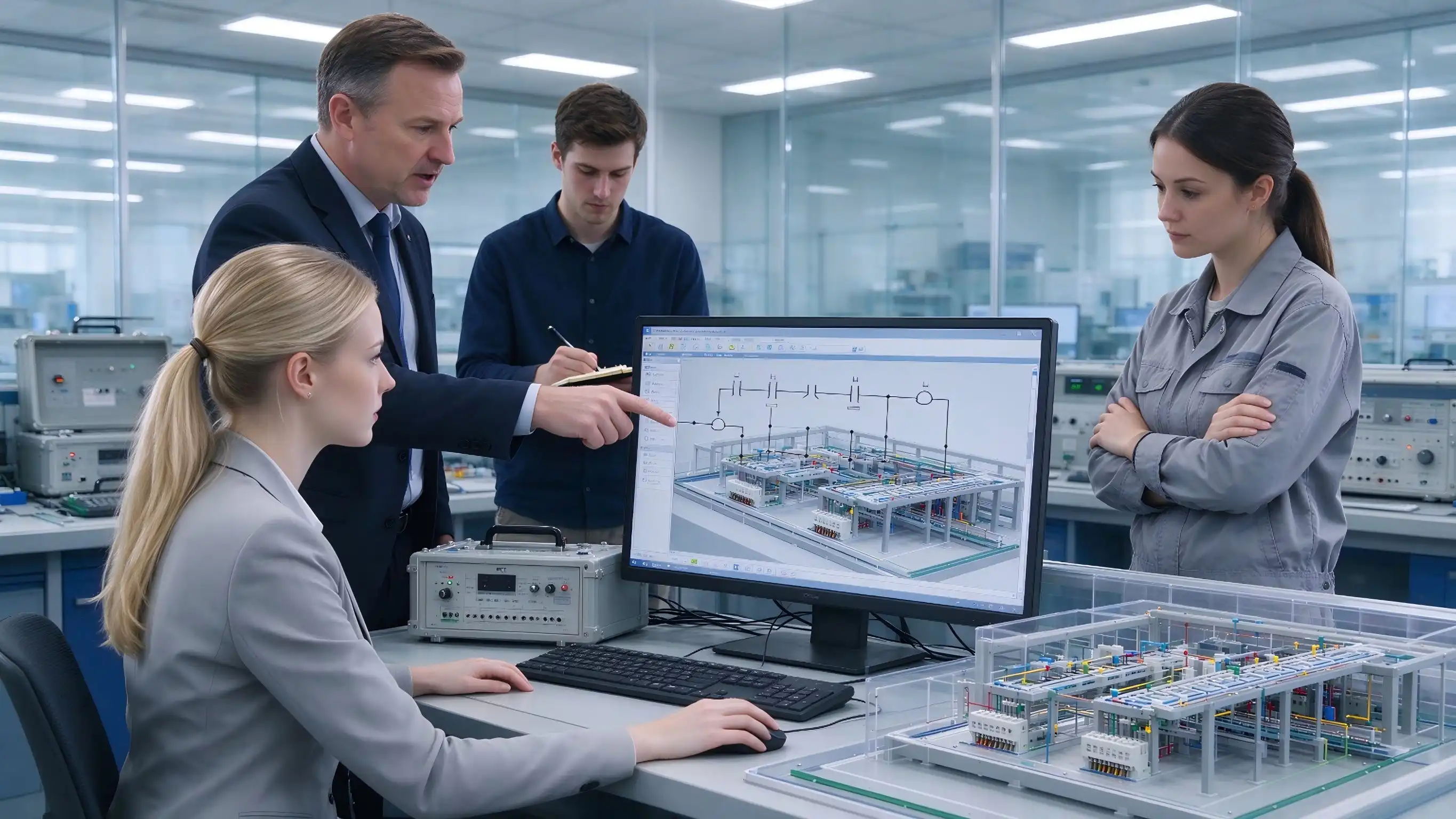
No longer just an academic practice, simulation-based training is now the main way that automation experts get ready to work in smart factories through digital design and simulation for smart production lines. From checking the logic of PLCs to fully integrating MES, the skills learned in structured virtual production training are exactly what you'll need on the job. The ECR Academy course gives students real-life experience with all the parts of an intelligent production line. It uses standard tools and is taught by engineers who have actually worked on the systems they teach.
FAQ
1. Can someone with no technical background take this course?
Yes, ECR Academy divides the program into two parts: an introduction and a certification track. The starter package starts with the basics of digital twins, basic equipment operation, and AI, and then it builds on those skills over time. You don't need to know anything about programming or automation to get started.
2. What roles does this training prepare engineers for?
For example, graduates are ready for jobs as an Industrial Robot Engineer, a System Integration Engineer, an AI Vision Application Engineer, a Digital Twin Application Engineer, or a MES System Operation and Maintenance Engineer. This program is also helpful for vocational teachers who want to teach intelligent manufacturing subjects.
3. How does this simulation platform differ from basic 3D visualization tools?
Scripted representations are made by visualization. This platform lets you run a physics- and logic-based simulation that is in sync with real PLC and MES data.
Partner with E.C.R Academy for Digital Design and Simulation for Smart Production Lines
Since 2010, E.C.R. Academy has trained almost 500,000 people in 28 countries, and 300,000 of them have earned recognized skills certifications. We are a reliable company that trains people in digital design and simulation for smart production lines. We work directly with trade schools, OEM training centers, and smart manufacturing facilities to create programs that are based on real industrial processes. Visit enteredu.com or email our team at ecr2008@enteredu.com to ask for a platform demonstration that is tailored to the training goals of your school or location.
References
1. VDI Verein Deutscher Ingenieure. VDI 3633: Simulation of Systems in Materials Handling, Logistics and Production. VDI, 2014.
2. ISO. ISO 23247: Automation Systems and Integration — Digital Twin Framework for Manufacturing. International Organization for Standardization, 2021.
3. ASME. ASME V&V 40: Assessing Credibility of Computational Modeling through Verification and Validation. American Society of Mechanical Engineers, 2018.
4. Mourtzis, D. "Simulation in the Design and Operation of Manufacturing Systems: State of the Art and New Trends." International Journal of Production Research, 2020.
5. Zheng, P., et al. "Smart Manufacturing Systems for Industry 4.0: Conceptual Framework, Scenarios, and Future Perspectives." Frontiers of Mechanical Engineering, 2018.
6. Lu, Y., et al. "Digital Twin-Driven Smart Manufacturing: Connotation, Reference Model, Applications and Research Issues." Robotics and Computer-Integrated Manufacturing, 2020.