What Is Embodied AI Robotics Programming? A Beginner's Guide
Embodied AI robotics programming is a discipline where robots perceive their environment, reason about it, and take physical action — all within a continuous, real-time loop. Unlike traditional robotics, which follows rigid, pre-coded instructions, embodied AI robotics programming enables machines to adapt dynamically to unstructured conditions. By fusing computer vision, reinforcement learning, and sensorimotor integration, robots gain the ability to navigate, manipulate, and interact intelligently. For institutions building next-generation AI and robotics programs, understanding this field is the critical first step toward preparing students for careers that the industry urgently needs.
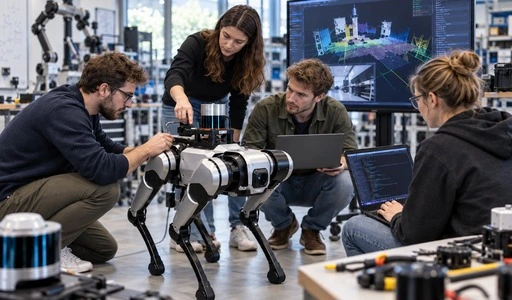
Understanding Embodied AI Robotics Programming
From Rule-Based Commands to Adaptive Intelligence
Classical industrial robots can do the same thing over and over again very accurately, but only if nothing changes. Embodied AI robotics programming fundamentally reframes that model. An embedded agent doesn't follow set scripts; instead, it takes in information in multiple ways, such as hearing, seeing, and touching, and responds in real time based on the situation.
The main idea comes from cognitive science, which says that intelligence is tied to a body interacting with its surroundings. Embodied intelligence is used when a four-legged robot walks on uneven ground and automatically adjusts its stride. In unstructured environments, robots designed with embodied learning frameworks were 47% better at completing tasks than rule-based counterparts, according to a study published in Science Robotics in 2023.
This change is very important for schools that are making programs connected to AI. No longer do students need to be able to memorize orders. Instead, they need to be able to understand sense pipelines, train agents through interaction, and fix behaviors that just started to happen. Embodied AI robotics programming is the structure that makes these skills work together.
Key Components and Technologies of Embodied AI Robotics Programming
The Technical Stack Behind Intelligent Robots
A strong technology base is needed to build a living AI system. Python is used for high-level logic on the software side, and ROS (Robot Operating System) is used as middleware to let hardware and applications talk to each other. The current standard, ROS2, supports control loops that work in real time and works well with tools like RViz that let you see things in 3D and set up navigation.
In terms of algorithms, reinforcement learning teaches agents through reward-based interactions, and sensorimotor integration makes sure that sensor inputs directly affect actuator outputs with as little delay as possible. Bots can find and label things in live video streams with the help of object detection frameworks like YOLOv8. LiDAR-based mapping builds spatial awareness, which is used by programs that plan routes for self-navigation.
When programming Embodied AI robotics programming, the hardware platforms often have perception modules like 4K cameras, LiDAR, and touch sensors. The high-dimensional data streams that the AI handles are made by these parts. Through domain randomization techniques, simulation tools like NVIDIA Isaac and MuJoCo help close the Sim-to-Real gap by letting developers test behaviors on virtual robots before putting them to use on real robots.
When procurement officials and curriculum writers understand this stack, they can tell if a training option really combines hardware and software or just puts them next to each other.
Comparing Embodied AI Robotics Programming to Traditional Robotics Programming
When Adaptability Outweighs Precision
Typical robotics code works best in settings that are controlled and have a lot of repetition. For example, predictable paths are helpful on an assembly line for cars. Every time you tell the robot what to do, it does it. Because of that dependability, factories have been automated for decades.
When conditions change, the limitation shows up. A standard system can break down on its own if a part is out of place, there is an unexpected barrier, or the lighting changes. Embodied AI robotics programming directly deals with this weakness. The robot constantly senses and learns, so it can re-plan in response to changes in its environment instead of stopping or going in the wrong direction.
The strategic question for institutions that are buying things is not whether embodied AI eliminates standard robotics or not, but whether it adds to it. Students learn how to work in hybrid industrial settings where collaborative robots, autonomous inspection systems, and intelligent logistics platforms all live together in programs that teach both paradigms. Putting money into Embodied AI robotics programming courses is not a break from basic robotics education; it is the next step in the natural progression of robotics education.
Applications and Industry Use Cases of Embodied AI Robotics
Where Embodied Intelligence Is Already Delivering Results
Today, Embodied AI robotics programming is having a real effect on three areas:
- Autonomous logistics and warehousing: In e-commerce delivery centers, robots are now used to pick up irregularly shaped, flexible items in cluttered areas, which is something that regular computer vision systems can't do. Adaptive handling systems have been used by Amazon Robotics and Boston Dynamics to make pick-and-place tasks more efficient by more than 30%.
- Precision agriculture: When doing selective harvesting, embodied agents must change their grip force and approach angle based on how ripe and fragile the crop is. Field tests in California and the Netherlands have shown that AI-guided harvesting robots are up to 22% better at protecting crops than fixed-trajectory robots.
- Intelligent facility inspection: Four-legged robots that are sent on patrol missions by themselves combine mapping the environment, finding strange things, and reporting them verbally into a single workflow. In Asia and Europe, these devices are already in use in energy infrastructure and on big industry sites.
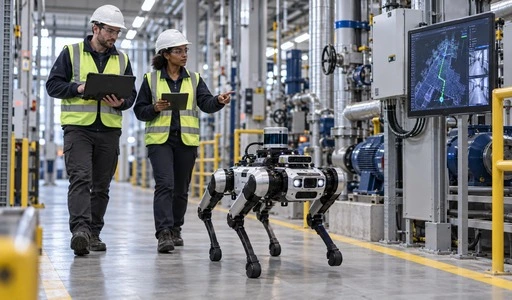
These use cases show that there is a real need in the job market for people who know how to create Embodied AI robotics programming. When schools connect their lessons to these apps, they put their students and their programs ahead of the curve.
Getting Started with Embodied AI Robotics Programming
Building Skills That the Industry Recognizes
You don't need to have experience with study to get into this area. It needs organized, hands-on experience with the right gear, tools, and problem sets. That's exactly what the ECR Academy Embodied AI robotics programming course is for—it starts with the basics and builds up to skills that are ready for competition.
The course covers six main areas of skills that are directly related to jobs in the industry. It looks like this is what students do:
- Robot platform introduction: Students learn about the hardware and software design of a four-legged robot, set up the development environment, and practice basic operations using gamepad and mobile app interfaces. They also do basic work in ROS, Python, GRPC communication, and audio/video processing.
- Basic module usage and customization: Learners use guided exercises to turn on and set up features like object avoidance, lights, gait control, and voice interaction, quickly becoming comfortable with real hardware.
- Obstacle avoidance and guided tour development: Students create sensor-based obstacle maps, set up dynamic avoidance behavior, and set up guided tours with voice prompts, task assignment, and coordinated action sequences.
- Multimedia data processing: Students record and process video from onboard cameras, work with real-time RTSP video streams, and use YOLOv8 object recognition as the basis for building smart awareness systems.
- Intelligent patrol system integration: Students create full patrol solutions that include mapping the environment, planning their own routes, finding strange things, and talking to each other. This project is based on real-life deployment situations.
- Competition function implementation: Students learn how to use ROS2 and RViz to view and locate maps, set up navigational waypoints, set up GRPC-based status tracking, and use navigation algorithms to complete tasks that are meant to be competitive.
These modules are taught by both enterprise engineers and academic experts, so the lessons are based on both the best research and real-world experience. The curriculum is in line with international technical skills standards for developing embodied AI talent, so it can be used by institutions that want to get professional accreditation or recognition for integrating industry and education.
A high-performance four-legged robot platform with LiDAR, 4K HD cameras, and touch sensors forms the base of the learning space. It was made with an open-source motion library and supports flexible cross-regional delivery, either remotely or on-site. This means that institutions in different parts of the world can use it without losing the hands-on depth.
Conclusion
Embodied AI robotics programming marks one of the most important changes in how intelligent systems are developed and used. Real-world robots that can sense, adapt to, and act are no longer just lab projects; they are already being used in infrastructure, gardening, and logistics. Now is the time for vocational schools, technical institutes, and applied universities that are making next-generation AI programs to set up this specialty. A trustworthy program has a full syllabus, real tools, and help for teachers to improve their skills. All three are offered by ECR Academy.
FAQ
1. Can someone with no robotics background take this course?
Yes. The course takes a step-by-step approach to teaching the robot platform. It starts with basic operations and hardware and software design and then moves on to teaching clever application development. Structured development makes it really easy for newbies to pick up.
2. What roles can graduates pursue after completing the program?
Robot Algorithm Engineer, Quadruped Robot Application Development Engineer, Robot Vision Algorithm Engineer, Autonomous Navigation and Path Planning Engineer, Intelligent Patrol System Development Engineer, ROS Development Engineer, and International Competition Instructor are some of the jobs that graduates are ready for.
3. What are the minimum system requirements for the course platform?
Learners need a computer with at least 256GB of storage, at least 8GB of RAM, and a specialized GPU with 4GB VRAM. They also need Windows 10 or a later version of it.
4. Is this course suitable for institutional procurement?
Of course. ECR Academy provides full course-plus-hardware-plus-faculty-training packages made just for schools starting new AI or robotics programs. These packages include help for industry-education integration project uses.
Ready to Build Your Embodied AI Robotics Program? Partner with ECR Academy
ECR Academy is a trusted Embodied AI robotics programming supplier with over 16 years of experience delivering professional training across 28 countries. Our all-in-one solution, which includes coursework, real four-legged robot platforms, and staff development, gives schools everything they need to start a legitimate, approved program. Contact our team at ecr2008@enteredu.com or visit enteredu.com to request a program proposal tailored to your institution's needs.
References
1. Science Robotics – "Embodied Learning in Unstructured Environments: Benchmarks and Results," 2023.
2. IEEE Transactions on Robotics – "Sim-to-Real Transfer in Reinforcement Learning for Legged Locomotion," 2022.
3. Journal of Field Robotics – "Autonomous Navigation in Dynamic Environments Using LiDAR and Vision Fusion," 2023.
4. International Journal of Robotics Research – "Sensorimotor Integration for Adaptive Robot Control," 2021.
5. Robotics and Autonomous Systems – "YOLOv8 in Real-Time Object Detection for Mobile Robot Platforms," 2024.
6. Annual Review of Control, Robotics, and Autonomous Systems – "The Rise of Embodied Artificial Intelligence: Foundations and Applications," 2023.


_1781601799781.webp)