Building Interactive 3D Scenes with Industrial Production Virtual Simulation & Development
Industrial production virtual simulation & development refers to the process of digitizing manufacturing environments, equipment, and workflows into interactive 3D scenes that learners and engineers can operate, test, and analyze without touching physical machinery. As smart manufacturing accelerates, institutions and enterprises need training solutions that mirror real production conditions. This approach replaces costly physical setups with browser-accessible virtual environments, giving learners hands-on exposure to UAV systems, reducer mechanisms, production lines, and more — all from a standard web browser.
Understanding Industrial Production Virtual Simulation
What It Actually Does in a Manufacturing Context
Virtual modeling turns real industrial tools and processes like conveyor belts, robotic arms, and assembly lines into digital models that can be interacted with. Engineers and students can use these models to see how systems react to fault scenarios and operate them. A report from the World Economic Forum in 2022 says that manufacturers who used digital simulation tools cut commissioning errors by as much as 40% compared to those who used traditional physical prototyping methods.
Why B2B Procurement Teams Are Paying Attention
When looking for ways to improve the skills of their employees, procurement managers at vocational schools and smart manufacturing companies are asking for simulation-based training tools more and more. The reasons are practical: it's expensive, hard to scale, and risky to use physical training tools for high-risk or high-cost tasks like calibrating UAVs or taking gearboxes apart. All three issues can be fixed at the same time with a browser-based simulation platform.
Linking Simulation to 3D Scene Construction
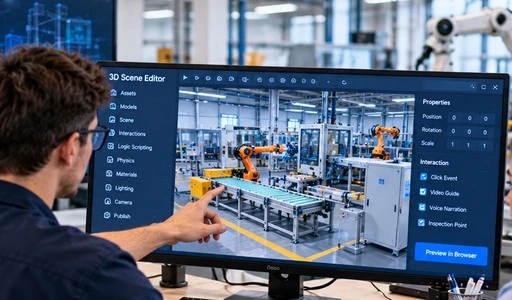
The first step in creating a useful virtual training environment is creating a 3D scene. This includes placing equipment models in accurate 3D layouts, giving the scene realistic materials and lighting, and programming interaction logic. Whether students learn skills that can be used in other situations or just click through animations depends on the quality of the scene. The process of making scenes is technical work and not visual design work because of this.
Core Components and Workflow of Building Interactive 3D Scenes
The Technology Stack Behind Industrial Scenes
Several technologies work together to make a dynamic 3D scene ready for production. These include 3D asset modeling, physics-based motion simulation, multimedia interaction design, and coding logic. All of this can run in a web browser without having to install any software thanks to platforms like VeryEngine that are based on HTML5 and WebGL. This B/S (Browser/Server) architecture lets both students in institutional labs and those learning from home access the system in a variety of ways.
The Step-by-Step Development Workflow
There are different stages in the development process. When institutions or training makers know this process, they don't have to make as many expensive changes. In a normal scene-building process, these steps are what happen:
- Asset digitization: Import or build 3D models of target equipment (e.g., reducer mechanisms, traffic signal systems) with accurate geometry and material properties.
- Scene assembly: Arrange assets in a virtual spatial layout that mirrors the actual factory or training environment, configuring lighting and camera perspectives.
- Motion logic programming: Apply object motion commands — rotation, translation, gear transmission — using JavaScript or TypeScript in industrial production virtual simulation & development to replicate real mechanical behavior.
- Interaction design: Layer in multimedia triggers: video explanations, voice guidance, image callouts, and clickable inspection points that respond to learner input.
- Testing and publishing: Debug interaction logic, verify performance on different browsers, then package and publish the final product for institutional deployment.
Set up the scene by placing objects in a virtual space that looks like the real workplace or training area and adjusting the lighting and camera angles.
A Real Deployment Example
Every stage builds on the one before it. For example, skipping scene validation before adding interaction logic usually makes debugging take twice as long later. Institutions that use this structured process always say that release goes faster and student participation numbers go up.
Comparing Virtual Simulation Software for Industrial Development
What to Evaluate Before Committing to a Platform
There are general-purpose 3D tools like Unity and Unreal Engine on the market, as well as platforms made just for industrial training simulation. General systems are flexible, but they need a lot of special work. Purpose-built platforms give up some freedom in exchange for speed: they come with industrial models that are already loaded, motion libraries that are already built in, and case projects that are ready to use.
How ECR Academy's Platform Stands Apart
The Industrial production virtual simulation & development course at ECR Academy is built around the VeryEngine platform, which is designed to work best in industrial training scenarios. It uses HTML5 and WebGL to run entirely in a browser, doesn't need to be installed, and lets you edit and preview in real time. If a teacher doesn't know much about programming, they can start with visual editing tools and move on to JavaScript and TypeScript scripting as they get better. One of the biggest issues about simulation systems is that they are hard to learn, which means that expensive tools aren't used. This graduated method fixes that problem.
Virtual Simulation vs. Physical Prototyping: A Practical Comparison
Physical prototyping is still useful for final testing, but it is too slow and expensive for large-scale training. Virtual simulations are a much cheaper way to teach because they allow for repeated practice, mistake repair, and different scenarios. According to a study released in Computers & Education in 2021, simulation-based technical training was just as good at improving skills as real lab training, but it cost 35% to 60% less. This difference in costs is very important for organizations that have to manage tight budgets for government-funded projects.
Optimizing Industrial Processes Using Virtual Simulation and Interactive 3D Scenes
Identifying Workflow Bottlenecks Through Scene Testing
One of the best things about digital simulation for training in production is that it lets you test workflows under stress before they happen on a real floor. Using fault injection, teachers can set up problems like a conveyor belt that won't move or a component that isn't lined up right and watch how students figure them out and fix them. This shows both skill gaps in the learners and problems with the way the process is designed at the same time.
Integrating Lean Principles Into Simulation Design
The ideas behind lean manufacturing can be directly applied to industrial production virtual simulation & development. Scenes can show takt time, limits on work-in-progress, and material flow sequences, teaching students both technical operation skills and how to think about how to make things more efficient. This is especially important for schools that teach smart manufacturing because grads are expected to help improve processes as well as running machines.
Closing the Loop: Simulation Data and Real Production Metrics
Modern modeling platforms record engagement data like time spent on task, errors made, and decision paths that teachers can look at to change how hard the curriculum is. When simulation metrics match real-world production performance benchmarks from industry partners, both corporate clients and regulatory reviewers are more likely to trust the training program.
Future Trends in Digital Twin Education and Industrial Scene Development
AI-Assisted Scene Generation
AI tools are starting to automate some parts of building 3D scenes. For example, they can make environment layouts from equipment specs or motion parameters suggestions from mechanical drawings. This means that scene creation will not need as much expert work, and smaller schools will be able to make their own custom simulation material.
Cloud Collaboration and Multi-User Environments
Multiple people can now interact with the same virtual scene at the same time in cloud-hosted simulation settings. For institutional partners that run regional training centers, this means that students from different campuses can work together on simulations without having to buy new hardware.
Skills Certification Tied to Simulation Performance
International groups that set standards for skills are starting to use simulation-based tests as part of licensing programs. With 16 years of experience teaching skills and evaluating them in 28 countries, ECR Academy is well-equipped to connect academic partners with these new certification paths as they become official.
Conclusion
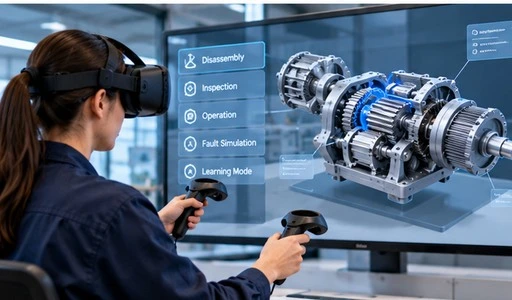
It's technical and organized work to make interactive 3D scenes for industrial training in industrial production virtual simulation & development. You need the right platform, a clear development process, and teachers who can move from visual editing to planned interaction design. Instead of buying pre-made content that they can't change, institutions that spend in the right infrastructure for simulation creation gain long-term capabilities. This is exactly what ECR Academy's industrial production virtual simulation & development course offers: a project-based path from scene basics to full product publication, built on an easy-to-use browser platform and taught by engineers and professors with real manufacturing experience.
FAQ
1. Does this course require prior programming experience?
No prior coding experience is required. The course begins with visual editing tools and recognition function basics before introducing JavaScript and TypeScript scripting. Learners build coding confidence through structured project work rather than abstract exercises.
2. What industries are the simulation cases drawn from?
Case projects include UAV systems, reducer mechanisms, and traffic signal control — industries that span aerospace, mechanical engineering, and transportation infrastructure. These reflect the equipment categories most frequently required for national virtual simulation base applications in China and smart manufacturing curricula internationally.
3. How does the B/S platform support institutional deployment?
Because the platform runs entirely in a browser, institutions do not need dedicated simulation lab hardware. Learners access development and experience environments through any standard web browser, which simplifies both deployment and remote access for distributed campuses.
Partner with ECR Academy for Industrial Virtual Simulation & Development Solutions
Over 500,000 people have been taught by ECR Academy over 16 years in 28 countries, and more than 300 business partners have worked with them. Our browser-based platform and project-driven curriculum give you measurable results whether you are a school looking for a qualified industrial production virtual simulation & development supplier for a national base project or a business building up its own digital manufacturing training capabilities. You can email us at ecr2008@enteredu.com or go to enteredu.com to set up a time to walk you through the platform and talk about a partnership that fits your needs.
References
1. World Economic Forum. The Future of Jobs Report 2023. World Economic Forum, 2023.
2. Merchant, Z., Goetz, E. T., Cifuentes, L., Keeney-Kennicutt, W., & Davis, T. J. "Effectiveness of virtual reality-based instruction on students' learning outcomes in K-12 and higher education." Computers & Education, 2014.
3. Chryssolouris, G., Mavrikios, D., & Mourtzis, D. "Manufacturing systems: Skills & competencies for the future." Procedia CIRP, 2013.
4. Tao, F., Qi, Q., Liu, A., & Kusiak, A. "Data-driven smart manufacturing." Journal of Manufacturing Systems, 2018.
5. Nee, A. Y. C., & Ong, S. K. "Virtual and augmented reality applications in manufacturing." CIRP Annals – Manufacturing Technology, 2013.
6. UNESCO-UNEVOC. Transforming TVET: Building Skills for Work and Life. UNESCO-UNEVOC International Centre for Technical and Vocational Education and Training, 2021.