Industrial Robot Simulation Training Course with Virtual Programming
An industrial robot simulation training course with virtual programming teaches people to program, test, and maintain robots on a computer before they touch real machines. It applies industrial robotics technology through 3D models, offline programming, PLC control, machine vision, digital twins, and system integration. E.C.R Academy delivers this training through project-based lessons, taught jointly by enterprise engineers and college experts, on a virtual simulation platform. In this article, I explain how simulation training works, what a strong course includes, which benefits to expect, how to choose a provider, and where the field is heading.
Understanding Industrial Robot Simulation Training
What Robot Simulation and Virtual Programming Mean
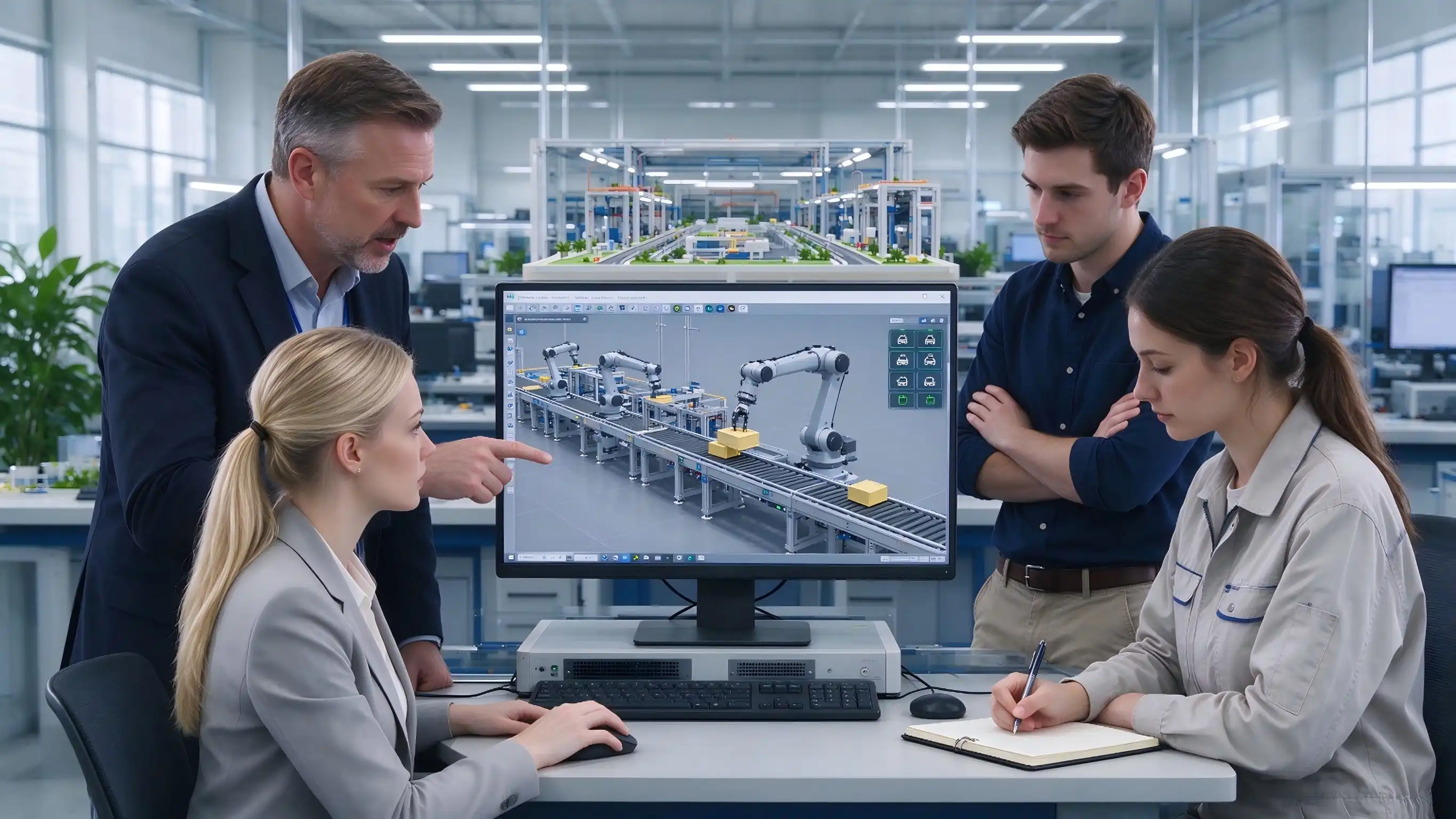
A three-dimensional model of the robot, its tools, the workpieces, and the area around it is made by robot simulation. It's called that when you use a model instead of the shop to write and test robot tracks. The person writing the code can make sure that the arm moves to each spot, hits a fastener, and then turns around for the right amount of time. It doesn't cost anything to make a mistake because the metal doesn't move. Students can work on 3D modeling, offline programming, and collision detection on the platform run by E.C.R Academy. Then they can look at the program online before they use it in real life. This lets a student try out industrial robotics technology without any risk. They can do it over and over again until they get it right.
Robot Types Learners Meet in Training
There are different kinds of industrial robots, and each one does a unique job well. Because their joints can turn, these robots can build, move things, and stack boxes. SCARA robots, on the other hand, can move quickly on a flat surface and are good for putting together little pieces. Their arm that is laid flat lets them quickly pick up light things. Just like cranes, these robots move in a straight line. Bots that work with people stay close to them and don't use too much force. They can try out different looks without having to spend real money on each one. Robot coders learn the basics at E.C.R. Academy. They learn how to set up a coordinate system, teach pendant operation, teach point and path, and fix bugs in a program.
Why the Topic Matters for U.S. Manufacturers
More and more people want robot skills. IFR, the International Federation of Robotics, said that 541,000 new factory robots were set up around the world in 2023. 34,200 of them were in the United States. Robots need people to program them, keep them running, and connect them to other machines. A lot of places can't stop working to show people how to use real robots. Simulations help with some of that because they let students work on computers while the line is still running. Companies, schools, and integrators can learn new skills this way without putting their tools at risk or having to wait for them to work.
Key Components of an Effective Industrial Robot Simulation Training Course
A Structured Curriculum from Basics to Integration
A strong road has steps. The industrial robotics technology program at E.C.R. Academy consists of seven parts: programming robots on-site, using programmable controllers, programming and simulating robots offline, machine vision, digital twin and virtual commissioning, integrating application systems, smart operation and maintenance, and programming and simulating robots online. First, people who are new to robots learn how they are put together and what their main ideas are. After that, they learn how to make models, program, and handle PLCs. If you know the basics of computers, technology, and electricity, you can keep up. Tasks that are based on projects connect each topic to a real process. This way, students can practice everything from writing code and fixing bugs to putting everything together and making sure it works.
Programming Languages and Software Platforms
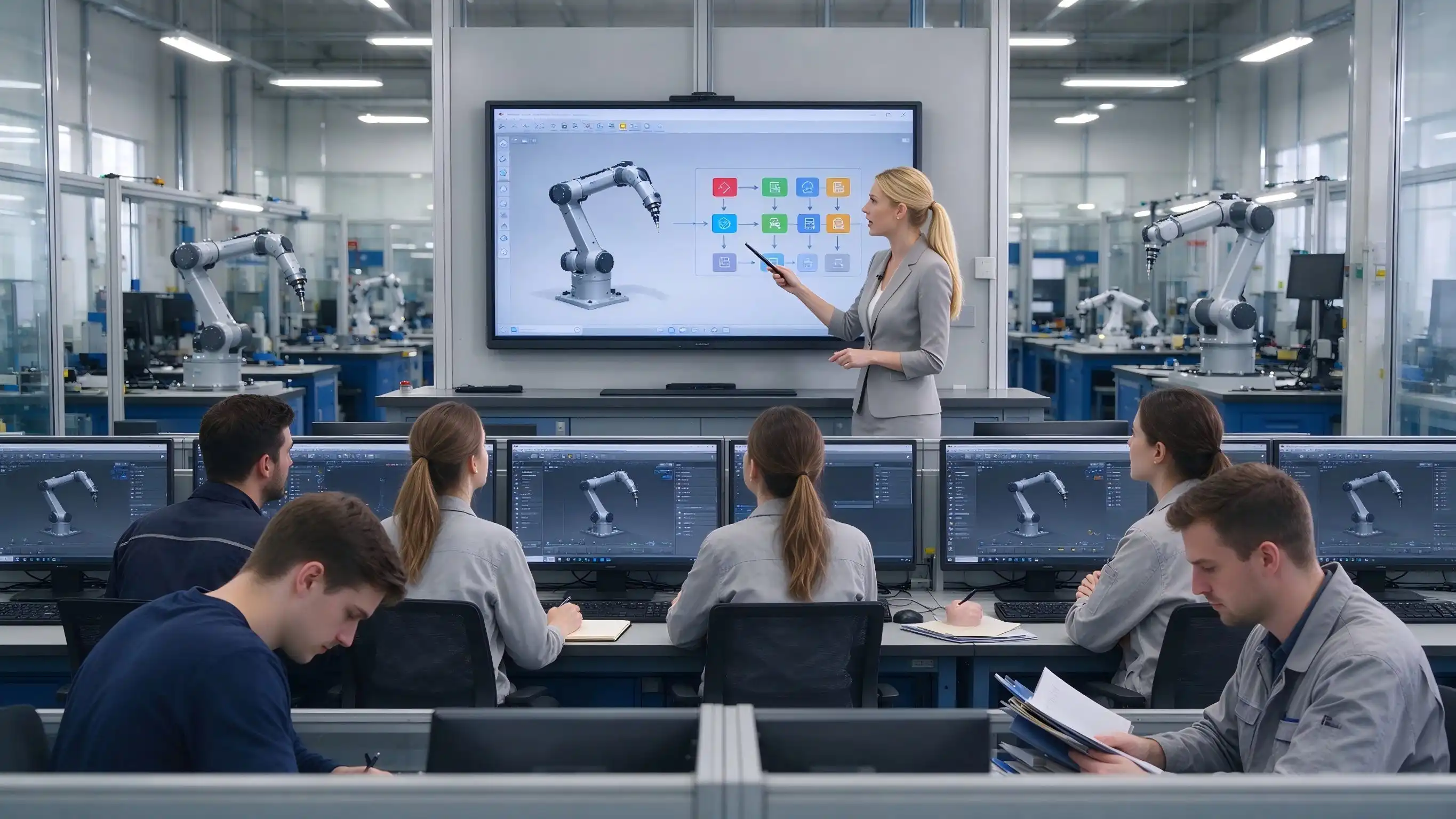
People who make robots need certain tools. Their robots are made with RAPID, KRL, and VAL3. ABB RobotStudio, FANUC ROBOGUIDE, and KUKA.Sim are all kinds of hardware simulation software. The main ideas are motion types, coordinate frames, data about the tool and the object, and how to think about input and output. The ideas are the same, but the language is different. People quickly get used to a new brand after reading these tips. At E.C.R. Academy, each student has their own virtual modeling platform that they use to build robots, program them, and test them. They also use these platforms to put the system together and do smart maintenance. Before you buy from a company, make sure they have a written list of all the tools and apps that work with the brand your team already uses.
Safety Training and Industry Standards
The first thing you do in a robot lesson is learn how to work safely. In the United States, there are rules about how to keep industrial robots and their work areas safe. These rules include international standards such as ISO 10218-1 and ISO 10218-2. In the first part of E.C.R. Academy's training, learners study how to operate a pendant safely and perform basic troubleshooting. Simulation can also show the robot's reachable area and identify potential collision risks before learners operate a real robot. That's why models are useful. People can learn safe operating principles through virtual training, but it can't replace a risk assessment that is made specifically for each cell and facility.
Benefits of Using Industrial Robot Simulation Training for Manufacturing B2B Solutions
Faster Programming and Fewer On-Site Errors
While the engineer writes and tests the program, the real robot can still do its job. The screen shows collision alerts when there is a potential crash, and path planning tools show early reach issues. Instead of waiting until a real installation to identify programming problems, trainees can build a virtual production line and troubleshoot PLC programs in that environment. Then, testing for virtual-physical mapping is done to see how the real and virtual production lines work together. Troubleshooting ahead of time keeps tools from breaking down when they don't need to and saves time at the customer site. You can learn these skills at the E.C.R. Academy by taking classes on digital twins, offline programming, and virtual commissioning.
Safer Practice and Lower Training Costs
Training rooms should provide a suitable environment for both virtual and hands-on practice. For each small group, the hands-on area should have appropriate safety fencing, tools, and training equipment. The virtual training area can provide computer-based practice without exposing students or equipment to physical hazards. There is no harm or damage in making a mistake in the virtual environment, so students can practice debugging programs and coordinating multiple robots. The platform can run on computers with Windows 10, at least 8 GB of memory, and a suitable graphics card. People should still practice in real life, and the platform lets them build foundational skills before they use real tools. I can't give you a general number because the exact amount of money saved depends on how many students are in the class and how much the lab costs now.
Fit for Different Team Sizes and Measuring Return
One robot and teacher is all that small integrators, big workplace training teams, and college programs can use at a time. Adding seats can make the class bigger, so there's no need to add computers. To find out how much money you made back, keep track of the information you've already gathered. It can take hours to set up a new cell, and mistakes in the code can be found after the fact. Also, a new worker might have to wait weeks before they can work alone. Check out those numbers before and after training. If they use this easy way, they can show proof from their own plant to back up what they say.
How to Select the Right Industrial Robot Simulation Training Course and Solutions
Check Brand Coverage and Course Depth
Deal with the robots on your floor first. Write down the tools, brands, and software that they use as a group. Then, talk to each service and find out which ones their course works with. After that, read the outline of the course. It shouldn't just be easy to handle in a full course. You should also be able to script, troubleshoot, and integrate the system. Pay attention to the teacher. At E.C.R. Academy, there are lessons that link what you learn in school to what you do at work. Both business engineers and college experts teach the lessons. You can look at a practice lesson or the website to make sure that the course will help both new and old employees. Look at the steps of learning from the beginner level to the integration level and see how they differ.
Match Training to Your Workflows
The best way for a school to help you is for its work to look like the work you already do. The most important things you need to do are on the list. These could be welding, spraying, putting together, palletizing, vision-guided picking, or loading and unloading. At E.C.R. Academy, learners study painting, loading and unloading, welding, and assembly in the system integration module. In the vision area, there are tasks like picking, checking for flaws, and sorting. Also, don't forget to look at communication issues. When robots connect to PLCs and other devices through fieldbus and networks, they need to be able to send and receive signals. Tell the provider what you want to learn and how the project tasks will help you get there. If you answer clearly and give examples, it shows that you know what you're talking about.
Compare Pricing Models and Support
There are many ways for trainers to get paid, such as through licenses, fees, and service contracts. It is best to buy a license for an industrial robotics technology tool that works well and lasts a long time. A sample class costs less at first if you are a member. If you have a service contract, you can get help with questions and getting set up. Find out what each price covers: how many computers, changes to the program, teaching help, and learning tools. Think about what your machine needs too. How much you spend on hardware will depend on things like whether it needs a graphics card and how much memory it has. Then figure out how much each student needs to pay for the whole semester, not just the first bill. With that number, it's simple to find the best deals.
Future Trends in Industrial Robot Simulation Training
AI and Smarter Simulation
AI is already used to help robots do a lot of things, like being able to see and pick up things from bins, check for flaws, and use sensor data to guess what problems might happen. You talk about the same things when you train. E.C.R. Academy's vision module goes over how to set up the camera, take a picture, find edges, and match features. As for the repair section, it studies how to predict faults, keep track of temperatures, and read vibrations. As AI tools get better, I think modeling software will make and test more robot tracks by itself. Paths are still important for engineers to understand. Bots' work needs to be judged by people who still need to learn the basics.
Digital Twins and Virtual Commissioning
An electronic copy of a real system that can talk to the real system is called a digital twin. In 2019, Fei Tao and others wrote a paper that came out in IEEE Transactions on Industrial Informatics. It went over how businesses use digital twins. They talked about how important they are becoming in making things. Teams build a virtual line and use it to test robot and PLC logic. They then compare it to the real cell to see how well it fits. In the lesson on digital twins and virtual commissioning at E.C.R. Academy, the steps above are explained. Process parameter refinement and virtual-physical mapping proof are also covered in this lesson. Teams like people with this skill because it helps them find problems early on in the project, before the tools come out.
AR/MR and Growth Across Industries
Tools for mixed reality and augmented reality can show planned robot paths on top of a real cell. Many businesses have used these tools to train their staff and make programs. These technologies can provide additional support for training and visualization rather than replacing core programming and engineering skills. People with those skills are needed in many areas. Based on what IFR says, electronics and cars are still the two biggest fields that use industrial robots. Bots are also used in logistics to do things like stack pallets. Students who know how to program, connect, and lead robots can do a lot of different things.
Conclusion
Students can write code for robots, test them, and fix them on a computer before they use real ones. This is known as training with an industrial robot simulator. Things like offline programming, machine vision, digital twins, system integration, and smart maintenance are just a few of the things that a good class on industrial robotics technology will cover. To teach safety, rules like ANSI/A3 R15.06 are used. This way, mistakes can be fixed more quickly, there is less risk, and each student doesn't need their own robot. But it doesn't take the place of hands-on practice; it just gets people ready for it. People should look at how much each course costs, how well it covers the robot brands and technologies they need, and how useful the projects are before they buy them. AI tools, digital twins, and AR/MR will let you practice online more, but you'll still need to know how to use them.
FAQ
1. Can beginners study this program?
Yes. The program is broken up into steps. To begin, learners study the robot's structure and basic operating principles. After that, code, PLC control, and modeling design are covered. The most important foundations for this training include basic computer skills, technology, electrical systems, and motors.
2. Can virtual simulation replace hands-on practice?
Not completely. Students can practice on the platform in realistic virtual settings before they use real tools. This allows them to build programming and troubleshooting skills while reducing the risk of mistakes during initial practice. As they get better, they can move from virtual training to supervised hands-on operation.
3. What roles can learners prepare for?
Learners can prepare for roles such as sales and technical service engineer, application system integration engineer, robot operation and programming engineer, maintenance engineer, and technical support engineer for smart production.
4. How is the platform deployed?
Software for virtual modeling is used on computer screens in the classroom. A suitable computer should have at least 8 GB of memory, Windows 10, and a graphics card capable of supporting the required 3D simulation software.
Start Your Industrial Robot Simulation Training Course with Virtual Programming with E.C.R Academy
You want to find a company that sells industrial robotics technology and helps people learn through projects. Business, school, and industry groups can take virtual training classes at E.C.R. Academy. A mix of business engineers and college leaders teach these classes. You can talk about what your team needs or find out more about the course by emailing ecr2008@enteredu.com. You can find out more at enteredu.com as well.
References
1. World Robotics 2024 – Industrial Robots, International Federation of Robotics, 2024
2. ISO 10218-1 Robots and Robotic Devices – Safety Requirements for Industrial Robots – Part 1: Robots, International Organization for Standardization, 2011
3. ANSI/RIA R15.06 Industrial Robots and Robot Systems – Safety Requirements, American National Standards Institute and Robotic Industries Association, 2012
4. ISO 9283 Manipulating Industrial Robots – Performance Criteria and Related Test Methods, International Organization for Standardization, 1998
5. Digital Twin in Industry: State-of-the-Art, IEEE Transactions on Industrial Informatics, 2019
6. Springer Handbook of Robotics, Springer, 2016