What to Expect From Industrial Robot Programming Training
If your institution is evaluating training solutions for smart manufacturing programs, understanding what a rigorous industrial robot programming & operations course delivers is the foundation of a sound procurement decision. This guide walks through curriculum structure, methodology, platform alignment, and post-training outcomes — giving decision-makers the clarity needed to move forward with confidence.
Understanding the Scope and Value of Industrial Robot Programming Training
Why Robot Programming Skills Are Non-Negotiable in Modern Manufacturing
Industrial robot programming & operations is at the heart of smart manufacturing. The International Federation of Robotics (IFR) says that more than 553,000 robots were installed around the world in 2022 alone, and that number keeps going up. To keep a system running, it needs at least one trained operator or programming worker.
This directly leads to demand for trade schools and business training areas. Graduates who know how to read electrical schematics, set up teach pendants, and fix bugs in motion paths can get jobs right away. The money spent on training isn't just a waste; it leads to job roles, industry certifications, and measured output results.
Good training in programming robots cuts down on mistakes made during commissioning, shortens the time that equipment is down, and increases the mechanical life of robots by using jerk-limited motion profiles. This means that the ROI for procurement managers goes far beyond the training room.
Core Components of Industrial Robot Programming Training
What a Complete Curriculum Covers — From Assembly to Integration
A program that is well put together doesn't start with the teach pendant. The first step is putting together the mechanical system. This includes reading engineering drawings, putting together robot bodies and end effectors, and fixing problems with the hydraulic and pneumatic systems. This foundation is important because technicians who know about the hardware make fewer mistakes when they program later on.
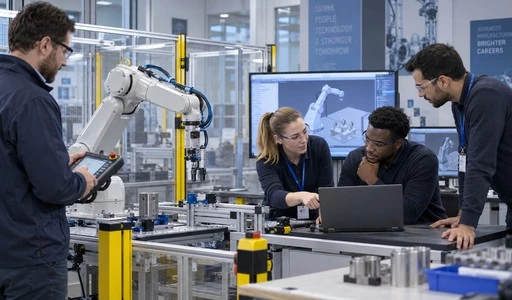
Here are the core training modules a comprehensive program should include:
- Mechanical System Assembly and Adjustment: This course goes over how to read mechanical drawings, how to put together robot bodies, parts, and tools, how to make sure they fit and work properly, and how to make precise adjustments. Before touching a device, learners get used to the physical system.
- Electrical System Assembly and Commissioning: This part talks about reading electrical schematics, connecting sensors, setting up safety circuits, and checking electrical functions. To use a workstation that meets ISO 10218 standards, you need to know how safety interlocks work.
- Teach Pendant Programming and Operation: This includes setting up the coordinate system, programming the motion, and programming for specific tasks like moving materials, palletizing, welding, and painting. On real platforms, learners also work on debugging programs and changing process parameters.
- System Integration and PLC: It goes over the basics of PLC, how to set up robot communication, how to make a master control program, how to program offline with tools like RobotStudio and ROBOGUIDE, and how to fully launch a workstation.
- Safety and Professional Practice: Professional ethics, emergency stop procedures, 6S management, and recognizing safety signs are all taught as part of the program.
Employers and skill certification bodies recognize the full-process skill chain that is made up of these modules. A program leaves clear gaps in a learner's skill profile if it doesn't cover all five.
Training Methodology and Content Structure
Balancing Simulation with Real-Equipment Practice
The best training for controlling industrial robots doesn't depend on just one way of teaching. RobotStudio (ABB) and ROBOGUIDE (FANUC) are examples of offline programming tools that let students check path logic in a virtual environment before putting programs on real systems. This method keeps equipment in better shape and eliminates the chance of costly accidents during the early stages of learning.
Once the program logic is checked in a computer, students move on to real ABB, FANUC, KUKA, and common home robot platforms to do testing by hand. This two-step process—simulate, then execute—is similar to real-life work and creates muscle memory that can't be created by just teaching in a classroom.
Project-Based Learning Anchored in Real Industrial Scenarios
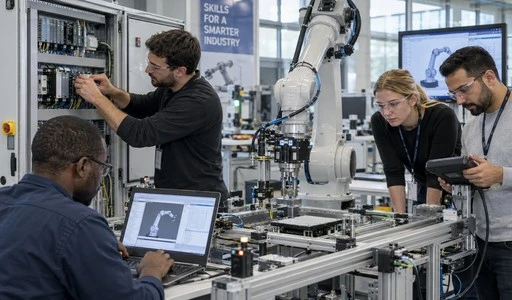
Using real-life production settings as training situations, like material handling workstations, palletizing cells, welding lines, and flexible assembly stations, gives students a sense of context that is missing from general exercises. When a student fixes bugs in a palletizing program on a real KUKA platform using settings from a real transportation app, they immediately and permanently gain skills that they can use for industrial robot programming & operations at work.
Selecting the Right Training Program for Your Business Needs
Alignment With Standards, Brands, and Certification Pathways
When purchasing managers look at robot programming training providers, three alignment factors stand out above the rest. The curriculum should be based on a well-known standard for job skills, like the National Occupational Skills Standard for Industrial Robot System Operators. Building programs on tested standards gives a solid foundation for institutional accreditation reviews, integrating 1+X certificates, and making sure that skills-level assessments are aligned.
Platform support is just as important. When people learn with ABB, FANUC, and KUKA hardware, they are directly prepared for the systems that will be used in their future jobs or competitions. RobotStudio and ROBOGUIDE are examples of brand-agnostic simulation tools that make things more flexible without reducing their depth.
The qualifications of the teachers decide the quality of the lessons. Case-based instruction that connects programming syntax to production outcomes is given by industry engineers who have worked on real projects and not just read about them in school. When looking at training providers as long-term institutional partners, this difference is important.
Post-Training Expectations and Implementation Support
What Learners Can Do After Completing the Program
When students finish a full course in industrial robot programming & operations, they are ready for jobs like robot operator, starting technician, programming technician, and equipment repair technician. These jobs are in high demand in the metal fabrication, transportation and storage, electronics assembly, and the making of cars. Partners in institutions get more than just trained graduates.
A well-designed training program delivers:
- Recognized certification alignment: Graduates have credentials that meet the requirements for skills-level assessments and back up institutional compliance documentation.
- Continuous learning access: Online platforms with video lessons, digital guides, and practice question banks keep skills up to date as new versions of robot software come out.
- Implementation support for training centers: Institutions get setting help for multi-brand robot platforms, which lets them keep up the quality of service on their own after the original setup.
These results directly lead to measurable value, such as higher job rates for graduates, better success by competition teams, and increased trustworthiness for the school with accreditation reviewers. The investment in training pays off for many groups of people.
Conclusion
Industrial robot programming & operations training is not something that can be bought in bulk. It is an investment in the long-term employability outcomes and institutional standing of a program. The best programs have a curriculum that is aligned with industry standards, access to multiple platforms from different brands, teachers with experience in the field, and a full learning path that goes from mechanical assembly to integrated workstation commissioning. It is always better for institutions and the students they serve when procurement professionals use these criteria instead of just price when making decisions. Since 2010, the ECR Academy has helped over 300,000 certified grads and nearly 500,000 trainees in 28 countries.
FAQ
1. Can learners with no prior experience enroll in this course?
Yes. The first part of the program is foundational theory, which covers things like basic electrical ideas and how to read mechanical drawings. You don't need to know anything about robots to start learning, as long as you're willing to practice on real tools.
2. What computer specifications are needed for simulation software?
If you want to use offline tools like RobotStudio or ROBOGUIDE, you need a computer that runs Windows 10 or 11 (64-bit), has 16 GB of RAM, a 256 GB solid-state drive (SSD), and a graphics card that supports OpenGL 3.0 or later. It is suggested that the screen size be at least 1920x1080.
3. What roles can graduates pursue after completing the program?
Graduates are ready for jobs as an industrial robot operator, a commissioning technician, a programming technician, or an equipment repair technician in the metal processing, electronics, automobile, or transportation industries.
4. Does the curriculum align with national skills certification standards?
Yes. The program was made using the National Occupational Skills Standard for Industrial Robot System Operators as a guide. It also helps institutions connect with well-known standards for skill-level evaluation and licensing.
Partner With E.C.R Academy for Proven Industrial Robot Programming & Operations Training
It has been 16 years since E.C.R. Academy has been teaching skills-based subjects in 28 countries. Our industrial robot programming & operations curriculum, which was made for businesses, schools, and industry groups, goes over every step, from putting together the robot's parts to setting up its integrated workstations on ABB, FANUC, and KUKA platforms. Get in touch with our team to find out how our training options can help your business or school. Reach us at ecr2008@enteredu.com or visit enteredu.com.
References
1. International Federation of Robotics. World Robotics Report 2023. IFR Press, 2023.
2. Nof, Shimon Y. Handbook of Industrial Robotics. John Wiley & Sons, 1999.
3. Spong, Mark W., Seth Hutchinson, and M. Vidyasagar. Robot Modeling and Control. Wiley, 2020.
4. Craig, John J. Introduction to Robotics: Mechanics and Control. Pearson Education, 2018.
5. Robotic Industries Association. RIA TR R15.606: Safety Requirements for Industrial Robots. RIA Standards, 2021.
6. National Institute for Metalworking Skills (NIMS). Industry-Recognized Credentials for Advanced Manufacturing. NIMS, 2022.


_1781601799781.webp)