Why Smart Factories Need Industrial Robot Maintenance and Integration Services
Smart factories run on precision. When robotic systems fail or fall out of sync, production lines stop — and every unplanned hour of downtime costs manufacturers thousands of dollars. That is why industrial robot maintenance and integration services have become non-negotiable for any facility serious about automation. These services cover the full lifecycle of robotic systems: from mechanical assembly and electrical inspection to control system configuration and multi-brand fleet coordination. For institutions training the next generation of robotics technicians, understanding these needs shapes what skills must be taught.
Understanding Industrial Robot Maintenance and Integration
What Maintenance Actually Covers
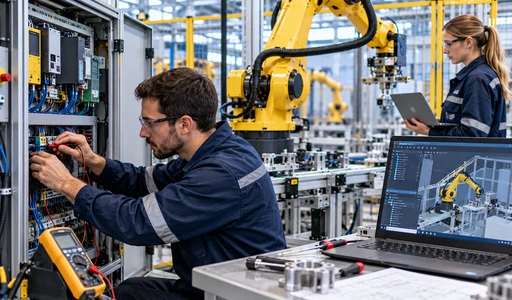
Taking care of a robot is more than just changing the oil and looking it over. Preventive scheduling, predictive diagnosis, and corrected fixes are all part of it. The International Federation of Robotics (IFR) says that more than 3.9 million industrial robots were installed around the world in 2022. Each robot needs regular maintenance to keep its ability to repeat itself within ±0.02mm of error. In well-run facilities, routine tasks like mechanical inspection, servo motor insulation testing, and grease spectroscopy analysis are all expected.
What Integration Services Address
Robotic arms are linked to the larger work world through integration, which includes PLCs, MES platforms, vision systems, and safety circuits. It's not just wiring that's hard; it's getting motion, data, and logic to work together across a line. It's important to set up fieldbus standards like EtherCAT, Profinet, and Ethernet/IP properly, or the whole cell will not work at full capacity. System compatibility problems are one of the main reasons why speed gaps happen after installation.
Why Both Must Work Together
When robots are maintained without being properly integrated, they work well when they are by themselves but not so well when they are part of a production system. When you integrate things without doing regular maintenance, the calibration changes, impact recognition alarms go off, and over time, you lose yield. Overall Equipment Effectiveness (OEE) scores are always higher in smart factories that treat these two fields as a single practice.
Key Benefits of Proper Robot Upkeep and System Integration
Uptime and Productivity Gains
Mean Time Between Failures (MTBF) stays high and unexpected stoppages stay low with scheduled preventive maintenance. Minor service is usually done every 3,000 hours and big overhauls are done every 10,000 hours. When robots are well taken care of, production stays on schedule instead of having to be sped up to make up for poor performance.
Safety and Compliance Assurance
As a result of quality industrial robot maintenance and integration services, safety circuit evaluation must be done. This includes checking the E-stop response time according to RIA R15.06 and ISO 10218-1 standards. If a facility doesn't do these checks, it could be sued or face regulatory problems. When robots are properly set up and kept, they protect workers and keep audit records clean.
Cost Reduction Over the Asset Lifecycle
Fixing things in an emergency costs a lot more than scheduling regular maintenance. When facilities train their own teams to diagnose faults, fix circuit problems, and install software updates, they rely less on expensive service contracts from the original equipment manufacturer (OEM). Studies in the car industry show that giving even 30% of maintenance chores to trained technicians who work for the company saves money every year.
Because of these benefits, it is clear that money should be spent on structured training programs that make people really good at the whole process of robot servicing.
How to Choose the Right Robotics Service and Training Partner
Assess Multi-Brand Coverage First
Factories don't usually use just one brand of robot. A normal car body-in-white line might have FANUC robots for welding, ABB robots for painting, and KUKA robots for moving things around. If a service provider or training program only focuses on one brand, technicians won't be ready for what they'll see on the shop floor. Covering more than one brand in the curriculum is a basic requirement, not an extra.
Evaluate the Depth of the Skill Chain
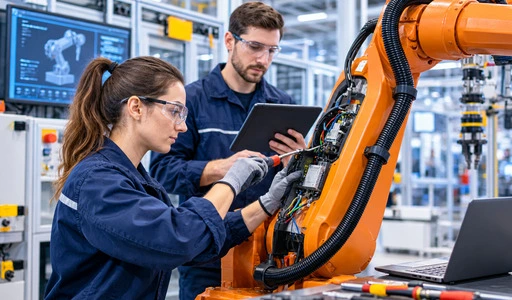
The best programs teach the whole technical chain, including taking apart and putting together mechanical parts, checking and fixing problems in electrical systems, and setting up and maintaining software for control systems. Technicians with only some training can run robots but not identify or fix them, which is a gap that quickly costs a lot of money.
Confirm Certification Alignment
Alignment with accepted credential systems is important for vocational schools that prepare students for work. Programs should teach students how to do jobs like Industrial Robot System Operations and Maintenance Technician and Robotics Engineering Technician, which are needed by reputable manufacturers and integrators in the field.
By picking a partner based on these factors, you can protect both the training investment and the career outcomes of all students who finish the program.
Overcoming Common Challenges in Robot Maintenance and Integration
Diagnosing Mechanical and Electrical Faults
Most of the time, service calls are about mechanical wear in reduction gears, especially RV and harmonic drives, and electrical problems that can be found in circuit wires and gas connections. Techs who know how to use multimeters, oscilloscopes, and teach pendants properly can find these problems more quickly and with fewer mistakes.
Managing Multi-System Complexity
To get robots on a production line to work together, network configuration, parameter setting, and software update procedures are skills that many general technicians don't have, making industrial robot maintenance and integration services essential. Failure Mode and Effects Analysis (FMEA) and fault tree methods provide organized ways to handle complicated problems with many nodes in a planned way, as opposed to an ad hoc one.
Keeping Skills Current as Technology Evolves
Diagnostic tools that use AI and monitoring tools that are connected to the internet of things are changing how predictive maintenance works. As robot models and software versions improve, technicians can stay useful by regularly upgrading their pathways and having access to new case libraries. It's easier for people to learn how to use new tools when their training builds on a strong technical base.
Future Directions in Industrial Robotics Servicing
Predictive Maintenance Driven by Data
Predictive maintenance models now use sensor data from motor drives, joint encoders, and power sources to find signs of wear and tear before they break. The technicians that factories need most in the future are those who know both how robots work mechanically and how their sensors collect data.
Collaborative Robot Integration
Cobots add levels of Contact between people and robots that older models of integration didn't take into account. For force sensing, safety-rated tracking, and hand-guiding programming to work, you need to learn new technical skills and keep your safety compliance information up to date. In the market for robots, this part is growing the fastest.
Workforce Pipeline as a Strategic Asset
When facilities invest in their own training infrastructure, they get faster responses, less staff turnover in technical roles, and better relationships with equipment vendors. Schools that prepare graduates for jobs that are in line with real industry needs become the first choice for local businesses looking for new workers. This is a long-term structural benefit.
Conclusion
Robots that work reliably, fit together cleanly, and are handled by people who really know what they're doing are needed in smart workplaces. The skills gap in industrial robot maintenance and integration services is real, can be measured, and is growing at the same rate as robot adoption. To close that gap, we need organized, hands-on training that looks and feels like working in a workplace, not just theory. Getting better at this is one of the best investments you can make right now, whether you're in charge of a production facility, a vocational program, or enterprise training.
FAQ
1. Can someone with no robotics background take a maintenance and integration course?
Yes. Courses that are well-planned start with the basics of mechanics and move on to electrical systems and control setup. Instructors give feedback based on each student's progress, which makes the material easy for newbies to understand while still being challenging enough to prepare students for working in a real workplace.
2. What roles do graduates typically qualify for?
After finishing a full robots maintenance and integration program, people are usually qualified for jobs like Industrial Robot System Operations and Maintenance Technician, robots Engineering Technician, Mechanical Equipment Installer, and Electrical Equipment Installer.
3. How often do industrial robots need formal maintenance?
Every 3,000 hours of operation, or about every six months when production is normal, minor inspections are done. Every 10,000 hours, major service intervals like replacing the grease and checking the controller battery happen to keep the machine from losing its memory and seizing up.
Build Your Robotics Training Capability with E.C.R Academy
Since 2010, E.C.R. Academy has helped nearly 500,000 people in 28 countries get training. Our curriculum for industrial robot maintenance and integration services includes both project-based learning and lessons taught by both industry engineers and academic experts. The course is taught on the BN-R365 combined training platform and covers all skills, from putting together machines to finding and fixing complex problems. Visit enteredu.com or email us at ecr2008@enteredu.com to talk about how we can help your business or institution as a reliable provider of industrial robot repair and integration services.
References
1. International Federation of Robotics (IFR). World Robotics Report. IFR Press, 2023.
2. Robotic Industries Association (RIA). ANSI/RIA R15.06: Industrial Robots and Robot Systems — Safety Requirements. RIA Standards, 2012 (revised 2019).
3. International Organization for Standardization. ISO 10218-1: Robots and Robotic Devices — Safety Requirements for Industrial Robots. ISO, 2011.
4. Sheng, W., & Chen, H. Robot Systems Integration and Applications in Smart Manufacturing. Springer, 2021.
5. Mobley, R. K. An Introduction to Predictive Maintenance. Butterworth-Heinemann, 2002.
6. Groover, M. P. Automation, Production Systems, and Computer-Integrated Manufacturing. Pearson, 2019.


_1781601799781.webp)