Elevator Installation and Maintenance
Training Model: Professional labs with mainstream elevator systems and real-work simulations
Faculty: Enterprise technicians and professional teachers
Certificate: Supports vocational skill certification for elevator installation and maintenance
Employment: Job-ready skills for installation, commissioning, repair, and maintenance
Target Partners: Enterprises, educational institutions, industry associations, and other organizations
Elevator Installation and Maintenance
Course Overview
Elevators are essential to modern buildings, and their safe operation directly impacts public safety. This course in Elevator Installation and Maintenance develops skilled professionals capable of assembling and commissioning elevator mechanical and electrical components, performing installation, repair, modification, and routine maintenance, and managing elevator operations.
The program targets career positions such as elevator installation and repair technicians and elevator assembly and commissioning technicians. Through systematic training—from mechanical drawing, electrical and electronic technology, and benchwork fundamentals to elevator structure, assembly installation, electrical control, fault diagnosis, maintenance, and safety technology—learners build the competencies required to perform routine elevator maintenance, diagnose common faults, and support on-site safety inspections under applicable safety procedures and regulatory requirements.
Why This Course?
1.Curriculum
An "Installation Skills + Maintenance Capability + Safety Awareness" integrated design, incorporating special equipment safety regulations and green, low-carbon concepts.
2.Facilities
Five specialized training venues, including elevator assembly installation labs and elevator maintenance labs, equipped with mainstream elevator models and supporting equipment to simulate real working conditions.
3.Faculty
Dual-qualified teaching team composed of enterprise technical specialists and professional instructors, ensuring course content stays aligned with industry standards.
4.Certification
Eligible learners may apply for or take the assessment for the Elevator Installation and Repair Technician vocational skill level certificate, subject to local certification requirements., enhancing employment competitiveness.
5. Career Paths
Learners can develop skills relevant to career paths in elevator installation companies, property management firms, elevator manufacturers, and maintenance service providers, performing assembly and commissioning, installation, maintenance, and operations management.
What You'll Be Able to Do?
1. Understand Elevator Structure and Perform Installation
- Identify elevator definitions, key parameters, and core component functions
- Explain the working principles of traction systems, guide systems, car and door systems, and safety protection systems
- Read and interpret assembly drawings of moderate complexity
- Install and commission equipment components following technical instructions
2. Apply Elevator Electrical Control Technology
- Identify the composition and operating processes of major elevator circuits
- Understand fundamental electrical control system principles
- Read and interpret electrical schematic diagrams
- Perform circuit testing and initial fault diagnosis and troubleshooting
3. Perform Elevator Maintenance and Servicing
- Apply basic elevator maintenance methods and equipment servicing specifications
- Independently and properly complete routine elevator maintenance tasks
- Develop consistent equipment inspection and checkpoint habits
4. Diagnose Elevator Faults and Apply Safety Technology
- Apply diagnostic methods and troubleshooting techniques for common elevator faults
- Apply elevator safety construction technical standards
- Conduct on-site safety inspections
- Execute emergency response procedures to ensure safe elevator operation
What You Will Learn?
|
Training Skills
|
Description
|
|
1. Elevator Structure Fundamentals
|
Understand traction systems, weight balancing systems, guide systems, safety protection systems, car and door systems, and escalator basics.
Explain the working principles of motors, traction systems, counterweight systems, guide systems, safety devices, and car/door assemblies.
|
|
2. Elevator Assembly Installation
|
Perform installation preparation (drawing reading, tool/material preparation, site survey).
install machine room equipment (traction machine, control cabinet, speed governor); install shaft components (guide rails, brackets, landing doors); assemble car body and safety gear.
Perform electrical wiring (machine room, shaft, landing stations).
Conduct slow-speed and full-speed commissioning, rated speed testing, and safety device verification per GB 7588 and GB 10060 standards.
|
|
3. Elevator Electrical Control Technology
|
Identify electrical control system composition (main circuit and control circuit).
Apply PLC control principles and elevator control programs.
understand VVVF variable frequency drive systems.
operate call systems, indication systems, and communication systems.
perform circuit testing using multimeters and oscilloscopes.
read electrical schematics and wiring diagrams.
|
|
4. Elevator Fault Diagnosis and Troubleshooting
|
Classify faults by type (mechanical, electrical, control system).
apply diagnostic methods (observation, measurement, substitution, and segmented isolation).
analyze typical faults—door system faults (door operator malfunction, incomplete closing), safety circuit faults (circuit interruption), control system faults (PLC/inverter failures), and communication faults (landing display errors).
Follow a structured troubleshooting flow: symptom recording → cause analysis → solution planning → implementation → verification; apply safety protocols, including lockout/tagout and PPE.
|
|
5. Elevator Maintenance and Servicing
|
Perform maintenance across cycles (daily, weekly, monthly, semi-annual, annual).
service mechanical systems — traction machine (oil level check, noise monitoring), guide rails (cleaning, lubrication), door systems (door operator cleaning, door vane adjustment), and safety devices (safety gear and speed governor testing).
service electrical systems — control cabinet (dust removal, fastener tightening), electrical components (contactors, relays), grounding resistance testing.
Follow checkpoint inspection specifications and record-keeping.
Apply energy-saving measures and eco-friendly lubricant disposal practices.
|
|
6. Elevator Safety Technology
|
Apply special equipment safety regulations (Special Equipment Safety Law, TSG T5002 Maintenance Rules, GB 7588 Safety Code).
Manage on-site safety—safety signage and PPE, shaft work safety (working at heights, fall prevention), electrical work safety (power isolation, voltage verification), and confined space protocols.
Conduct installation process safety supervision, periodic safety inspections, and hazard identification and correction.
Execute emergency response procedures under authorized safety protocols, including entrapment response, fire emergency response, equipment fault response, and incident reporting and documentation.
|
Learning Environment
Benchwork Training Lab — Equipped with workbenches, bench vises, grinding machines, and drilling machines for foundational metalworking skill development.
Electrical Training Lab — Equipped with electrician tool kits, measuring instruments, electrical control cabinets, and PLC training stations for electrical fundamentals and control system practice.
Welding Training Lab — Equipped with arc welders, gas-shielded welders, TIG welders, and dedicated welding stations for metal welding and fabrication training.
Elevator Assembly Installation Lab — Equipped with traction machine models, control cabinets, guide rail installation frames, and door operator systems for elevator installation process training.
Elevator Maintenance and Repair Lab — Equipped with complete training elevator units, escalator models, and fault diagnosis equipment for elevator commissioning, repair, and maintenance practice.
Company Strength
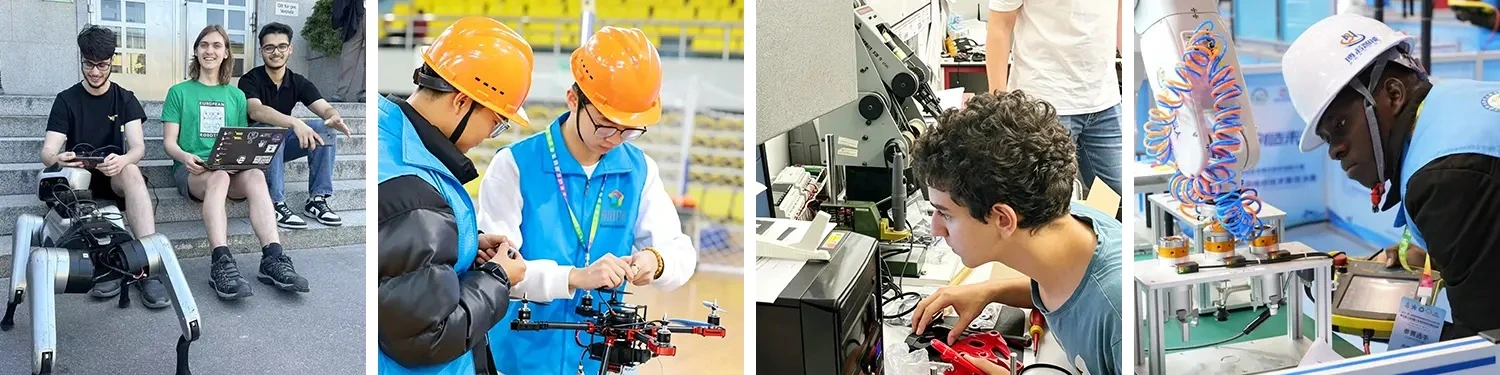
When you choose ECR Academy for Elevator Installation and Maintenance training solutions, you're partnering with a globally proven education platform. Our comprehensive curriculum covers installation skills, maintenance capability, and safety awareness—delivered through professional labs equipped with mainstream elevator systems for real-work simulations. Here's what sets us apart:
- Nearly 500,000 participants trained across China and 28 countries since 2010, with over 300,000 earning recognized skills certifications
- 16 years of specialized experience in vocational training and skills education development
- Over 150 successful skills competitions organized, benefiting more than 30,000 learners in technical capability enhancement
- Access to 3,300+ industry and academic experts partnered with 500+ enterprises
- 60,000+ educational resources including skill standards, courseware, assessment systems, and test banks tailored for the product
- Faculty combining enterprise technicians and professional teachers for industry-aligned instruction
- Support for vocational skill certification preparing learners for installation, commissioning, repair, and maintenance roles

FAQ
Q: What background do I need to study the product?
A: Basic physics knowledge and hands-on ability are helpful. Familiarity with simple mechanics and basic circuit concepts from secondary school physics will make it easier to get started. Since elevators are classified as special equipment, anyone entering this field must have a strong safety awareness, a sense of responsibility, and a careful, detail-oriented work attitude.
Q: What are the career prospects for the product?
A: Elevators are an essential part of modern urban life, and market demand continues to grow. Urbanization and the increasing need for older elevator replacement and renovation are driving strong demand for skilled professionals. Graduates can find employment with elevator installation companies, property management firms, elevator manufacturers, and maintenance service providers—working in assembly and commissioning, installation, maintenance, and operations management. Career pathways are stable with good advancement potential.
Q: Is elevator maintenance dangerous? How is safety ensured?
A: Elevator maintenance is classified as special equipment operation and does carry inherent risks, but these are manageable when strict operating procedures and proper PPE are followed. Safety awareness is heavily emphasized throughout the program. A dedicated Elevator Safety Technology course covers safety regulations, on-site construction safety, and emergency response. Students must pass safety assessments before performing hands-on operations, ensuring every learner possesses the necessary safety knowledge and skills.

Contact Us
Ready to build job-ready skills in Elevator Installation and Maintenance? Reach out to us at ecr2008@enteredu.com to explore partnership opportunities today.



_1781601799781.webp)