What’s Next for AI-Based Power Inspection Technology?
The next step in AI-based power inspection goes beyond just finding one flaw in a picture. Images, thermal data, LiDAR readings, and sensor readings will all be put together by systems into a single view of an asset's health. The systems then do edge analysis and provide the results straight to the maintenance personnel, along with an explanation of what they found. Human engineers will continue to analyze safety-critical calls. Utilities, contractors and training institutes struggle to establish teams that can gather clean data, train models and implement these systems on real equipment. This essay discusses the most critical trends, buying checks, risks and skills.
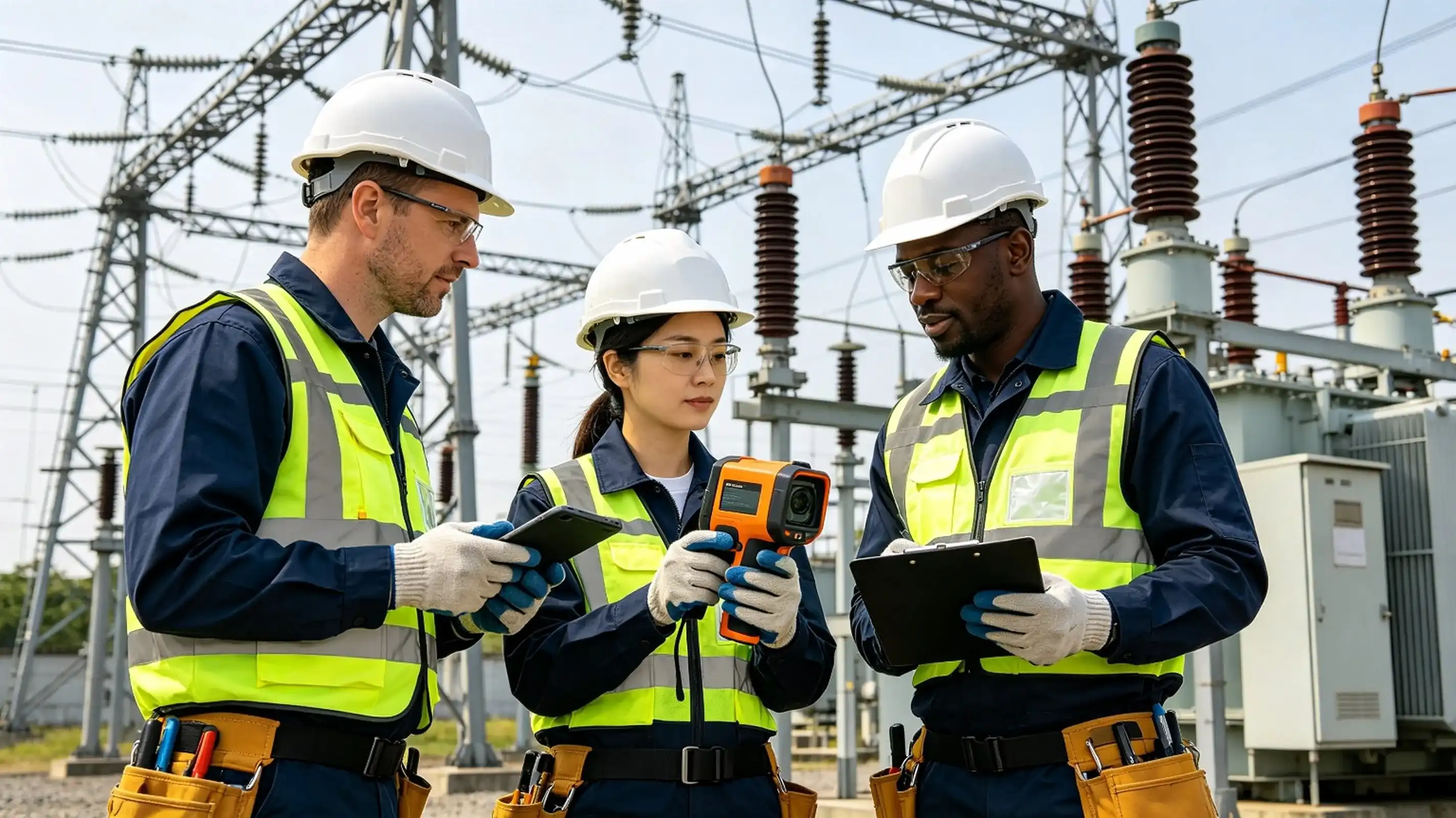
From Manual Patrols to AI-Based Power Inspection
Where Manual Inspection Falls Short?
Technicians have traditionally climbed towers, walked around substations and looked at photographs. The task is dangerous and the results changed from one inspection to another. Drones take plenty of pictures, and it would take days to go through them manually. Aging transformers, towers and cables make the work harder. A tired reviewer could easily miss early problems, for example, a little crack in the insulator or a hot area that grows slowly. The AI does not replace the engineer. In the first round of evaluation, it organizes the photographs, highlights possible issues and levels of danger, leaving the judging to people.
How the Workflow Operates?
A normal AI-based power inspection process is made up of four steps. First, data are acquired using drones, four-legged robots, fixed cameras, thermal devices and sensors. This is phase two. The teams clean the data, tag it and link it to asset IDs. Third, computer vision models may identify issues such as corrosion, broken insulators, oil leaks, overheating and plants growing too close to power wires. In 2015 LeCun, Bengio and Hinton demonstrated that deep learning, in particular convolutional networks, are quite good at this sort of image issue. Fourth, the platform determines the severity of the incident, creates reports and warns the relevant personnel. Teams may schedule repairs based on asset status rather than the calendar by linking results to work orders and history.
Where It Is Used Today?
Utilities and contractors use AI power inspection to transmission lines, distribution networks, substations, transformers and renewable energy projects. Models can see from above which portions are missing, which conductors are damaged and which insulators are faulty. Thermal analysis may reveal abnormal temperatures in transformers, switchgear, busbars and cabinets. At substations the routes are fixed and the robots always view the same panoramas. This makes it simple to compare views from one week to the next.I was so impressed the first time I saw the movie. By adding in data on vibration, sound or oil, teams may get a fuller picture of asset health. Nguyen et al. assessed this vision-based approach in their 2018 review published in the International Journal of Electrical Power & Energy Systems . This cuts down on the need for personnel to look at photos and helps them know where they need to do field checks.
What’s Next: Trends Shaping AI-Based Power Inspection Technology
Multimodal Sensing Cuts False Alarms
Single-image detection struggles with cluttered, shadowy or bright backgrounds. Newer systems incorporate information from thermal, LiDAR, auditory, vibration and visible electrical sources. Once the camera identifies a suspect element and a thermal sensor shows the temperature has risen, confidence is established and many false warnings disappear. The LiDAR gives distance information that may be used to remove vegetation and to determine the geometry of towers. In the same way, a system may assess an asset as a whole and not just one frame. Buyers will need to ask what sorts of sensors a particular model can function with, and how the supplier evaluates the data under varying light and weather situations. A model that only functions when it’s light outside will irritate crews.
Edge Computing, Digital Twins, and Work-Order Links
Many electrical cables and substations are remote from powerful networks. With Edge AI, the models remain on the robot or a device nearby, so alarms go out rapidly even when connection isn’t strong. Cloud or hybrid systems manage model changes and collaboration. That’s something that models that aren’t too hefty can do. In 2016 Redmon et al. revealed at CVPR that you can do real-time detection at roughly 45 frames per second. Later versions of YOLO such as YOLOv5 expand upon this principle. Ma and his collaborators created ShuffleNet V2 on the speed of real devices in 2018, which works well with edge hardware. The other alteration is the get-together. Once the results are entered into GIS, asset management, maintenance systems and digital twins, they are no longer loose reports but scheduled work.
Explainable Results and Faster Reporting
An engineer doesn’t provide a rating for nothing. Explainable AI displays what portion of a picture caused a judgment, so a reviewer may swiftly let it go or not. In a 2018 paper in IEEE Access, Adadi and Berrada talk on the need of explainability for artificial intelligence systems that are used to support essential decision making. There is also more automatic reporting. Systems may provide inspection reports with photographs, locations and evaluations of how terrible the situation is. Then someone looks at them. Safety and compliance examiners want a detailed record of what the model observed, what the engineer concluded, and what fix was undertaken later. This is as crucial as the detection itself.
How to Compare and Choose an AI Power Inspection Solution
Software, Integrated Systems, and Deployment Models
Solutions encompass a wide spectrum of concerns. Software-only solutions are best suited for teams who already have drones and cameras. Conversely, integrated systems are comprised of robots or drones, analytics, dashboards and reporting. Deployment is different too. Cloud installations allow for collaboration, on-premise settings retain data inside business networks, edge setups reduce wait times, and hybrid setups provide a combination of these benefits. You may compare completely automated analysis to analysis by a human, and broad models to those tuned to particular assets. The most accurate claim isn’t necessarily the greatest fit. The proper one considers your resources, your network rules, and the expertise of your team members and delivers you results that your engineers can utilize.
Checks to Run Before You Buy
Before you buy anything, I suggest you do these three checks.
- Performance evidence: Ask for precision, recall, false positives, and false negatives measured on assets and conditions close to yours, not only on a demo set. Request samples of missed and wrongly flagged cases, so your engineers can judge the failure patterns themselves before you sign anything or commit any budget.
- Integration and security: Confirm that the system works with your drones, thermal devices, GIS, asset management, and maintenance software. Ask about access control, encryption, data retention, hosting location, and third-party processing, then have your cybersecurity team review every answer in writing. Also ask how the supplier handles APIs, user limits, and future updates.
- Total cost and support: Count hardware, licenses, storage, customization, training, updates, support, and maintenance together. A low purchase price can hide large training and integration costs, so request a written breakdown. Also ask about warranty terms, response times, and who answers when a model misses a defect in the field.
These checks connect a purchase to results in the field and give engineering and procurement a single list to use.
A Phased Rollout Lowers Risk
Begin with one asset category, a clear list of problems, and defined targets like time spent per picture or the percentage of flaws detected. Engineers establish thresholds for low-confidence or safety-critical outcomes and cross-reference AI findings with expert-reviewed records. Once the pilot is functional, link the data to the GIS, asset management and work order systems using standard asset IDs and problem names. Next, enter the locations and kinds of equipment. Monitor the model, feed it fresh data, update the fault library, and incorporate the findings of the repair teams to keep improving. There is quantitative proof at the conclusion of each step which is especially useful when group budgets need to be formally authorized.
Risks, Business Value, and Skills Behind AI-Based Power Inspection
Key Risks to Manage
Being correct doesn’t assure success in itself. A model might fail in practice if it was trained on data that isn't representative, produces too many false alarms or cannot be integrated with maintenance routines. Try out the performance in various climes, with varied equipment, and in varying picture situations before going worldwide. Hold persons responsible for results which are not clear or have safety implications. Host it, keep it secure, encrypt data, regulate access . Cybersecurity is a must. Take care of it right immediately . Check the supplier's APIs, amount of users and product plans to ensure the platform can be adapted to your demands. undesirable labeling and inexperienced operators lead to undesirable outcomes. A tool is only as good as the people using it!
Business Value Beyond Detection
AI-based power inspection helps with safety, productivity, and dependability when it's done right. Remote data collection lowers the risk of being hurt in high-risk, elevated, or hard-to-reach places. When maintenance teams can rank defects more quickly, they can send workers, spare parts, and outage windows to the places that need them the most. Early detection lowers the risk of failures that cost a lot of money and can make equipment last longer. Lifecycle planning, service contracts, and digital twins can all use structured inspection data. The best return on investment seems to happen when AI is part of a larger asset plan instead of being bought as separate software. Users who have been trained decide how useful that plan is.
Why Skills Training Decides the Outcome
Technology only works when it can be run by people. Teams that used to do manual patrols need to learn new ways to clean up data, label things, train models, and run systems. In their 2015 review in Science, Jordan and Mitchell talk about how machine learning systems get better with data. This is why the quality of the dataset is so important for training. Training centers need to make sure that their courses are relevant to these new roles as well. When people learn through projects based on real inspection tasks, they can practice the steps they will use at work. Training doesn't take the place of a boss's safety rules and qualifications. It gives them the data and AI skills that go with them.
Build Job-Ready Skills with E.C.R Academy’s AI-Based Power Inspection Course
Course Content and Learning Path
The full process of inspecting intelligent power equipment is covered in our AI-based Power Inspection course. The first thing that learners do is collect and process data, which includes cleaning, deduplicating, dealing with missing values, and standardizing formats. The next step is intelligent data annotation, which includes text annotation, object detection annotation, image annotation, and semantic segmentation, along with rules for annotation and quality checks. The students then use algorithms like YOLOv5 and ShuffleNet to train models in TensorFlow, PyTorch, or PaddlePaddle. They check the results with F1 score, accuracy, and recall. They also learn how to spot models that are too good or too bad at fitting data and how to make them better through tuning, transfer learning, and fine-tuning. Beginners can join because it comes with a module on Python basics.
Platform: Quadruped Robot and AI Inspection System
In the learning environment, there is a four-legged inspection robot, a data annotation platform, an AI algorithm platform and an intelligent inspection system all in one area. The robot is able to travel in any direction, overcome obstacles up to 250 mm high and reach a speed of up to 7.2 km/h. It can also drive itself, steer clear of obstacles and be precise to within 10cm of where it is. The inspection system contains features of intelligent identification, task management, real-time monitoring and data analysis. It also offers digital twin and 3D visual alarm features. Learners practice route planning, traveling by fixed locations and utilizing remote controllers. With the program already installed, workers may concentrate on inspection duties, not setup.
Faculty, Standards, and Career Paths
The course is taught by power sector experts and university academics, providing students with hands-on experience and organized technical teaching. In its construction, we have taken reference from worldwide standards of technical skills and employment criteria for AI engineering and intelligent inspection applications. Those who are looking to study may become ready for careers like Data Annotation Engineer, Machine Vision Algorithm Engineer, Intelligent Inspection System Operations Engineer, and Smart Grid Technology Engineer. Businesses, institutions and trade associations may utilize the course to update their curricula or retrain their workers. Since 2010, E.C.R. Academy has taught and tested almost 500,000 individuals in China and 28 other countries. We also partner with over 500 companies and 3,300 specialists.
Conclusion
AI-based power inspection is moving away from finding problems with a single image and toward connected systems that use visual, thermal, LiDAR, and sensor data, run at the edge, explain their findings, and send work orders for maintenance. Buyers should look at both software-only and integrated options, ask suppliers for proof of accuracy and recall, make sure integration and security are clear, and start with a focused pilot before rolling out to more people. False alarms, data that doesn't show the whole picture, and poor human review of safety-critical findings are the main risks. The value for the business can be seen in safer data collection, better maintenance priorities, and fewer failures that cost a lot of money. All of this depends on people who know how to prepare data, train models, and run inspection systems. Because of this, project-based skill training is an important part of any plan for adoption.
FAQ
1. What is AI-based power inspection?
Computer vision, machine learning, thermal imaging, drones, robots, and sensors are all used together to find problems in power equipment faster and more reliably than just looking at them by hand. Engineers are still in charge of making final decisions and confirming important findings.
2. Can beginners take the course?
Yes. All software environments are already set up and installed. The course starts with basic data processing and then goes over data annotation, model training, and deploying an app step by step. It also comes with a Python basics module.
3. How is the platform deployed?
An integrated model is used by the platform. The four-legged robot is ready to use right out of the box, and the PC workstation comes with all the software and development environments you need. The system can be used from afar and in the cloud, and it can connect to other enterprise inspection management systems.
4. What jobs can learners prepare for?
AI Trainer, Data Annotation Engineer, Machine Vision Algorithm Engineer, Intelligent Inspection System Operations Engineer, Smart Grid Technology Engineer, and Industrial AI Solution Engineer are some of the jobs that are available.
Contact E.C.R Academy About AI-Based Power Inspection Training
Plan to teach your inspection teams how to use AI? E.C.R Academy teaches project-based AI-based power inspection using a four-legged robot and an AI inspection platform. The courses are taught by engineers and academics who work in the power industry. If you want to review an AI-based power inspection provider or make a new course, please email ecr2008@enteredu.com with the number of people on your team, your skill goals, and a timeline. You can find out more at enteredu.com as well.
References
1. International Journal of Electrical Power & Energy Systems, 2018: Automatic Autonomous Vision-Based Power Line Inspection: A Review of Current Status and the Potential Role of Deep Learning
2. IEEE Conference on Computer Vision and Pattern Recognition (CVPR), 2016: You Only Look Once: Unified, Real-Time Object Detection
3. European Conference on Computer Vision (ECCV), 2018: ShuffleNet V2: Practical Guidelines for Efficient CNN Architecture Design
4. IEEE Access, 2018: Peeking Inside the Black-Box: A Survey on Explainable Artificial Intelligence (XAI)
5. Nature, 2015: Deep Learning
6. Science, 2015: Machine Learning: Trends, Perspectives, and Prospects