New Energy Vehicle Fault Diagnosis & Troubleshooting: Skills for Future Mobility
New energy vehicle fault diagnosis & troubleshooting is a specialized discipline covering the identification, isolation, and repair of faults across the battery, motor, and electronic control systems of modern electric and hybrid vehicles. As NEV adoption accelerates globally—with the International Energy Agency reporting over 40 million electric cars on the road by 2023—the demand for technically proficient service personnel has never been greater. Vocational institutions, automakers, and service chains all face one shared pressure: producing technicians who can confidently work on high-voltage systems from day one.
Understanding Common Faults in New Energy Vehicles
The tech needs to know what they want to find before they pick up a diagnostic tool. There are different types of NEV faults, and catching each one early saves a lot of money on costly downtime.
Battery Degradation and BMS Errors
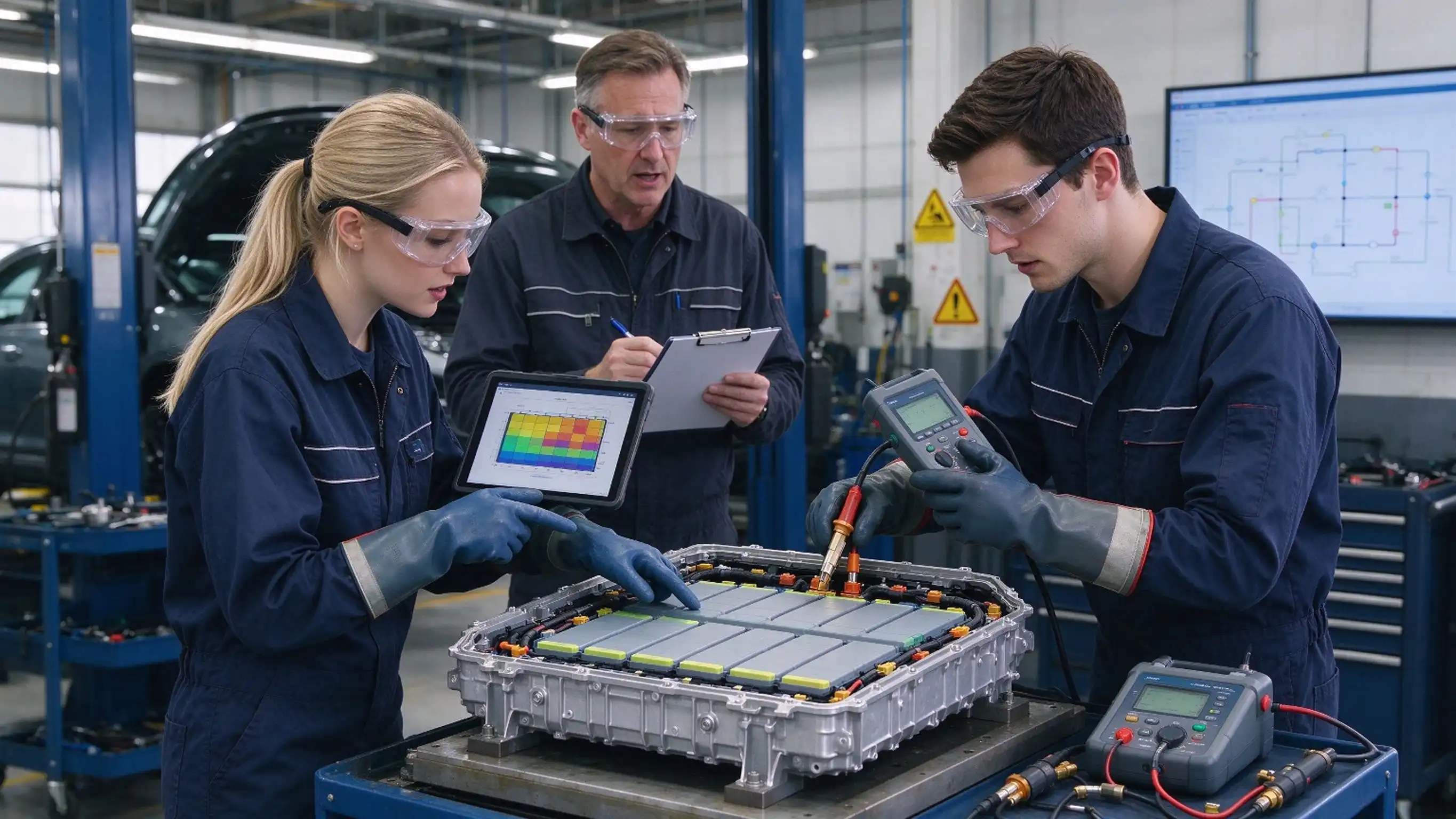
In field service, battery capacity loss and cell imbalance are two of the most common problems that are brought up. When the voltages of individual cells move outside the BMS tolerance window, the system sends out a warning about insulation problems or charge cutoffs. In places with a lot of humidity, old connection sealants let water in, which lowers the isolation resistance below the 500 Ω/V safety level. This is a known failure pattern that is spelled out in the GB/T 18384 safety testing guidelines.
Motor Controller and Signal Faults
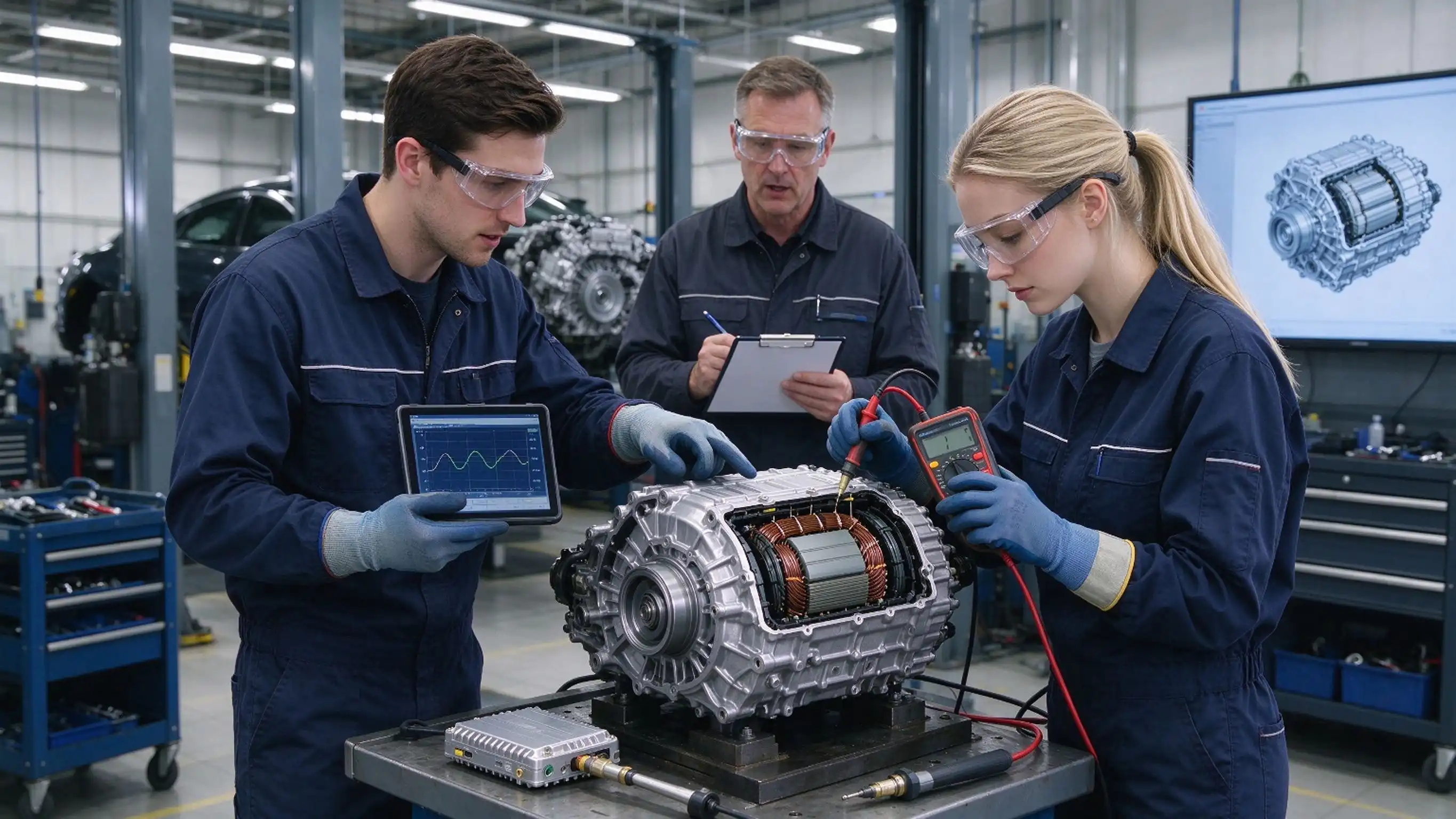
Rather than software bugs, drive motor problems are usually caused by IGBT hardware failure or sensor signal interruption. Using an oscilloscope to watch the PWM output is a useful way to tell the difference between the two: right logic signals along with an uneven three-phase output are a clear sign of a hardware problem in the inverter. Communication errors on the CAN-FD bus make these problems worse, especially in cars with a lot of software built in.
Charging System and Thermal Management Anomalies
There are a lot of complaints about "failure to charge" in public fast-charging networks that are caused by problems with the handshaking between the on-board charger and the EVSE. Failures in thermal management, such as a coolant pump not working, channels getting clogged, or sensors not being calibrated correctly, can speed up cell degradation and, in the worst cases, raise the risk of thermal runaway. ISO 6469 spells out the safety limits that technicians must stick to when they are inspecting a thermal system.
Best Tools and Software for NEV Fault Diagnosis
Buying the right diagnostic equipment has a direct effect on how quickly the workshop works and how safe the technicians are. There are many types of pocket scanners on the market, from cheap ones for beginners to high-end ones for professionals that can connect to the cloud.
Handheld vs. Professional-Grade Scanners
Handheld devices like the Launch X431 can read common DTCs and basic BMS info. Professional platforms like Autel MaxiSYS or Bosch BEA series offer the unique BMS PIDs that regular OBD-II scanners can't reach. These platforms give you access to more information, such as individual cell voltage logs, SOC/SOH estimation records, and high-voltage interlock loop state.
Software Update Policies and Compatibility
NEV designs change very quickly in new energy vehicle fault diagnosis & troubleshooting. Because of the switch to 800V systems and silicon carbide (SiC) transformers, diagnostic software that was up to date 18 months ago might not recognize new faults. Before buying a tool, procurement teams should make sure that it comes with an ECE R10 EMC compliance certificate and a multi-year software subscription that covers the vehicle lines that their technicians work on. This is to make sure that the tools don't interfere with vehicle control networks.
ROI Considerations for B2B Buyers
A skilled NEV diagnostic machine usually costs two to five times more than a regular car scanner, but you can see a clear return on your investment. Fewer repeat repairs and faster fault isolation cut down on the average time a vehicle stays in the shop, which has a direct effect on the amount of money the shop makes per bay. This cost-benefit analysis shows that for fleet operators and 4S service centers, the investment is worth it within the first year of use.
Step-by-Step Guide to Troubleshooting New Energy Vehicles
A structured method for troubleshooting cuts down on guessing and keeps workers safe when they are working with high-voltage systems. The steps listed below are normal in the business and follow the rules set by SAE J1979 for diagnostic communication.
Initial System Verification
The 12V backup battery voltage and the High-Voltage Interlock Loop (HVIL) continuity are the first things that should be checked when the "Vehicle Won't Ready" status shows up. If the safety loop is broken or there isn't enough extra logic power, the high-voltage Contactors won't work. This one step fixes a lot of what look like problems with the propulsion system without taking it apart again.
Root Cause Analysis Workflow
Technicians start by making sure the power is working properly. Then they get fault codes, look at live data streams, and test components one by one. As part of a battery health check, the insulation resistance is tested under 1000V of stress, and the charge/discharge is checked against factory standards. As part of checking a motor system, the controller output is measured, the resolver signal is checked, and the accuracy of the temperature sensor is confirmed.
Documentation and Safety Compliance
Record the results of insulation tests done before and after each high-voltage repair, as well as the state of the technician's license. Before work starts, it must be proven that the necessary safety gear is present. This includes CAT III 1000V insulated tools, Class 0 high-voltage gloves, and a calibrated non-contact voltage tester. These records help with both internal quality checks and following the rules set by UN ECE R100.
Procurement Strategies for NEV Fault Diagnosis Solutions
The process of sourcing comes with real institutional risk for department heads and training directors who are looking at New energy vehicle fault diagnosis & troubleshooting curriculum suppliers. Here are the main things that set trustworthy partners apart from generic vendors.
Because high-voltage safety is so important in new energy vehicle fault diagnosis & troubleshooting, verified supplier qualifications are more important in this area than in regular car training. It is important for procurement teams to make sure that any platform provider has the right safety certifications, offers hardware-level protections like insulation monitoring and emergency stop systems, and can show that course content matches current OEM technical standards, not just rough copies from textbooks.
- Warranty and update coverage: Make sure that the hardware comes with a warranty that lasts at least two years and that the course material is updated every year to reflect changes in the platform, such as the addition of 800V systems and CTP/CTC battery architecture.
- After-sales technical support: Check to see if the supplier offers on-site setup, remote troubleshooting, and instructor training in addition to the platform itself.
- Confidentiality handling: Before adding proprietary technical material to a shared curriculum, schools that teach OEM-affiliated order classes should make sure that it has been approved by the maker for declassification.
These standards keep school funds safe and make sure that students get up-to-date, safe, and verifiable training results.
Emerging Trends and Future Outlook in NEV Fault Diagnosis
In the next generation of EV service technology, maintenance will be planned ahead of time instead of being done after an accident. Diagnostic algorithms that are run by AI and have been trained on large fleet datasets can spot patterns of battery degradation weeks before a fault code shows up. Cloud-based BMS telemetry already lets business teams watch SOH from afar, which cuts down on unplanned downtime by a large amount.
AI and Cloud-Based Diagnostics
When used with real-time car data, machine learning models make problem classification more accurate than static rule-based systems can. Over-the-air (OTA) diagnostic updates are now being used by some OEMs. This means that technicians need to know how to use tools well and also how to manage software versions.
IoT Integration and Remote Service
IoT connection connects diagnostic tools in the workshop directly to maker support centers. This lets multiple people work together to do remote diagnostics for complicated fault situations. This feature is especially useful for approved service networks that are spread out over large areas, making it impractical to send an expert to every problem.
Workforce Readiness
According to the Future of Jobs Report 2023 from the World Economic Forum, EV maintenance is one of the technical jobs that is growing the fastest around the world. Over the next five years, institutions and businesses that invest in organized, hands-on NEV training now will have a clear edge when it comes to hiring people.
Conclusion
No longer a niche skill, being able to correctly identify and fix NEV systems through new energy vehicle fault diagnosis & troubleshooting is a basic requirement for anyone wanting to work in the car service industry. Every part of this set of skills needs to be carefully taught and practiced, from understanding BMS fault patterns to using structured repair methods and picking the right diagnostic tools. Businesses and institutions that build this capacity now will be able to confidently and technically meet the growing service demand in the industry.
FAQ
1. Can someone with no prior automotive experience take an NEV fault diagnosis course?
Yes. Well-thought-out NEV training programs begin with basic electrical and mechanical concepts and then move on to high-voltage systems. It's good to know how electronics and computers work on a basic level, but it's not necessary for the first courses.
2. What safety equipment is required during high-voltage troubleshooting?
Before touching any high-voltage parts, technicians must wear Class 0 high-voltage gloves, use CAT III 1000V rated shielded tools, and carry a certified non-contact voltage tester to make sure the parts are no longer live.
3. How often does NEV diagnostic course content need to be updated?
Because platforms change so quickly, like 800V architectures, SiC inverters, and CTP battery structures, content should be looked over and changed at least once a year to make sure it stays in line with OEM service standards.
Build NEV Diagnostic Competency with E.C.R Academy
A structured New energy vehicle fault diagnosis & troubleshooting training program that covers the full three-electric system—battery, motor, and electronic control—is provided by E.C.R. Academy in collaboration with vocational institutions, businesses, and industry associations. We bring verified content, hardware-safe training platforms, and teachers pulled from active NEV engineering practice as a well-known New energy vehicle fault diagnosis & troubleshooting provider with 16 years of skills education experience across 28 countries. To ask for a program review, email us at ecr2008@enteredu.com or go to enteredu.com.
References
1. International Energy Agency. Global EV Outlook 2024. IEA, 2024.
2. World Economic Forum. The Future of Jobs Report 2023. WEF, 2023.
3. SAE International. SAE J1979: E/E Diagnostic Test Modes. SAE, 2020.
4. ISO. ISO 6469-3: Electrically Propelled Road Vehicles — Safety Specifications. ISO, 2021.
5. United Nations Economic Commission for Europe. UN ECE R100: Approval of Battery Electric Vehicles. UNECE, 2021.
6. National Institute of Standards and Technology. Handbook 44: Specifications, Tolerances, and Other Technical Requirements for Weighing and Measuring Devices. NIST, 2023.


_1781601799781.webp)