The Role of Multi-Rotor Drone Applications and Flight Operations in UAV Development
Multi-rotor drone applications and flight operations sit at the center of today's UAV development story. From power line inspection to agricultural spraying, these systems have moved well beyond hobbyist use and into serious industrial work. As demand for trained UAV professionals grows across logistics, emergency response, and precision agriculture, institutions and enterprises need a clear picture of how this technology works, where it adds the most value, and how structured training turns raw interest into job-ready capability.
Multi-Rotor Drone Use Across Key Industries
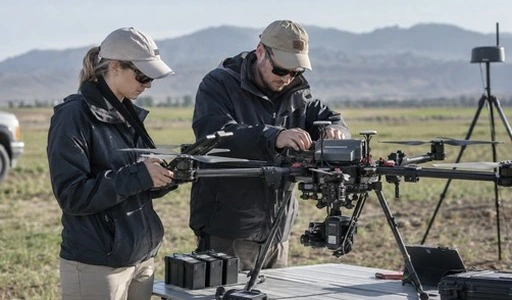
It's amazing how many different fields now depend on rotary-wing UAVs. The Association for Unmanned Vehicle Systems International (AUVSI) said in a report in 2023 that the global commercial drone market would be worth more than $58 billion by 2026. Inspection and farming will be the main industries that use drones.
Precision Agriculture
NDVI maps are made by multirotor devices with multispectral cameras. These maps show crop stress before it can be seen with the naked eye. Then, operators can carry out targeted variable-rate spraying tasks that can cut chemical use by up to 30% compared to traditional ways while keeping or even increasing crop yields.
Power Line and Infrastructure Inspection
UAVs with thermal imaging or optical gas imaging (OGI) packages can quickly look over kilometers of transmission lines, while ground workers need a lot more time. This method cuts down on both the number of unplanned outages and the number of dangerous settings where workers are exposed. It gives grid operators a clear return on investment (ROI).
Search, Rescue, and Emergency Response
Electro-optical and infrared (EO/IR) sensor sets let drones find lost people even when it's dark outside or in thick forest canopy. Rotary-wing UAVs are a standard tool in modern emergency management protocols because they can be sent from a vehicle to the air in less than five minutes.
Just these three areas show why there aren't enough qualified UAV pilots and engineers. Well-structured UAV Training programs are meant to fill the gap between what the industry needs and who is available to do it.
Flight Operations and Technical Best Practices
It's not enough to just know which businesses use drones. What sets skilled operators apart from beginners is their knowledge of how professional flight operations really work.
Core System Mechanics
For industrial multi-rotors to work, they need a tightly combined stack that includes high-voltage ESCs and brushless motors, a flying driver that combines data from the IMU and GNSS, and a backup power system. Thrust-to-weight ratios of about 2:1 give professional platforms the extra stability they need for missions with a lot of payload. Ratings from IP45 to IP67 keep gadgets safe when it rains or is dusty out in the field.
Flight Planning and Route Execution
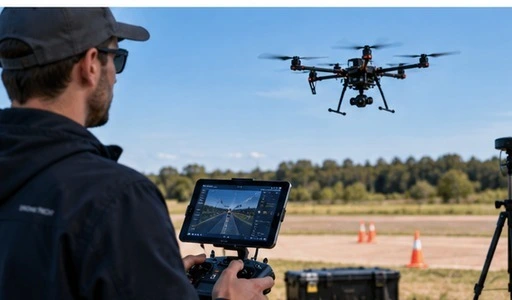
Mission fulfillment in multi-rotor drone applications and flight operations that works starts on the ground. Operators can set waypoints, altitude profiles, and payload triggers with ground station software before the plane even takes off. The best route balances coverage and battery life, and consistent flight-line overlap (usually 70–80%) makes sure that the photogrammetric data is usable.
Regulatory Compliance and Safety
In the US, commercial UAV operations are regulated by FAA Part 107, which requires a Remote Pilot license and airspace authorization through LAANC for controlled airspace. Fail-safe logic (automatic Return-to-Home on signal loss) and Remote ID broadcast compliance are quality standards that must be met by all business airplanes. The control link is encrypted with AES-256 to meet the data security needs of private infrastructure clients.
Technology Advances Shaping UAV Capability
There is a big difference in performance between industrial systems today and those from even five years ago, and things are changing quickly.
AI Navigation and Obstacle Avoidance
Six-directional obstacle sensing and AI-driven path re-planning make it possible for aircraft to fly in crowded places like orchards, substations, and urban canyons with a level of independence that wasn't possible until recently. SLAM (Simultaneous Localization and Mapping) and Visual Positioning Systems allow activities to happen in places where GPS can't, like caves or buildings.
Extended Endurance and Payload Flexibility
High-density lithium polymer cells and hybrid power systems have made it possible for mid-size platforms to fly for longer than 40 minutes on a single charge. Because the payload bays are modular, operators can switch between LiDAR, multispectral, thermal, and RGB sensors without having to change the airframe.
RTK-GNSS and Precision Positioning
Real-Time Kinematic GNSS integration gives horizontal accuracy of less than one centimeter, which is needed for survey-grade mapping, precise spraying boundary compliance, and repeatable inspection flight paths. This level of accuracy in placement is what turns drones from a fun item into a service that can be billed for.
Choosing the Right UAV Training Program
It's important to have the right tools, but training is what makes that equipment work. Here are the real differences between a good UAV training program and a basic introductory course:
- Full-chain coverage: The program should move from airframe assembly and flight controller configuration through to industry-specific application scenarios—not stop at basic hovering practice. Look for structured progression covering VTOL operation, sensor integration, autonomous mission execution, and swarm coordination.
- Standards alignment: Training built around global UAV industry standards and recognized certification pathways gives learners credentials that employers and regulators actually recognize. For institutions targeting CAAC license examination sites, alignment with those assessment criteria is a practical requirement.
- Real hardware platforms: Simulation has its place in multi-rotor drone applications and flight operations, but professional competence requires time on actual aircraft. A credible program provides access to multiple frame configurations, motor and ESC variants, RTK-equipped platforms, and dedicated maintenance benches for fault diagnosis training.
- Qualified faculty: Instructors should carry direct field experience in at least one major application domain—agriculture, inspection, or emergency response—not just academic familiarity with the subject matter.
- Measurable outcomes: Flight hours logged, assessment pass rates, and documented task completion data are the evidence that both employers and regulatory bodies want to see.
These things are important for any serious procurement evaluation, no matter if you're from a business looking to train an operational flight team or a vocational school building a new UAV program.
Real-World Results: What Structured UAV Training Delivers
If you teach workers, what they can do after class is proof that you paid for it.
Agriculture Deployment Outcomes
Teams that have been trained on autonomous spraying workflows have seen 8–12 times more efficient application per acre than with manual backpack sprayers. Chemical drift is also cut down by using precise nozzle triggering linked to GNSS position data.
Infrastructure Inspection Efficiency
Utility inspection teams that use trained UAV pilots say that they can cut the time it takes to check each tower from about four hours of work by a ground crew to less than 25 minutes of surveying from above, and they can find defects at rates that meet or beat eye inspection standards.
Emergency Response Readiness
Municipal emergency management units that taught UAV operations saw faster initial scene assessments—aerial images were sent to incident commanders within eight minutes of the teams arriving—than those that only did ground reconnaissance.
Conclusion
In the fields of public safety, agriculture, energy, and logistics, multi-rotor drone applications and flight operations have become a real priority for workforce development. The technology is now advanced enough that most businesses don't have to worry about the hardware being too expensive; instead, they need to make sure they have enough people trained to use it professionally. Businesses and institutions that invest in organized, standards-aligned UAV training now will be ready to meet the rising demand in this field. There is a clear road from being a UAV beginner to being a job-ready professional. The question is which training partner can provide that path consistently.
FAQ
1. Can someone with no prior experience take a professional UAV course?
Yes. Well-designed programs start with UAV platform fundamentals—hardware architecture, basic controls, and pre-flight checks—before advancing to flight controller configuration and industry applications. The learning path is structured so that no prior experience is required.
2. What career roles does UAV training prepare graduates for?
Graduates typically pursue roles including UAV Pilot, UAV Assembly and Maintenance Technician, UAV Industry Application Engineer, Flight Control System Development Engineer, Payload System Integration Engineer, and UAV Training Instructor.
3. How does wind affect industrial UAV operations?
Professional platforms are rated for Beaufort Scale 6 to 7 winds. High-voltage ESCs adjust motor output in real time to maintain attitude stability, though mission planning should still account for wind direction to preserve battery endurance and data capture quality.
Advance Your UAV Program with E.C.R Academy
As a reliable provider of multi-rotor drone applications and flight operations training, E.C.R Academy works with businesses, educational institutions, and industry groups. Our project-based curriculum includes putting together UAVs, setting up flight controllers, integrating multiple sensors, and making industry-specific apps. It is designed to meet global UAV industry standards and is taught by engineers who have worked in the field. When training platforms support both real hardware and virtual simulation, students graduate with skills that can be documented and measured. You can email us at ecr2008@enteredu.com or go to enteredu.com to talk about how we can help you reach your UAV program goals.
References
1. Association for Unmanned Vehicle Systems International (AUVSI). The Economic Impact of Unmanned Aircraft Systems. AUVSI, 2023.
2. Federal Aviation Administration. FAA Aerospace Forecast: Fiscal Years 2023–2043. FAA, 2023.
3. Pajares, G. "Overview and Current Status of Remote Sensing Applications Based on Unmanned Aerial Vehicles." Photogrammetric Engineering & Remote Sensing, 2015.
4. Shakhatreh, H., et al. "Unmanned Aerial Vehicles: A Survey on Civil Applications and Key Research Challenges." IEEE Access, 2019.
5. Hunt, E. R., & Daughtry, C. S. T. "What Good Are Unmanned Aircraft Systems for Agricultural Remote Sensing and Precision Agriculture?" International Journal of Remote Sensing, 2018.
6. Kardasz, P., et al. "Drones and Possibilities of Their Using." Journal of Civil & Environmental Engineering, 2016.

_1781601799781.webp)