3D Exhibitions and Virtual Reality Digital Content Creation: What’s Next?
The next chapter of immersive exhibitions is already being written. Virtual reality digital content creation is reshaping how museums, corporate showrooms, and educational institutions present information to the world. Rather than passive browsing, audiences now walk through spatially rich environments, interact with digital exhibits, and absorb narratives in ways that static websites simply cannot replicate. As institutions and enterprises race to modernize their display capabilities, understanding where this field is heading — and how to build the skills to get there — has never been more urgent.
Understanding Virtual Reality Digital Content Creation in 3D Exhibitions
What Makes VR Different from Traditional 3D Modeling
Making 3D images is only one aspect of virtual reality digital content creation. Spatial planning, dynamic logic, multimedia integration, and release across accessible platforms are all part of this end-to-end field. Standard 3D modeling creates static images, but immersive exhibition development puts the visitor inside the environment, giving them a sense of space, a faster pace for the story, and more ways to interact that standard design can't.
A report from 2023 by PwC says that by 2030, VR-based learning and experience environments will have added $1.5 trillion to the global economy. Education and experiential marketing will be two of the main areas where this happens. This is a clear sign of a strategic chance for institutions that act quickly.
In this field, the main process is made up of four steps: coming up with ideas for concepts, designing spaces and building scenes, making engaging functions, and deploying on multiple devices. Mastering this process, not just individual software tools, is what sets professionals who are ready for work apart from those who only understand theory.

Current Challenges and How Immersive Exhibition Development Is Evolving
Why Traditional Exhibitions Fall Short
There are real problems with physical exhibitions, like being limited by location, having high setup costs, and not being able to quickly change the content. A lot of organizations have tried to close this gap with regular websites or video walks, but these don't offer enough spatial connection and interaction depth.
These structural issues can be fixed with immersive digital display places. Cloud drawing makes local systems less dependent on it. Multi-device adaptation makes sure that visitors using desktop computers, tablets, or mobile browsers all have the same high-quality experience. Scene assembly is sped up by AI-assisted content tools, and programming isn't needed at all with zero-code development platforms. This means that educators, artists, and editors who aren't very technical can work in this field.
You can measure the shift. A study released in 2022 in Computers & Education found that students who learned in digital settings that were spatially immersive remembered a lot more of what they learned than students who learned in flat media forms. This proof makes the case for investing in immersive media training even stronger for schools that are building their courses around these tools.
Tools, Software, and Platforms: Choosing the Right Virtual Reality Digital Content Creation Solution
Evaluating Platforms Beyond Feature Lists
More than just a feature list must be considered when choosing the best platform for virtual reality digital content creation. All of these factors are important: how well it works with current workflows, how often it is updated, how licensing works, and how long it takes for teachers and students to learn it.
Professional-level engines like Unreal Engine 5 and Unity give you the most artistic freedom, but they require a lot of technical know-how and money to buy the right tools. Browser-based platforms are a different but growingly important type of platform. They are designed to be easy for everyone to use, allow for quick changes, and allow teams to work together without having to run anything.
Here's how the main rating factors differ for each type of platform:
- Zero-code and low-code accessibility: Platforms that use visual scene editors and template libraries let teachers and junior developers make exhibition spaces that work perfectly without writing a single line of code. This makes it much easier for teachers to get hired and cuts down on the time it takes to get started.
- Cloud rendering and cross-device support: When exhibition projects work well on all browsers and devices without any local hardware dependencies, schools can show student work to real people right away, turning homework into portfolio-quality projects.
- Built-in collaboration and content management: Multi-user online workflows, visitor interaction data, and display management tools turn a development platform into a working environment that can be used for both training and business delivery.
These factors show if a platform meets a real need in the school or just makes things more complicated technically. When these benchmarks are used to guide procurement decisions, both faculty adoption and student results tend to improve significantly.
Implementing VR Digital Content in Your 3D Exhibitions: A Practical Roadmap
From Planning to Deployment Without Starting Over
The most common place where display digitization projects fail is where the idea doesn't meet the reality. A lot of the time, institutions pay for detailed planning documents that never get built because the tools, skills, and workflows were never matched up correctly.
This is directly dealt with by a structured implementation path. Set clear goals for the exhibition, including not only what to show but also how people should move through the area, what they should be able to do, and what they should be able to take away. Before you start building the scene, make a map of these visitor journey markers.
There are different skill levels that are used to create content. These levels include spatial layout and scene building, integrating multimedia assets, setting up interactive functions, and testing the user experience. Each step creates a real deliverable that can be looked over, improved, and used in other tasks.
After launch, the work keeps going. Monitoring performance in real time, analyzing how visitors interact with your site, and making changes based on real usage data are what set skilled practitioners apart from truly capable ones. Schools that teach students this whole cycle, not just the design phase, make graduates with portfolios that are useful in the business world.
Future Outlook: What's Next for 3D Exhibitions and VR Digital Content Creation?
Hybrid Models, AI Integration, and the Skills Gap
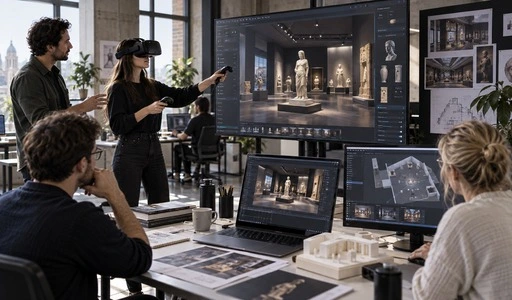
Virtual reality digital content creation is likely to lead to hybrid exhibition models that combine real and virtual touchpoints without any problems in the near future. People who visit a museum in person will activate digital overlays, and people who are not in the museum can move around the same space from their browsers. With 5G connection and edge computers, latency won't be a problem, and AI-driven scene creation will make production times much shorter.
In real life, this means that the skills gap between what practitioners can do now and what the industry needs will get bigger before it gets smaller. If schools start building their courses around commercial-grade virtual exhibition processes right now, they will have a real edge when it comes to getting graduates jobs and forming partnerships with businesses. There is a greater need for qualified immersive media producers in fields like education, public experience design, cultural tourism, and corporate communication than there are training programs that can keep up.
Conclusion
Virtual reality digital content creation is no longer just a fad. It is now a required skill for digital media programs, business training departments, and any other school that wants its graduates to be truly ready for work. There is a growing gap between schools that teach theory and those that teach real-world project skills that can be used. The easiest way to close that gap is to choose a program that covers the whole production cycle, from designing spaces and making interactive games to deploying platforms and making sure they work best. The technology is easy to get to. The process can be learned. You need to decide if your school is ready to teach it at the level that the business world requirements right now.
FAQ
1. What is the difference between a digital exhibition hall and a regular website?
People who go to a digital exhibition hall are put in a space-designed setting where they can move through virtual spaces, interact with exhibits, and read multiple stories. A normal website sets up its content so that it can be browsed and sped through in a flat, linear way. The immersive depth of a virtual show, made possible by 3D scene design, interactive elements, and the use of multimedia, makes it more interesting than regular web forms.
2. Does this course require prior art or programming experience?
You don't need to know anything about programming or prior art. The lessons gradually teach basic design ideas and how to think about space. Veryengine is the platform that was used. It is a zero-code and low-code environment that has visual scene editing, component libraries, and display themes. This lets students focus on interaction design and curating instead of technical syntax.
3. What industries actively use virtual exhibition platforms?
There are many areas where this technology can be used, such as corporate brand showrooms and product experience centers, museums and memorial halls that preserve cultural heritage, science classrooms, cultural tourism experiences, commercial marketing campaigns, and personal creative portfolios. Because they can be used in different fields, virtual exhibition skills are truly transferable between jobs.
Partner with E.C.R Academy for Professional Virtual Reality Digital Content Creation Training
E.C.R Academy offers a structured, project-based curriculum in virtual reality digital content creation, delivered by industry professionals and aligned with international technical skills standards. Our Veryengine-powered training platform requires no installation and supports real project delivery from day one. Whether you are a vocational institution, enterprise training department, or industry association seeking a reliable virtual reality digital content creation supplier for program development, reach out to our team at ecr2008@enteredu.com or visit enteredu.com to explore partnership options.
References
1. PwC. (2023). Seeing Is Believing: How VR and AR Will Transform Business and the Economy. PwC Global.
2. Radianti, J., Majchrzak, T. A., Fromm, J., & Wohlgenannt, I. (2020). A systematic review of immersive virtual reality applications for higher education. Computers & Education, 147, 103778.
3. Mystakidis, S. (2022). Metaverse. Encyclopedia, 2(1), 486–497. MDPI.
4. tom Dieck, M. C., & Jung, T. (Eds.). (2019). Augmented Reality and Virtual Reality: Changing Realities in a Dynamic World. Springer International Publishing.
5. Dalgarno, B., & Lee, M. J. W. (2010). What are the learning affordances of 3-D virtual environments? British Journal of Educational Technology, 41(1), 10–32.
6. Slater, M., & Sanchez-Vives, M. V. (2016). Enhancing our lives with immersive virtual reality. Frontiers in Robotics and AI, 3, 74.

_1781601799781.webp)