What Makes New Energy Vehicle Detection & Maintenance Technology Training Effective?
Effective training in new energy vehicle detection & maintenance technology teaches technicians how to safely find root causes, not just read fault codes. It uses both theory and project-based practice, has a repeatable diagnostic workflow, and safety with high voltage is the most important thing. It also gives students realistic tools or simulation platforms where they can practice taking cars apart, testing them, and figuring out what's wrong with them before they touch a real one. Finally, tasks, not attendance, are used to measure skill. I wrote this guide to put each part into simple terms and show how E.C.R. Academy uses them in its course for businesses, schools, and industry groups.
Why Traditional Automotive Training Falls Short?
Electric Vehicles Depend on Connected Systems
An electric car is a group of systems that work together. The charger, communication lines, cooling loop, battery, drive motor, and inverter all have an effect on each other. When you charge something, you add another link because SAE J1772 describes the standard charge coupler for North America. The International Energy Agency said that sales of electric cars around the world reached almost 14 million in 2023 and went over 17 million in 2024, making up more than 20% of all new car sales that year. Every year, more of these cars and trucks get to service bays. Someone who only knows how to work on engines and brakes might see a warning light but not know what system set it off. Before you pick up a wrench, you should look at the entire chain to learn about new energy vehicle detection & maintenance technology.
Code Reading Alone Does Not Find Root Causes
Reading basic OBD codes tells you what the control unit saw. It doesn't say why. Low coolant, a broken water pump, a bad temperature sensor, or a controller that is too busy could all cause a code for an overtemperature fault. Techs lose money and time for the shop and customer when they swap out the most expensive part first. Techs who have been trained use a code as a starting point. They check the connectors, read the data streams, measure the resistance and insulation, and test again after the repair. This habit saves time and helps keep repair records that other technicians can use in the future.
High-Voltage Work Raises the Cost of Mistakes
Because traction systems use high voltage, one mistake can hurt someone or damage parts that cost a lot of money. ISO 6469-3 sets electrical safety standards for vehicles that move on the road using electricity. These standards include protection against electric shock. NFPA 70E is a standard for electrical safety in U.S. workplaces. High-voltage power-off steps, insulated tools, and protective gear should not be taught all at once on the first day of training. Instead, they should be taught every day. A skilled technician who doesn't follow safety rules is still a threat to the team. When people are shown how to do something over and over again, they form safe habits. That repetition is most important for the steps with the most risk, like making sure the system is turned off.
The Core Elements of Effective New Energy Vehicle Detection and Maintenance Training
Project-Based Learning Linked to Real Tasks
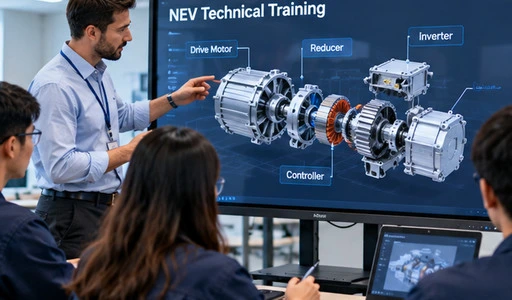
Lectures teach ideas, but projects make habits. Students in E.C.R Academy's course work on projects in workshops that are based on an integrated eight-in-one electric powertrain platform. The drive motor, motor controller, DCDC system, OBC, PDU, BMS, and VCU are all part of the platform. Each new energy vehicle detection & maintenance technology is based on a real testing or maintenance task, like taking out a powertrain, setting up a motor, or finding a phase loss fault. Theory comes first so that students can understand why a step is important. After doing the step a few times, it will come naturally. When you study and practice together, you turn what you know into skills that are ready for work.
A Clear Diagnostic Workflow
Powerful programs teach a single, easy-to-follow way to do things. First, the technician writes down what's wrong with the car and what the customer is complaining about. After that, a high-voltage safety check is done before any tool is hooked up. The technician then checks the system, reads live data, and takes measurements of important things like resistance and insulation. The technician scans, tests, and writes down the result again after the repair. This is how our course makes sense. Learners read fault codes and look at data streams with diagnostic tools. They then test and inspect the system to make sure that each repair worked. People won't skip steps when the shop is busy if there is a set order, and there will be a record for the next service visit.
Coverage of the Core Electric Systems
A lot of people call the system with the battery, the drive motor, and the high-voltage control system the "Three-Electric" system. The course at E.C.R. Academy is mostly about NEV drive motor systems and electronic controls. In its theory units, it also talks about power battery systems, vehicle electrical systems, smart connected vehicle technologies, and safety standards for NEVs. Students learn about switched reluctance motors, induction motors, and permanent magnet synchronous motors. They also learn about vector control and direct torque control. Techs can tell if a problem starts in the motor, the controller, or the wiring between them by looking at how these parts work together. I suggest that buyers match the level of detail in a course to the systems that their own vehicles use.
What Equipment and Platforms Should Training Include?
Core Diagnostic and Measurement Tools
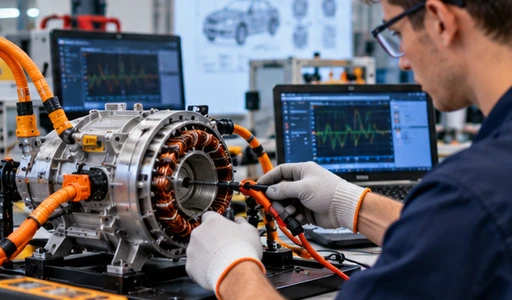
Tools used in good training are the same ones used in real service work. Multi-brand EV scanners, high-voltage multimeters, insulation resistance testers, voltage absence testers, and insulated hand tools are all everyday examples of this. Teachers should talk about measurement ranges, the need for calibration, and safe ways to use each tool. In our class, students learn how to use diagnostic tools with OBD ports to check ECUs, read data streams, and calibrate motors to zero positions. It is multimeters and insulation testers that are used for static checks. To choose adjustment shims, they use vernier calipers, depth gages, and height gages. Learners learn when they can trust a reading and when they need to measure again by doing guided tasks with the instruments.
Virtual Simulation for Safe Repetition
Doing some things over and over on a real powertrain is dangerous or costs a lot of money. Our built-in virtual simulation platform lets students practice taking apart and putting together drive motor systems, as well as inspecting and adjusting them in virtual workshops. Smart terminals run the platform, so students can study online and practice technology at the same time. Trainees need a computer that has Windows 10, at least 8GB of RAM, and a graphics card that is only used for games. The platform lets you learn online and practice with simulations at any time. Simulations can't take the place of the bench, but they do let people practice each step, make mistakes, and fix them before they touch real hardware. It helps you feel good about yourself and form good habits.
Static Testing and Fault Diagnosis Platforms
The learning space is now complete with two more platforms. Learners can figure out how healthy a drive motor's electricity is by using the static testing platform to test its insulation, its phase-to-phase resistance, and its sensors. ISO 6469-1 gives more information about the safety rules for the rechargeable energy storage system. Common drive system faults that the fault diagnosis platform can simulate are resolver, insulation, overtemperature, phase loss, collision signal, and cooling system faults. Learners read fault codes, check out the system, figure out what's wrong, and make sure the repair was done right. Electricity systems like batteries, compressors, and motors need to be carefully checked for insulation faults. When there are problems with cooling, students need to check the high-voltage fuses, water pumps, connectors, and control signals. Technicians get ready for the wide range of situations they will face at work by practicing with these cases.
How to Compare Training Solutions and Suppliers
Look Beyond the Purchase Price
Low prices can hide high costs in the long run. I advise buyers to start by writing down the types of cars they want to repair, how often they need repairs, how skilled the technicians are, and their business goals. Then you can decide if an easy-to-use OBD scanner, a professional diagnostic platform, or a full training program meets your needs. A simple scanner can read codes, but it can't teach a technician how to check the insulation or look at a motor controller. Software updates, calibration documents, warranty terms, lead times, spare parts, and language support are some other things that buyers should ask about. You can get a better idea of the total cost of ownership by adding up all of these things.
Check Standards, Faculty, and Documentation
Promises are not as important as proof. You can ask any provider for a course outline, a list of tasks, sample tests, and the names of the standards that the curriculum is based on. Our course is based on international standards for technical skills and on what the NEV industry does now. It is taught by engineers from the industry and academic experts. Since 2010, E.C.R. Academy has helped nearly 500,000 people in China and 28 other countries with their training and assessments. We've also hired more than 3,300 experts and teamed up with more than 500 businesses. Even though those numbers show experience, I still tell people to look at the tasks and tests that come with a course before they buy it. Keep asking if a provider can't show you what students do.
Match the Solution to Your Organization
Things that different groups need are different. An OEM service team might want all of its branches to follow the same process. Schools might need a project structure that works with the way they teach. An industry group might want its members to have a common list of skills. Ask each provider how well their course fits your needs and if they offer technical support after the sale, help with installation, and support for training other trainers. Since E.C.R. Academy works with businesses, schools, industry groups, and other groups, I want each partner to start by talking about its setting. It's much easier to compare when you have a clear picture of your vehicles, team, and schedule.
How Effective Training Improves Workshop Performance and ROI
Faster, More Accurate Repairs
When you train, it pays off most in the service bay. When technicians use a measured process, they don't have to guess as much when replacing parts and don't have to do as many repairs. Every avoidance of a comeback frees up a lift for the next paying job and cuts down on the time a customer has to wait without a vehicle. Simple numbers can help shops keep track of this: the percentage of cars that are fixed the first time, the average amount of time it takes to diagnose a problem, and the percentage of cars that come back with the same problem. I think you should write down these numbers before and after training. Real numbers from your own shop are more convincing than averages from other shops in the same field.
Safer Shops and Consistent Standards
It's easy to make sure something is safe when you follow known steps. Techs can be checked by their bosses to make sure they all know how to turn off the high-voltage power in the same way. How to use electrical protection equipment correctly, standard maintenance and inspection, and what to do in an emergency in a workshop are some of the things we teach in class. Companies with more than one location can make sure that teaching is the same at all of them by using shared assessment tasks and train-the-trainer programs. Making sure the repair is safe and done well is easier when steps are always taken. To figure out what needs more work, managers can also look at how the results vary from place to place.
Clear Career Paths and Job-Ready Skills
People who are new to the job need to show that they can do it. Project-based learning, in which each task has a clear end goal, is proof of that. When students finish the training, they will be qualified to work as a NEV drive motor system testing engineer, an electric drive system assembly and adjustment engineer, a drive motor fault diagnostics engineer, a NEV drivetrain technician, a NEV maintenance technician, or an after-sales service technician. If you know how to use a computer and the basics of electrical and electronic engineering, you can follow along. When the course starts, it goes over basic NEV structures. Employers can get a better idea of what skills each person has, and students can learn how to get into the field.
Conclusion
Effective new energy vehicle detection & maintenance technology training includes hands-on projects, a clear diagnostic workflow, strict high-voltage safety rules, and an in-depth look at the motor, controller, and battery-related systems that technicians will encounter on the job. In connected electric systems, engine training and reading codes are not enough to find the root causes. Learners can practice dangerous tasks with realistic tools and simulation platforms. Static tests and fault cases help them get better at measuring. People who want to buy something should not only compare prices, but also look at things like syllabi, standards, faculty, and assessments. When shops have good training, they have fewer repairs that need to be done again, safer procedures, more consistent standards across all branches, and graduates who can show what they can do.
FAQ
1. Can I take this course with zero background knowledge?
Yes. The course is both theoretical and practical. It starts with basic NEV structures and then moves on to drive motor systems and finding problems. Instead of starting with more advanced controller topics, learners build from the very beginning. I still think it's important to know the basics of electrical and electronic engineering, basic mechanics, and how computers work.
2. What positions can I pursue after completing the course?
The course prepares students for jobs like NEV drive motor system testing engineer, electric drive system assembly and adjustment engineer, drive motor fault diagnosis engineer, NEV powertrain technician, NEV maintenance technician, and after-sales service technician.
3. How is the platform deployed?
Smart terminals are used for virtual simulation technology. Trainees need a computer that has Windows 10, at least 8GB of RAM, and a graphics card that is only used for games. The platform lets users learn online and practice simulations at any time and from anywhere, so students can study theory and practice simulations at the same time. You don't need a full workshop for them to start practicing with simulations.
Start Your New Energy Vehicle Detection & Maintenance Technology Plan with E.C.R Academy
Looking for a supplier of new energy vehicle detection & maintenance technology who provides project-based courses, a virtual simulation platform, and instruction from industry engineers and academic experts? We want to know what kind of vehicles you have, how many people are on your team, and what your training goals are. Email us at ecr2008@enteredu.com to get more information about the course or to talk about making a plan for your group. You can also visit enteredu.com for more details.
References
1. International Energy Agency, Global EV Outlook 2024
2. International Energy Agency, Global EV Outlook 2025
3. International Organization for Standardization, ISO 6469-3: Electrically Propelled Road Vehicles – Safety Specifications – Part 3: Electrical Safety, 2021
4. International Organization for Standardization, ISO 6469-1: Electrically Propelled Road Vehicles – Safety Specifications – Part 1: Rechargeable Energy Storage System (RESS), 2019
5. National Fire Protection Association, NFPA 70E: Standard for Electrical Safety in the Workplace, 2024
6. SAE International, SAE J1772: SAE Electric Vehicle and Plug-in Hybrid Electric Vehicle Conductive Charge Coupler, 2017