Virtual Reality Digital Content Creation: Key Industry Applications
Virtual reality digital content creation is reshaping how industries communicate, train, and engage audiences. From museum-quality digital exhibitions to corporate showrooms and educational simulations, immersive content development now spans nearly every sector. At its core, virtual reality digital content creation combines 3D spatial design, interactive media production, and real-time rendering to build experiences that go far beyond what a standard webpage or video can offer. For institutions and enterprises investing in this space, understanding where these immersive experiences deliver the strongest outcomes is the critical first step.
Understanding Virtual Reality Digital Content Creation
What Makes Immersive Content Different
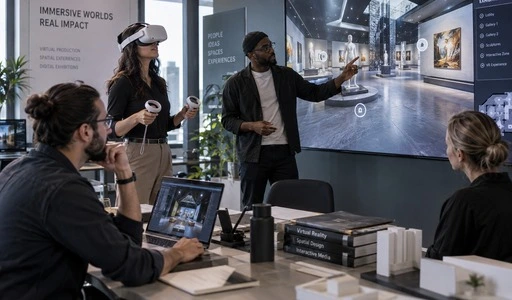
Traditional digital media delivers information linearly. Virtual reality digital content creation works differently — it places the visitor inside the experience. Spatial perception, narrative layering, and interactive triggers replace static scrolling. According to PwC's 2020 VR Soft Skills Training Study, VR learners were up to four times more focused than their e-learning counterparts, completing training up to 1.5 times faster. That data point alone explains why procurement teams across education, culture, and enterprise are accelerating adoption.
Concept planning, building 3D scenes, integrating multimedia assets, designing interaction logic, and deploying the experience in the cloud are all common steps in the production process of immersive digital experiences. At each stage, both design sense and technical skill are needed. That's why schools that are building programs from scratch need training and tools that are specifically made for them.
Key Industry Applications of VR Digital Content Creation
Cultural Heritage and Museum Experiences
Cultural institutions were some of the first and most dedicated users of virtual space experiences. Virtual display spaces are now used by museums, memorial halls, and historical places to reach more people than they could before. A visitor from another country can use a browser to walk through a digital reconstruction of a historic site, interact with displays of artifacts, and follow a carefully chosen story. They don't need any special hardware to do this.
In this area, the need for skilled coders is steadily rising. Institutions need staff who know both how to organize collections and how to make spaces interactive. Training in virtual exhibition creation directly meets this need.
Corporate Display and Brand Experience
Businesses use realistic digital shops to show off their goods, talk about their past, and give stakeholders far away a branded experience. A virtual showroom is different from a PDF leaflet or a regular website because it lets the customer move around in space, watch product demos, and read information at their own pace. This style works really well for business-to-business sales cycles, where people making decisions need more than just surface-level views.
Education, Training, and Skills Development
You can practice complicated processes without any risks in VR-based learning settings. Immersive digital content is being used more and more in science museums, campus orientation areas, and online course supplements to help students remember and be interested in what they are learning. When trade schools include virtual show projects in their lessons, they give students portfolio work that they can use, not just theoretical knowledge.
Cultural Tourism and Commercial Marketing
Tourism boards and marketing teams use interactive digital material to show people places, plan their trips, and run online campaigns that feel more like experiences than ads. When new products are launched through virtual show spaces, people are much more interested than on basic landing pages. This is especially true when game-like elements and interactive elements are added.
Selecting the Right VR Digital Content Creation Tools and Solutions
Platform Capabilities and Accessibility
Picking the right working setting affects both how quickly you learn and how well your work turns out in the end. Some virtual reality digital content creation platforms require you to know a lot about programming, while others focus on visual editing and workflows that use templates. Accessibility is just as important as skill for business training teams and educational organizations.
With the Veryengine Digital Exhibition Hall Development Platform, you can build full virtual exhibition environments without having to install any software on your computer. You can do this by editing scenes visually, using interactive component libraries, and using industry-specific templates that are already set up. With cloud rendering and multi-device adaptation, projects work well on all browsers and devices, which makes hardware barriers much smaller.
Here are the core capabilities that distinguish this platform approach:
- Visual Scene Editor: lets you build scenes by dragging and dropping objects into place. It also lets you import 3D models and change lighting and materials right from the browser.
- Interactive Component Library: has pre-made interaction triggers like clickable displays, scene changes, information pop-ups, and multimedia layers that students can set up without having to write code.
- Multi-User Collaboration: Workflows for team-based project creation and content management work in both classroom and business production settings.
- Built-in Analytics: tracking how visitors interact with and use exhibits and collecting data on how well they do help developers improve and iterate experiences after they've been launched.
When students finish a course without a finished project they can show companies, this is one of the biggest problems that keeps coming up in immersive content education.
Best Practices and Design Principles for Effective VR Content
Balancing Narrative and Interaction
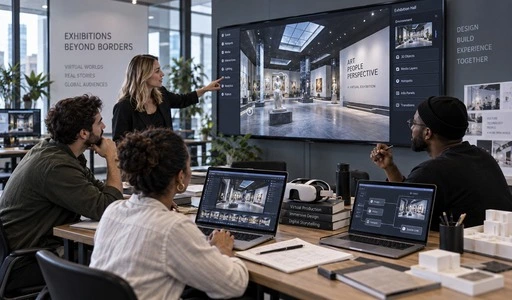
Adding information to 3D space isn't enough to make a realistic experience work. They change the way information is organized based on spatial logic, visitor choice, and multi-layered stories. Visitors to a well-designed virtual show are led through a logical story while still being free to explore. Structure and availability are the two things that make a digital experience interesting or frustrating.
Performance optimization is just as important. Frame stability, loading speed, and response across devices all play a role in how long a person stays on the site or leaves. Developers who go through training programs that include testing the user experience, analyzing speed, and iterative optimization rounds know about these issues before they start working.
Future Trends and Innovations in VR Digital Content Creation
AI, Real-Time Rendering, and SaaS Models
Things are changing quickly in the world of interactive video. Shorter production times are being made possible by AI-assisted design tools. The level of real-time rendering is getting closer and closer to that of pre-rendered images. Instead of buying software all at once, SaaS-based virtual exhibition platforms are switching to subscription models that automatically deliver updates and new features.
The smartest thing for institutions that are building VR programs right now is to make sure that their courses are aligned with platforms and workflows that follow these trends, not with old pipelines that will need to be replaced in two years. Curriculum built around current industry standards and kept up to date by teachers with real-world work experience are useful through all technology cycles.
Conclusion
Virtual reality digital content creation has moved well past novelty. It now leads to measurable results in business marketing, education, corporate communications, cultural heritage, and tourism. Businesses and institutions that spend money on organized, project-based training that includes things like interactive development, platform rollout, and spatial design prepare their students and teams for work that is actually needed. When training is based on real projects, current platforms, and teachers who do what they teach, the gap between "learning VR tools" and "making work that gets hired" gets smaller.
FAQ
1. What is the difference between a digital exhibition hall and a regular website?
Immersive movement, spatial awareness, and multi-layered storytelling are all important in digital display rooms. People explore virtual worlds the same way they would a real one: by going through rooms, activating exhibits, and following a planned path. Websites normally set up their content so that you can browse and read it, not move around and look around. Because a virtual exhibition lets you really experience something, it works much better for cultural, educational, and business marketing goals.
2. Does this course require an art background?
You don't need to be an artist to do this. Along with technical skills, the curriculum teaches basic design ideas, how spaces work, and how to judge what looks good. The Veryengine app has industry-specific templates and asset sets that can help students of all levels. The focus is on developing skills that employers value more than raw artistic technique: the ability to think like a curator and judge the user experience.
3. What application scenarios does virtual exhibition development cover?
It covers a lot of ground. It is used by cultural groups to show off museums and history. Businesses use it for product experience centers and brand showrooms. Educational groups build additions to science museums and places for new students to get to know the school. Tourism and marketing teams make campaign experiences and presentations to destinations. It's used by independent artists for web galleries and shows. The course builds the same core set of skills that are used in all scenarios.
Partner with E.C.R Academy for Virtual Reality Digital Content Creation
With 16 years of experience teaching skills internationally in 28 countries, E.C.R Academy offers structured, project-based training in virtual reality digital content creation. Our curriculum, teachers, and Veryengine platform are ready to help you reach your goals, whether you are a school starting a new digital media program or a business looking for a dependable virtual reality digital content creation provider for team building within the company. To talk about business possibilities, email us at ecr2008@enteredu.com or go to enteredu.com.
References
1. PwC. (2020). The Effectiveness of Virtual Reality Soft Skills Training in the Enterprise. PricewaterhouseCoopers LLP.
2. Radianti, J., Majchrzak, T. A., Fromm, J., & Wohlgenannt, I. (2020). A systematic review of immersive virtual reality applications for higher education. Computers & Education, 147.
3. Marr, B. (2021). Extended Reality in Business: How VR, AR and MR Are Transforming Organizations. Kogan Page.
4. Greenlight Insights. (2022). 2022 VR/AR Enterprise Market Report. Greenlight Insights Research.
5. UNESCO. (2021). Digital Cultural Heritage: Policies, Practices and Challenges. UNESCO Publishing.
6. Jerald, J. (2015). The VR Book: Human-Centered Design for Virtual Reality. Association for Computing Machinery and Morgan & Claypool Publishers.

_1781601799781.webp)