Embodied AI Robotics Programming With ROS2: Key Skills to Master
Embodied AI robotics programming marks a decisive shift in how intelligent machines perceive and act in the physical world. Rather than executing fixed scripts, robots built on embodied AI principles integrate sensory input, real-time reasoning, and adaptive motor control into a unified loop. When paired with ROS2 as the development backbone, this approach unlocks capabilities that classical automation simply cannot match—from autonomous navigation in unstructured spaces to dynamic object recognition using YOLOv8. This article outlines the key skills institutions and engineering teams need to master this discipline and build workforce-ready competency at scale.
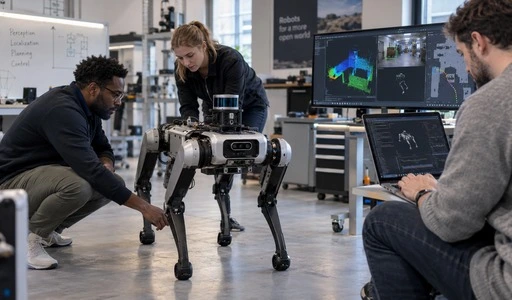
Understanding Embodied AI Robotics Programming
From Static Code to Sensorimotor Intelligence
Usually, industrial robots move in a way that is predetermined and can't be changed. Embodied AI robotics programming changes this rigidity with a perception-action loop, in which the robot's behavior is constantly updated based on real-time sensor data. The International Federation of Robotics reported in 2023 that exports of service robots that can navigate themselves increased by 48% year-over-year. This shows that there is a strong need for these skills in the business world.
The difference between embedded and detached AI is how they are built. Systems that don't have bodies, like language models that work with static information, don't have any real connections. Embodied systems, on the other hand, need to take high-dimensional, multimodal inputs like LiDAR point clouds, HD camera streams, and touch sensors and turn them into motor orders with low delay. This needs inference latency to be less than 20ms for real-time reactive control. This is a standard that affects both the choice of hardware and the design of software architecture.
This difference is not just academic for schools that are making new AI and robots programs. Understanding what embodied AI robotics programming actually needs at the engineering level is important for planning the curriculum, getting lab tools, and making sure that teachers have the right skills.
Core ROS2 Skills for Embodied AI Robotics Programming
Architecture, Communication, and Language Proficiency
ROS2 is now the most popular software for building professional robots. Its flexible design lets engineers make systems that can grow by using nodes that can be used again and again. The DDS (Data Distribution Service) communication layer makes sure that messages are sent reliably and in real time between distributed components. This is very important for embodied AI robotics programming applications because sensor fusion pipelines, navigation stacks, and perception modules need to be able to share data with as little jitter as possible.
Engineers who work in this area need to be able to use both Python and C++ well. Python speeds up the development of machine learning inference pipelines and perception algorithms, while C++ takes care of control loops that need to work quickly. Some of the most important skills in a well-organized ROS2 skill set are:
- Node architecture and lifecycle management: To build stable robotic systems, you need to know how ROS2 nodes start up, post, subscribe, and shut down properly.
- Navigation2 (Nav2) stack integration: Nav2 is the standard ROS2 framework for autonomous navigation; it supports planning a global path, avoiding local obstacles, and setting up tasks based on behavior trees.
- Sensor integration with LiDAR and HD cameras: It's important for practitioners to set up sensor drivers, adjust transform trees (TF2), and feed processed data into SLAM processes so that maps can be made in real time.
- RViz2 for visualization and debugging: For troubleshooting and visualizing, RViz2 is useful because it lets engineers see the state of the robot, map data, planned paths, and trust in the robot's location, which is important for rapid development and getting ready for competitions.
If graduates learn how to use these tools well, they will be able to start working right away on professional robotics projects, like autonomous shipping, intelligent police systems, or robotics competitions.
Practical Applications: From Tutorials to Real-World Use Cases
Structured Learning Pathways and Industry Deployments
To turn theory into skills that can be used, the structure of the program needs to be like how engineering works in the real world. This is directly dealt with in ECR Academy's embodied AI robotics programming course, which is based on projects and follows international technical standards for developing embodied AI talent.
There are six skill-building modules in the course: basic robot platform operation, obstacle avoidance and guided tour development, multimedia data processing, intelligent patrol system integration, and competition-grade function execution. Each lesson builds on the one before it, making sure that students learn clear, useful skills instead of separate technical bits.
A high-performance four-legged robot platform with LiDAR, 4K HD cameras, and touch sensors is at the middle of the learning space. The platform is based on an open-source motion library and comes with both preset motion libraries and extra development interfaces. Students can use built-in behaviors or make their own control programs that can do anything from simple things like adjusting the robot's gait to complicated integrated patrol scenarios that include voice Contact and finding strange things.
This method has been proven to work in the real world. Autonomous warehouse robots that pick items in an unpredictable way, agricultural robots that pick specific crops in changing lighting, and service robots that move around in unpredictable home environments all rely on the same core set of skills: sensor fusion, SLAM, YOLOv8-based object detection, and ROS2-native navigation algorithms.
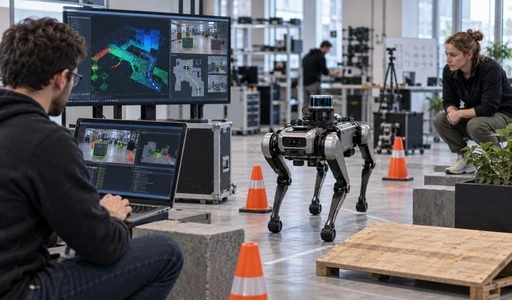
Comparing Embodied AI Robotics Programming With Traditional Approaches
Autonomy, Adaptability, and Strategic ROI
Classical code for robots focuses on making things repeatable. On an assembly line for cars, a welding arm follows the same path thousands of times, with accuracy down to the micron level. When the environment isn't structured or when the task needs contextual judgment, that model doesn't work anymore.
Embodied AI robotics programming adds the ability to execute long-horizon tasks, which are complicated action sequences that change based on feedback from the environment instead of pre-written steps. It also allows adaptive path planning and zero-shot generalization to new objects. There are real trade-offs in engineering: embodied AI systems need more computing power, stricter protocols for transferring data from simulation to real life, and more faculty knowledge to teach well.
The strategic math supports embodied AI for institutions that are deciding where to invest in programs. Graduates who learn how to develop embodied intelligence using ROS can work as a Robot Algorithm Engineer, Autonomous Navigation Engineer, ROS Development Engineer, or Intelligent Patrol System Developer, all of which are in high demand in the job market. The program is designed to meet the needs of students throughout their entire career, so grads will be able to keep up with the times as technology advances.
Future Trends and Strategic Considerations in Embodied AI Robotics
Reinforcement Learning, Edge AI, and Workforce Readiness
Embodied AI robotics programming is changing as a field because of three trends that are coming together. Robots can improve their motor policies by watching examples instead of writing a lot of code by hand thanks to reinforcement learning from human feedback (RLHF). Edge AI processors, like the NVIDIA Jetson Orin, are moving Vision-Language-Action (VLA) model inference to the robot itself. This makes it less reliant on the cloud and faster. Visual, tactile, and audible data streams are being combined by more advanced sensor fusion structures into unified world models that allow for more complex environmental thinking.
These trends have direct effects on buying for schools that are making new AI programs or improving current ones. Onboard GPU inference must be supported by hardware systems. Along with traditional ROS2 development, the curriculum must include GRPC communication protocols, protobuf data structures, and how to handle RTSP video streams. Not just academic qualifications are enough for faculty members to work in the field.
Every program that ECR Academy puts on is backed by 16 years of professional experience, work with over 3,300 domain experts, and partnerships with over 500 businesses. Its embodied AI robotics programming curriculum is co-created by business engineers and academic experts. This way, the material is updated with the latest deployment facts instead of being behind the times in the industry.
Conclusion
Embodied AI robotics programming with ROS2 is one of the most important skills that engineers need to learn today. Institutions that teach their graduates how to handle quadrocopter robots, use SLAM-based guidance, understand YOLOv8 perception, and integrate ROS2 systems gain a clear edge in setting their programs apart and making their grads more employable. The structured, hardware-based, internationally aligned curriculum at ECR Academy has it all: qualified teachers, physical robot platforms, and a path from basic skills to implementation that is ready for competition. The technology window for early adopters in this field is still open, but it won't stay that way forever.
FAQ
1. Can institutions without robotics infrastructure adopt this program?
Yes. The curriculum is meant to be open to everyone, no matter what their department's infrastructure is like. ECR Academy helps schools with the whole process of onboarding, which includes setting up tools, orienting teachers, and setting up learning environments. The open-source motion library and development tools that can be accessed from afar also make cross-regional deployment flexible.
2. What minimum technical background do students need?
The class is open to students who have never worked with robots before. The organized learning path starts with robot platform architecture and basic operations. Next, it moves on to ROS2 development, sensor integration, and designing an intelligent system. Students who already know how to code in Python will find it easy to switch to developing with ROS2.
3. How does this curriculum align with industry certification and competition standards?
The course is based on international technology standards for developing embodied AI talent and includes all the skills needed for competitive robots events, such as RViz2 localization, Nav2 waypoint configuration, and YOLOv8-based detecting pipelines. Graduates can go on to get industry-recognized licenses and work as competition coaches or trainers.
Partner With ECR Academy for Embodied AI Robotics Programming Solutions
ECR Academy is a reliable source for embodied AI robotics programming for schools that need a full course load, hardware, and teacher support. We offer co-created programs that meet international standards and real industry needs. Our network spans 28 countries and we have been teaching skills around the world for 16 years. Get in touch with our team to find out how we can help your school get accredited, your staff grow, and your students do well. Email us at ecr2008@enteredu.com or go to enteredu.com.
References
1. International Federation of Robotics. World Robotics Report. 2023.
2. Quigley, M., et al. "ROS: An Open-Source Robot Operating System." ICRA Workshop on Open Source Software. 2009.
3. Peng, X. B., et al. "DeepMimic: Example-Guided Deep Reinforcement Learning of Physics-Based Character Skills." ACM Transactions on Graphics. 2018.
4. Macenski, S., et al. "Robot Operating System 2: Design, Architecture, and Uses in the Wild." Science Robotics. 2022.
5. Redmon, J., & Farhadi, A. "YOLOv3: An Incremental Improvement." arXiv preprint. 2018.
6. Duan, Y., et al. "Benchmarking Deep Reinforcement Learning for Continuous Control." Proceedings of the 33rd International Conference on Machine Learning (ICML). 2016.


_1781601799781.webp)