Multi-Rotor Drone Assembly and Tuning
Standards: International technical skills standards for UAV talent development
Faculty: Industry engineers and academic experts
Platform: Integrated UAV selection, commissioning, maintenance, and inspection platform
Outcomes: Build practical, job-ready skills aligned with real UAV industry needs
Target Partners: Enterprises, educational institutions, industry associations, and other organizations
Multi-Rotor Drone Assembly and Tuning
Course Overview
This course focuses on the assembly, configuration, and debugging of multi-rotor UAV systems in Multi-Rotor Drone Assembly and Tuning. It covers the core technologies used in drone platforms, including flight control systems, power systems, communication systems, payload integration, and flight safety procedures.
Learners will work with complete UAV systems through hands-on assembly and testing tasks. Training includes airframe assembly, component selection and installation, flight controller configuration, system calibration, communication setup, and payload integration. The course also covers flight principles, basic aerodynamics, and standard UAV operating procedures.
Practical training focuses on system integration, multi-subsystem debugging, flight operation, and fault inspection. Through workshop-based projects and real operating scenarios, learners build practical skills for UAV assembly, testing, maintenance, and technical support applications.
Why This Course?
1. Curriculum
Learn through hands-on projects that combine UAV theory with real assembly, configuration, and testing tasks
2. Organization
Designed in line with international UAV technical standards and current industry practices.
3. Faculty
Delivered by industry engineers and instructors with experience in UAV systems and flight technologies.
4. Platform
Train on a practical platform covering UAV assembly, system configuration, maintenance, inspection, and flight testing.
5. Outcomes
Build practical skills for technical roles in UAV assembly, maintenance, inspection, and flight operations.
What You'll Be Able to Do?
This course is designed around real UAV assembly, configuration, and maintenance workflows.
1. UAV System Integration
- Select components for different multi-rotor UAV frame structures.
- Assemble UAV airframes and payload systems.
- Complete wiring connections and structural inspections.
- Perform assembly quality checks and system integration tasks.
2. UAV System Configuration and Debugging
- Configure flight controllers and remote control systems.
- Calibrate ESCs, compasses, and flight parameters.
- Test power, control, communication, landing, and payload systems.
- Perform subsystem integration and flight stability verification.
3. UAV Fault Detection and Maintenance
- Use multimeters and diagnostic tools to inspect UAV systems.
- Detect faults in power distribution, communication, motor, and flight control systems.
- Analyze fault conditions and locate system failures.
- Perform troubleshooting, repair, and system recovery tasks.
What You Will Learn?
|
Training Skills
|
Description
|
|
1. UAV Selection and System Integration
|
Learn how to select and integrate key UAV components, including frames, motors, ESCs, flight controllers, GPS modules, and receivers.
Complete airframe assembly, payload installation, wiring connections, and structural inspection tasks using professional tools and equipment.
|
|
2. Multi-Subsystem Configuration and Debugging
|
Configure and test UAV power systems, control systems, communication systems, landing systems, and payload systems.
Perform ESC calibration, compass calibration, flight mode configuration, subsystem testing, and flight stability verification tasks using professional ground station software.
|
|
3. UAV Inspection and Maintenance
|
Inspect, diagnose, and troubleshoot common UAV system faults.
Use diagnostic tools such as multimeters to detect faults in power distribution systems, communication systems, ESCs, motors, and flight controllers.
Perform fault localization, repair, and system recovery tasks.
|
Learning Environment
The training environment is built around three core platforms: the UAV Selection and Debugging Platform (TY-Basic400-HVE), the UAV Assembly and Debugging Toolbox (TY-Tool), and the UAV Maintenance and Inspection Platform (TY-TheoryWD), supporting hands-on training in UAV assembly, configuration, testing, and maintenance.
Selection and Debugging Platform (TY-Basic400-HVE)
Provides three frame layout configurations ("+" type, "X" type, and "H" type), five different motor specifications (20 units total), three ESC specifications (20A/30A/40A, 12 units total), four propeller specifications, equipped with a high-performance flight controller (STM32H743VIT6 processor, clock speed ≥480MHz), supporting position hold mode, altitude hold mode, mission mode, and return-to-home mode.
UAV Assembly and Debugging Toolbox (TY-Tool)
A complete set of assembly and maintenance tools, including hex wrench sets, needle-nose pliers, wire strippers, a soldering iron, solder wire, a multimeter kit, a power battery tester, leveling columns, and 22 other categories of professional tools, providing comprehensive support for UAV disassembly, assembly, and maintenance training tasks.
UAV Maintenance and Inspection Platform (TY-TheoryWD)
Provides a complete UAV fault detection training environment, featuring various fault types, including power supply faults, distribution board faults, receiver faults, flight controller power faults, motor power faults, motor signal faults, motor phase loss faults, motor rotation direction faults, etc. Faults are set and restored through a latch pull-out design, supporting nine major categories of fault detection experiments.
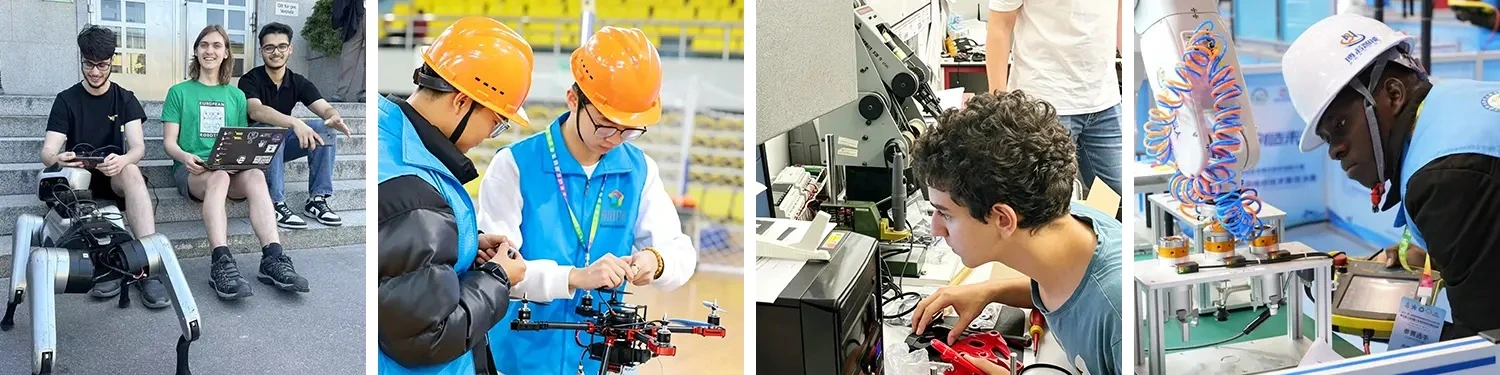
Company Strength
At ECR Academy, our Multi-Rotor Drone Assembly and Tuning program is built on 16 years of vocational education expertise and real-world application experience. We've empowered nearly 500,000 learners across 29 countries, with over 300,000 earning recognized certifications. Our approach combines rigorous technical standards with hands-on practice:
- We deliver project-based curriculum integrating theory with practical product operations
- Our network includes 3,300+ industry engineers and academic experts specializing in UAV systems
- We've organized 150+ skills competitions helping 30,000+ participants master drone assembly techniques
- Our comprehensive resource library features 60,000+ educational assets including technical standards and assessment systems
- We maintain partnerships with 500+ enterprises ensuring your training aligns with current industry demands
- Our integrated platform covers UAV selection, tuning protocols, maintenance procedures, and inspection workflows
You'll gain job-ready competencies in thrust-to-weight optimization, PID calibration, and electromagnetic compatibility—skills that match real industry requirements.

FAQ
Q: Can I take this course with zero background knowledge?
A: Yes. The course starts with basic UAV theory and adopts a progressive teaching model combining theoretical learning, virtual simulation, and hands-on training. The learning threshold is low, allowing even beginners with no prior experience to gradually master professional skills.
Q: What positions can I pursue after completing the training?
A: After completing the training, you will be qualified for the following positions:
- UAV Assembly, Debugging, and Maintenance Engineer
- UAV Inspection and Maintenance Technician
- UAV Industry Application Engineer
Q: How is the platform deployed?
A: The course adopts a combined virtual-physical learning approach. The virtual simulation platform supports computer-based simulation training, while the hands-on platform provides real equipment for practical experience. The platform supports flexible training schedules and blended online-offline learning, allowing flexible arrangement of practical training according to learning progress.

Contact Us
Ready to advance your Multi-Rotor Drone Assembly and Tuning expertise? Connect with ECR Academy today at ecr2008@enteredu.com to explore our training solutions.










_1781601799781.webp)