Mold Manufacturing Technology: Injection Molds vs. Stamping Dies
When professionals talk about mold manufacturing technology, they mean the technological field that includes the design, machining, assembly and quality inspection of precision equipment used to create complex parts at scale. In the field two types of primary tooling exist: injection moulds and stamping dies. Molten plastic is used in injection moulds to create finished items. Sheet metal stock is pressed and cut to exact forms by stamping dies. Knowing the difference between the two is the first step to making knowledgeable procurement and curriculum selections in precision manufacturing.
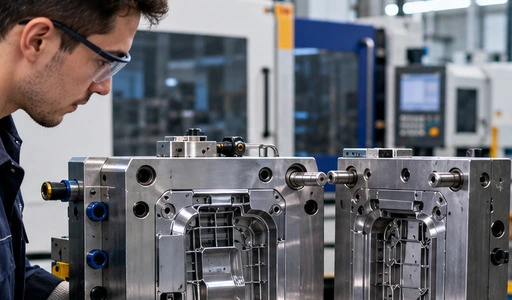
Understanding Injection Molds and Stamping Dies
What Is an Injection Mold?
Under high pressure, an injection mold takes in liquid thermoplastic or thermoset material, fills a perfectly machined cavity, and then lets go of a finished part when it's cool. Precision injection molding usually has tolerances of ±0.01mm for dimensions, and for optical-grade parts, the surface roughness can drop to Ra 0.05¼m. Industries like making medical devices, car interior trim, and housing for consumer electronics depend on injection molds to make complicated shapes that can't be stamped or machined one at a time.
What Is a Stamping Die?
A stamping die uses mechanical or hydraulic force on a metal sheet to cut, bend, or draw it into the desired shape at one or more moving stations. Stamping dies are usually made of tool steels like D2 or H13, which are hard after being heated and don't wear down easily (usually 58–62 HRC). Stamped goods include body panels for cars, electrical connectors, and brackets for appliances. Often, production runs go over one million rounds per die set.
Key Differences at a Glance
The material that is worked with is the clearest line between injection molds and stamping dies. Injection moulds are for plastics, stamping dies are for metals. This difference directly impacts cycle time, tooling cost and part geometry requirements. It helps procurement professionals and training program planners select the correct technology for each assignment.
Comparison of Mold Manufacturing Technologies: Injection Molding vs. Stamping
Cost and Tooling Investment
Tooling for mid-complexity plastic component injection moulds generally ranges from $15,000 to $100,000 USD depending on cavity count and steel grade. A progressive die for a similar metal bracket could cost $20,000 to $150,000. Both technologies involve high initial investment, which is why institutional training programs need to cover the entire cost of ownership, including maintenance schedules and replacement electrode expenses for EDM-finished cavities.
Production Scalability and Lead Time
Moulds designated as SPI Class 101 in mold manufacturing technology are rated for over one million cycles and are suitable for continuous high-volume plastic manufacture. With adequate maintenance stamping dies can meet or exceed that cycle life. Lead time from design to first item is typically four to twelve weeks for injection moulds and six to sixteen weeks for complex progressive stamping dies, depending on the number of EDM and CNC operations necessary.
Quality Management and Defect Control
Sink marks, flash and warpage are among the injection moulding problems handled by our scientific moulding studies, mould flow analysis and judicious gate position design. Stamping flaws such as springback, burr height and dimensional drift are controlled by process parameter adjustment, die clearance control and in-line inspection. Both technologies benefit from coordinate measuring machine (CMM) verification at the cavity and component level, a practice that is immediately incorporated into the quality inspection module of the ECR Academy’s training program.
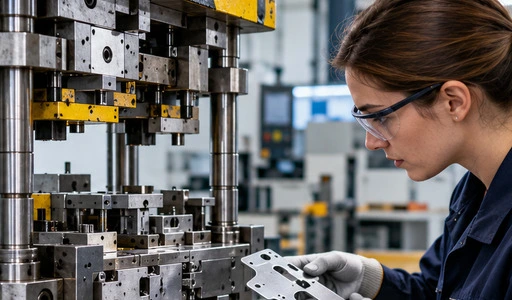
How to Choose the Right Mold Manufacturing Technology for Your Project
Defining Your Project Requirements
The first thing that the buyer should specify is the material of the part, the annual production quantity and the tightest tolerance requirement. Injection moulding is the best process to manufacture a plastic product with undercuts or thin walls that requires a Class A surface finish. If you have relatively flat metal parts that are going to be fabricated in huge quantities you can stamp them and save money on every part.
When to Choose Injection Molding vs. Stamping
Injection moulding is best for complex part shapes, thermoplastic or thermoset materials and good surface finish. Automotive sensor housings, medical syringe bodies and 3D gadget cases are manufactured with injection moulds. For metal clamps, Contact springs, and structural panels that need to be strong and have a low cost per piece, stamping dies are the best way to go.
Vendor and Supplier Evaluation Criteria
When looking for a mold manufacturing technology source, make sure that the company has ISO 9001 certification, can show you CMM inspection records from previous projects, and has CNC and EDM tools that can achieve ±0.005mm tolerances. When institutions are making training programs, they should be just as strict: make sure that the training provider's list of equipment and course content match the tolerance standards that their graduates will face on the job.
Advanced Mold Manufacturing Technology Insights and Solutions
Defect Analysis and Remediation
Fixing bugs in a planned way saves more money than trying things out and seeing what works. Mold flow modeling software can predict short shots and air traps in injection molds before the steel is cut. This cuts T1 sample rework by up to 40%, according to case data from big car suppliers that has been made public. Tier 1 automotive die shops now use finite element analysis of springback for stamping dies as part of the process planning process.
Advanced Materials and Machining Technologies
Tool steels like S136 (for non-rusting injection moulds) and powder metallurgy grades for high-wear stamping inserts are now making dies last far longer than the typical P20 or D2 in mold manufacturing technology. Directed energy deposition is a metal additive manufacturing process that allows the repair of damaged cavity parts without the need to replace the entire die. This reduces the maintenance cost in high cycle applications.
Training and Certification as Risk Mitigation
Putting money into structured training for mold technicians cuts down on scrap rates and unplanned downtime. The full-process mold manufacturing course from ECR Academy meets this need by dividing project-based learning into five separate training bases: disassembly and assembly of molds, CAD/CAM, CNC machining, electrical discharge machining, and assembly and commissioning. The staff is made up of professional teachers and business experts, and grads who meet the requirements get a certificate in vocational skills training that can help them get jobs right away in the medical, aerospace, automotive, and electronics mold industries.
Future Trends in Mold Manufacturing Technology
Digital Twins and Smart Mold Monitoring
Engineers can use digital twin technology to build a virtual twin of a physical mould and model wear, temperature distribution, and cycle behaviour before putting a design change into effect. Smart mould systems integrate sensors directly into the cavities to monitor pressure and temperature in real time, allowing predictive maintenance that lowers unscheduled stops by 20-35% in recorded industry installations.
Sustainability and Lean Manufacturing
Environmental pressure is forcing mould makers to adopt lean practices such as dry machining, minimum quantity lubrication and recyclable cooling fluids. Metal 3D printed conformal cooling channels reduced injection cycle times by 20–40%, resulting in direct savings in energy usage per part.
Automation and AI-Driven Process Control
The best mould shops are taking robotic part removal, automated inspection cells and AI-driven parameter optimisation out of experimental projects and into routine production. Training programs that fail to include these technologies run the danger of creating graduates who are ill-prepared for the workplaces they enter.
Conclusion
In the mold manufacturing technology, injection moulds and pressing tools are utilised for different types of materials, forms and sizes. Competitive precision producers select the correct tooling method and then train their personnel to work with confidence in either. This is what distinguishes them from those fighting scrap and downtime. What separates the grads who can read a drawing from the grads who can solve a production problem is a well-structured program that corresponds to an industry. This is true whether you are developing a national skills training foundation or accelerating the readiness of new hires at a precision mould firm.
FAQ
1. What factors most influence the choice between injection molding and stamping?
Part material is the primary driver. Plastic pieces enter injection moulds, metal sheet parts enter stamping dies. Secondary factors are part geometry complexity, necessary tolerances and production volume. Both processes can be cost-effective for volumes over 500,000 units per year, although the per-piece cost advantage of stamping increases with volume.
2. What is a realistic lead time for mold production?
For a mid-complexity injection mold, expect four to twelve weeks from design sign-off to T1 sample. A progressive stamping die with multiple forming stations may require eight to sixteen weeks. These timelines assume access to CNC machining, EDM, and CMM inspection, all of which are part of ECR Academy's training platform.
3. Where does 3D printing fit in mold manufacturing?
Additive manufacturing currently serves two roles: producing prototype tooling for low-volume validation runs, and repairing worn mold sections through directed energy deposition. It does not yet replace conventional CNC and EDM for high-cycle production tooling, but it is a skill increasingly expected of precision mold technicians.
Connect With E.C.R Academy for Expert Mold Manufacturing Training
Since 2010, E.C.R. Academy has helped almost 500,000 people in 28 countries. Our mold manufacturing technology course covers the whole production process, from reading structures and writing CAD/CAM to CNC machining, EDM, and quality control. Our certificates are accepted by partners in the aerospace, medical, automobile, and medical technology industries. Businesses, schools, and trade groups are all welcome to get in touch. To ask for a program review, email us at ecr2008@enteredu.com or go to enteredu.com.
References
1. Rosato, D. V., & Rosato, M. G. Injection Molding Handbook. Springer, 2012.
2. Boljanovic, V. Sheet Metal Forming Processes and Die Design. Industrial Press, 2004.
3. Society of the Plastics Industry (SPI). Mold Classification and Standards. Plastics Industry Association, 2019.
4. Kalpakjian, S., & Schmid, S. R. Manufacturing Engineering and Technology. Pearson, 2014.
5. China Die & Mould Industry Association. Annual Report on China's Mould Industry Development. CDMIA, 2023.
6. Groover, M. P. Fundamentals of Modern Manufacturing: Materials, Processes, and Systems. Wiley, 2020.