Industrial Robot Programming Course: Learn Programming Step by Step
Industrial Robot Programming Courses offer systematic pathways to master automation technologies step by step, covering essential skills in teach pendant operation, offline simulation, and system integration. Industrial Robotics Technology drives modern manufacturing transformation by integrating mechanical precision, electronic control, and software intelligence to automate complex production tasks. Mastering robot programming unlocks opportunities across automotive assembly, electronics manufacturing, and intelligent logistics, where precision and efficiency define competitive advantage.
Understanding Industrial Robotics Technology and Programming Fundamentals
Core Robot Types in Industrial Applications
Articulated robots are the most common type used for welding and painting because they can move in complicated ways around irregular workpieces thanks to their six-axis freedom. SCARA robots are great at picking up and placing parts quickly in electronics assembly, where millisecond cycle times have a direct effect on output. Cartesian robots are very good at precisely placing themselves for tasks like tending to CNC machines and dispensing things precisely. Delta robots can pick up more than 150 items per minute and quickly package them in food processing areas. By knowing about these setups, procurement teams can better match robot layouts to specific production needs, making sure that automation investments give the best return on investment.
Programming Methods and Control Interfaces
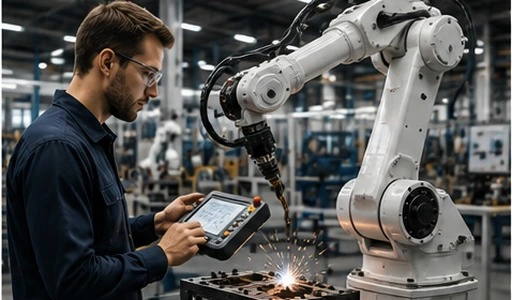
Because operators may physically assign and record waypoints on tiny devices, teach pendant programming is currently the simplest technique to learn robot control. Engineers may create complex virtual motion sequences utilizing offline programming tools like RobotStudio and Tecnomatix. Production downtime during software development is reduced. These simulation tools can discover collisions and optimize cycle speeds before launch. More sophisticated integrators use script-based programming using proprietary languages like RAPID or KRL. This allows more exact motion parameter and sensor integration control. Graphical and text-based computers allow multi-skilled expert teams to collaborate.
Strategic Value for Procurement Professionals
When buying automation, it's important to know the total cost of ownership, which includes more than just the original equipment costs. The ability of robots to program has a direct effect on deployment times and the ability to change how operations work when product lines do. Industry standards say that project costs can be cut by 30–40% when companies have their own programmers instead of hiring outside integrators. Being able to re-program current robots to do new jobs increases the useful life of equipment. This is especially important for mid-volume manufacturers whose products change often. Long-term operational agility is ensured by looking at vendor training programs and software ecosystems during procurement.
Step-by-Step Guide to Industrial Robot Programming
Establishing Kinematic Foundations
Robot kinematics describes how joint actions are turned into movement of the tool center point in three dimensions. To write correct motion commands, programmers need to know about base, tool, and work object frames and how they change coordinate frames. Learning forward and backward kinematics is important for accurate positioning calculations, especially when adding extras like conveyor belts or spinning tables. Manual running and keeping track of your position are useful tasks that improve the spatial thinking needed for complicated path planning. Common programming mistakes that cost a lot of money to fix are avoided by having this basic knowledge.
Writing and Debugging Basic Programs
The first computer lessons in Industrial Robotics Technology are mostly simple pick-and-place tasks that use commands for both linear and joint movements. Programmers learn syntax structures that let them define positions, set speed limits, and turn on digital outputs that control things like grippers and welding torches. Step-by-step execution modes and position verification routines are used in debugging to make sure the program is correct before it runs at full speed. Learning how to control the flow of a program using if statements and loops lets you make actions that change to sensor inputs. By working on projects that get harder over time, from easy tasks like moving materials to complex assembly sequences, you build the problem-solving mindset that is needed for industrial settings.
Simulation and Virtual Commissioning
Offline programming environments use CAD-accurate models to make virtual workcells that let you create programs without having to use production tools. After engineers load 3D models of the parts and tools they need to work on, they program the robot to move while the software checks for collisions and limits on its reach. Virtual commissioning adds PLC logic and sensor behaviors to simulations, which lets the whole system be tested before the hardware is installed. This method cuts the time needed to set up robotics on-site by 50–70%, which is especially helpful when adding robots to production lines that already have limited downtime. Procurement teams should put a high priority on training programs that include modeling skills, as these skills greatly lower the risk of a project.
Advanced Integration Techniques
Path optimization algorithms find the fastest routes between set waypoints while staying within acceleration limits and avoiding singularities. This cuts down on cycle times. Adding sensors makes it possible for robots to change their paths of motion based on real-time camera feedback that finds differences in parts. This is called vision-guided positioning. Fieldbus communication methods, such as PROFINET or EtherNet/IP, let robots work with upstream machining centers, quality inspection stations, and elevators to organize their actions. When humans and robots work together, safety-rated tracking makes sure that joint operations meet ISO 10218 standards. With these advanced features, robots go from being separate machines to being smart parts of manufacturing systems that are all connected.
Industrial Robotics Programming Applications Across Industries
Automotive Manufacturing Applications
Up to eight robots can work together in coordinated multi-robot programs to do spot welds on vehicle frames at the same time in body welding cells. Programming these systems means keeping track of complicated sequences to avoid crashes and get the most work done. Using special elliptical path commands, paint application programming finds a balance between making sure the film thickness is the same all over and cutting down on cycle time. Powertrain assembly uses force-torque sensing to make sure that parts are properly mated while the engine block is being put together. The high-volume, low-mix production model used in the auto industry means that a lot of money needs to be spent on offline programming. For example, simulation engineers work on programs for months before they go into production. For this type of work, you need programmers who are good at managing large libraries of programs and version control systems.
Electronics and Consumer Goods
For high-speed component placement in circuit board assembly, repeatability of less than a millimeter and fast acceleration between pick points are needed. Programming is all about making the best motion sequences so that there is as little air time as possible while still maintaining gentle acceleration profiles that keep parts from breaking. More and more, collaborative robots are doing final assembly jobs like driving screws and applying glue. To make sure operators are safe, programmers have to set up parameters for tracking speed and force. High-mix, medium-volume production in the electronics industry works best with modular code, which lets workers quickly change recipes to make new versions of products. Training programs for this industry should focus on teaching people how to handle recipes and switch things up quickly.
Material Handling and Logistics
Pattern generation software is used in palletizing apps. This is where programmers set up the layer configurations and the system figures out each person's pick-and-place spot automatically. Machine tending programs work with CNC machining processes to keep an eye on production state thru I/O data and change based on queue management logic. Combining 3D vision with AI-driven grasp planning to handle randomly arranged parts—tasks that used to require human dexterity—bin picking is the cutting edge of programming. The logistics industry values flexible scheduling that lets workers be quickly redeployed when building plans change or when seasonal product mixes change.
Emerging Trends and Future Prospects in Industrial Robot Programming
Artificial Intelligence Integration
Based on motor current signatures, machine learning algorithms now look at past motion data to suggest ways to shorten cycle times and guess when maintenance is needed. Computer vision models that have been trained on thousands of part images can reliably recognize objects in a range of lighting conditions without the need for explicit feature code. Thru trial-and-error modeling, reinforcement learning lets robots get better at difficult tasks like cable routing, finding ways to do things that human coders might miss. AI makes things possible, but it also requires new skills. For example, coders need to know how to check the quality of training data and validate models. Teams in charge of buying things should check to see if the companies that train people cover these new skills along with the basics of programming.
Cloud-Based Programming Environments
Cloud platforms let various engineers working in Industrial Robotics Technology collaborate to improve different parts of a cell at the same time, and version control keeps them from clashing. Simulation tasks are sent to cloud computing resources, which lets them do complicated math like collision checking and optimization that would not be doable on local computers. Over-the-air program updates let factory fleets get new motion routines without having a technician visit the site. This is especially helpful for operations that are spread out geographically. When looking at cloud-connected robotics architectures, security concerns like protecting intellectual property and making sure the network is reliable are still very important.
Digital Twin and Virtual Commissioning
Digital twin technology makes permanent virtual copies of real production cells that are always in sync with each other thanks to sensor data streams. Engineers try changes to the program in the digital twin to see how they affect performance before putting the changes into real equipment. This feature lets you do predictive "what-if" analysis, which means you can test how production will react to sudden increases in demand or broken equipment. Virtual commissioning speeds up projects by letting real installation and program development happen at the same time. This way, final integration only needs to be validated, not fully debugged. When compared to traditional sequential approaches, organizations that use digital twin workflows say that commissioning takes 40 to 60 percent less time.
Choosing the Right Industrial Robot Programming Course and Supplier
Course Structure and Delivery Models
Robot programming courses that work well combine theoretical concepts with hands-on practice using software and hardware that are standard in the industry. The Industrial Robotics Technology school at E.C.R. Academy is a good example of this integration because it uses project-based learning and virtual modeling tools that look and feel like real production settings. The lessons go from basic teach pendant operation to advanced system integration and predictive maintenance, covering all the steps an automation engineer might take to become a professional. When enterprise engineers and academic experts teach together, the material is relevant to current business practices while still keeping the highest standards of teaching. This mixed method helps students learn both technical skills and ways to solve problems that can be used with different robot brands and in different types of applications.
Flexible delivery fits a range of learning situations. Teams can get better at using their specific production equipment thru on-site training programs, but this method conflicts with production plans for equipment access. Dedicated training sites with a variety of robot brands allow for comparative learning, which helps engineers understand how computing ideas can be used on different platforms, even if the syntax is different. Virtual simulation platforms make expensive equipment more accessible to more people. They let learners practice complex scenarios, such as intentionally creating faults for troubleshooting practice, without affecting production or putting people's safety at risk. Companies should judge training providers by how advanced their platforms are and how many robot brands they support, especially if they work in production environments with robots from more than one vendor.
Certification Credibility and Industry Recognition
Professional certifications show employers and clients that you have the skills they want, which sets trained workers apart in competitive job markets. Manufacturer-specific certifications from ABB, FANUC, KUKA, and Yaskawa show that you have the platform knowledge that is needed to service your own equipment. Industry-neutral certifications from groups like the Robotic Industries Association (RIA) show that skills can be used with any brand. The school at E.C.R. Academy is in line with the standards for intelligent manufacturing, and it prepares students for jobs in technical support, system integration engineering, and automation testing. When reviewing training providers, procurement teams should make sure that the certifications are in line with area workforce development programs and hiring tastes in the industry.
Evaluating Training Providers and Support Services
Complete training partnerships go beyond teaching the initial course. They also provide technical assistance and curriculum updates to stay up with technology. E.C.R Academy's 500+ company connections and 150+ skills challenges prove that equipment partnerships and competition organization keep training material current. Large collections of code examples, debugging hints, and application case studies accelerate learning outside of classroom. Companies should evaluate service stability and consumer satisfaction. After 16 years, E.C.R. Academy has aided 500,000 students in 28 countries. They may keep doing what they do and reach people worldwide.
Beside per-seat costs, the total value of the learning ecosystem must be taken into account when evaluating a training investment. When compared to putting together courses from different providers, E.C.R Academy's seven-module platform design makes it easier to coordinate because it supports progressive skill development from basic operation to intelligent upkeep. Virtual simulations let you keep practicing your skills without having to pay for ongoing access to equipment. This is especially helpful for keeping your skills up during production periods when training windows are limited. Flexible licensing models that allow large institutional enrollments or integrator white-label delivery cover a wide range of purchase situations, from vocational schools to systems integrators who build training into customer solutions.
Conclusion
Automation value is unlocked across manufacturing sectors with skilled labor shortages and quality consistency demands by mastering Industrial Robotics Technology through structured programming education. From basic teach pendant operation to advanced digital twin integration, step-by-step learning paths build skills that meet industry certification standards and job expectations. The fact that programming skills can be used in different fields, like automotive, electronics, and logistics, shows how flexible programming skills are and how many career paths there are. New technologies like AI-enabled adaptive control and cloud-based joint development are changing the way people program, and professional teams need to make a commitment to learning all the time. By choosing training partners with a broad curriculum, legitimate certification alignment, and ongoing industry involvement, companies can be sure that their investments in automation will lead to improved business capability and a competitive edge.
FAQ
1. What prerequisites are needed to start learning industrial robot programming?
Basic understanding of mechanics, electricity, and how computers work is helpful, but comprehensive classes are also good for beginners because they build on what you already know. Knowledge of coordinate geometry and the ability to think logically, which can be gained thru technical education, helps people understand things more quickly. Most importantly, being ready to do iterative writing and troubleshooting builds skills that go beyond what you learn in the classroom.
2. How long does it typically take to become proficient in robot programming?
It takes between 40 and 80 training hours to become basic operationally proficient in using teach pendants to do simple pick-and-place jobs. This depends on how much technical knowledge the person already has. Most people need between 120 and 200 hours of structured learning and practice to reach intermediate levels. This includes skills like offline programming and sensor integration. Over 300 to 500 hours of real-world project experience and advanced system integration skills that cover multi-robot coordination and predictive maintenance become clear. Throughout a job in robotics engineering, it is important to keep learning because technology changes and applications become more complicated.
3. Can programming skills transfer between different robot brands?
Core computing ideas, like coordinate systems, motion types, and program flow control, are the same across all makers, even tho the syntax may be different. For basic tasks, programmers who are familiar with one brand can usually learn how to use other platforms within days. However, they need to put in a lot of time and effort to learn how to use brand-specific advanced features. Cross-platform adaptation goes faster when training focuses on basic ideas instead of remembering specific orders. Organizations that run facilities for more than one brand benefit from general training followed by modules that are specific to the platform.
Partner with E.C.R Academy for Comprehensive Industrial Robotics Technology Training
E.C.R. Academy offers full turnkey solutions for makers, integrators, and educational institutions that want to improve their automation skills. Our Industrial Robotics Technology curriculum is one of a kind because it blends project-based learning with virtual simulation tools that let students learn by doing without always having to access real equipment. The seven-module integrated platform covers everything from the basics of robot programming to intelligent operation and maintenance. It prepares students for a wide range of jobs, such as system integration engineering, automation commissioning, and technical sales support. Enterprise engineers and academic experts teach together to make sure that the material is relevant to current business practices.
Our flexible engagement models allow for academic licensing, custom content development, and OEM white-label delivery, which is good for companies looking for Industrial Robotics Technology training provider partnerships. For 16 years, we've helped over 500,000 learners around the world and kept up more than 500 business relationships. This means we can help you with your automation journey and are confident in our abilities. Get in touch with our team at ecr2008@enteredu.com to talk about how our complete training ecosystem can help you speed up the transition to smart manufacturing and the development of your workforce's skills. You can look at detailed program frameworks and plan platform demos that are tailored to your specific technology needs by going to enteredu.com.
References
1. International Federation of Robotics. (2023). World Robotics 2023: Industrial Robots Report. IFR Statistical Department.
2. Robotics Industries Association. (2024). Certified Robot Integrator Program Standards and Guidelines. RIA Education Foundation.
3. Society of Manufacturing Engineers. (2023). Advanced Manufacturing Skills Standards: Industrial Automation Competency Framework. SME Publications.
4. National Institute of Standards and Technology. (2024). Digital Twin Framework for Smart Manufacturing Systems. NIST Advanced Manufacturing Series.
5. Association for Advancing Automation. (2023). State of the Automation Workforce: Skills Gap Analysis and Training Recommendations. A3 Research Division.
6. IEEE Robotics and Automation Society. (2024). Programming Methods for Industrial Collaborative Robots: Safety and Efficiency Considerations. IEEE Standards Association.


_1781601799781.webp)