How Virtual Reality Digital Content Creation Is Reshaping Industries
Virtual reality digital content creation is fundamentally changing how industries communicate, train, and engage audiences. From corporate showrooms to museum exhibitions, immersive digital experiences now deliver depth and interactivity that flat media simply cannot replicate. Organizations across education, culture, and commerce are actively investing in spatial content workflows — not as an experiment, but as a strategic capability. Understanding how this shift works, and where structured training fits in, is essential for any institution or enterprise serious about staying relevant in today's experience-driven economy.
Understanding Virtual Reality Digital Content Creation
What Does Immersive Content Development Actually Involve?
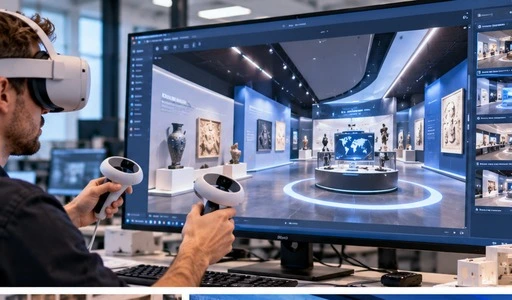
At its core, Virtual Reality Digital Content Creation is a process that combines 3D space design, interactive logic, multimedia integration, and deployment engineering into a single production workflow. VR content, on the other hand, puts the viewer inside the experience; they move around, talk to others, and respond. This needs a different set of skills than making websites or videos.
For procurement professionals and program directors evaluating training partnerships, the pipeline typically spans concept planning, scene construction, interaction design, multimedia embedding, and cross-device optimization. At each stage, you need to be very good at both technical details and curatorial thinking, which means you need to know not only how to set up a scene but also why a visitor should move through it in a certain way.
PwC's 2023 Extended Reality Report says that VR-based learning settings help people remember things up to 75% better than regular classrooms. That number alone shows why trade schools and business training departments are putting more money into interactive media features.
Comparing Leading VR Content Creation Tools and Software
Choosing the Right Platform for Your Team
There are a lot of tools available for making immersive content. The best one for your team will depend on their technical skills and production goals.
Unity and Unreal Engine are still the best real-time rendering engines for high-fidelity VR environments, especially when it comes to building complex interactive experiences. Both, though, have steep learning curves and need hardware investments in the area. Autodesk tools are great for high-precision 3D modeling for architecture and product visualization, while Adobe Substance 3D is great for creating textures and materials.
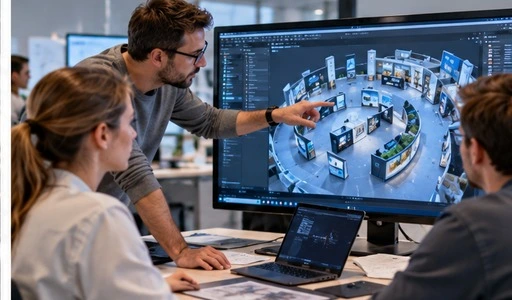
Browser-based platforms are a great option for large organizations that run VR programs but don't have their own dedicated IT infrastructure. The Veryengine Digital Exhibition Hall Development Platform is at the heart of ECR Academy's lessons. It is a Veryengine Digital Exhibition Hall Development Platform, a zero-code and low-code environment made just for virtual exhibition development. Learners can use a browser to directly connect to the platform, without having to install any software. This dramatically reduces hardware dependencies and allows institutions to onboard students faster without costly lab setups.
Veryengine comes with an interactive component library, a visual scene editor, and exhibition templates that are ready for use in the real world. Learners can use these tools to create virtual worlds, set up multimedia interactions, and test their projects on a variety of devices, all from a single cloud-rendered workspace.
Overcoming Challenges in VR Digital Content Development
Why Most Programs Struggle — and How to Fix It
The most persistent barrier in VR education is not technology — it is the gap between what students learn and what they can actually produce. Many programs teach software theory without grounding it in real project workflows. Students graduate able to navigate an interface but unable to deliver a finished, deployable experience.
Here are the core challenges that program directors and training managers consistently face:
- Rapid technology turnover forces curriculum updates every 12–18 months, making it difficult to maintain course relevance without strong industry connections.
- Faculty shortages in virtual media mean most institutions depend on educators who learned VR tools academically, not professionally.
- Portfolio gaps remain the top cause of bad graduate job outcomes in digital media studies.
These challenges are solvable — but only with a curriculum architecture that prioritizes real production output over theoretical coverage. ECR Academy addresses this directly by embedding eight skill modules into a project-based sequence, from exhibition planning and spatial design to user experience testing and platform deployment. Every module culminates in a deliverable, not just a quiz.
Faculty comes from both academic and industry backgrounds, bringing real project experience into the classroom. This combination ensures that learners understand not only the technical workflow, but also the client expectations and delivery standards that define professional practice.
How VR Digital Content Creation Is Transforming Key Industries
Real Applications Driving Real Investment
Immersive content creation is no longer confined to games or entertainment. Across industries, organizations are deploying virtual exhibition and spatial experience technology to solve concrete operational and communication challenges.
Cultural institutions use virtual exhibition tools to spread physical museum access abroad. Museums and heritage sites now offer browser-accessible 3D walkthroughs that allow visitors to explore collections without geographic constraints. The Smithsonian Institution, for example, has invested significantly in digitizing and presenting collections through immersive online environments.
Corporate training departments harness spatial learning settings to onboard workers faster and keep routine knowledge more effectively. A 2022 study by the Journal of Applied Learning and Teaching found that immersive scenario-based training reduced onboarding time by an average of 30% across manufacturing and logistics sectors.
In education, science centers and university programs are building interactive exhibition material to supplement classroom teaching. Learners connect with spatial content as both users and makers — a dual role that builds both technical fluency and curatorial judgment.
Commercial applications include virtual showrooms, product launch environments, and brand experience centers — all areas where the demand for skilled Virtual Reality Digital Content Creation specialists is growing faster than the talent pipeline can currently supply.
Future Trends and Strategic Insights in VR Content Creation
Where the Industry Is Heading Next
AI-assisted content generation is beginning to reshape production timelines. Scene construction requires less work to be done by hand thanks to procedural environment building, automated asset optimization, and smart interaction logic. This doesn't get rid of the need for skilled makers, but it does raise the bar for what a finished experience should be like.
Cloud-based deployment and compatibility with multiple devices are quickly becoming must-haves for buyers. Companies no longer want experiences that need special headsets or high-end hardware on-site. VR material that is rendered in a browser and hosted in the cloud is where the market is going, and Veryengine is built around this approach.
For businesses and institutions that are investing in training programs right now, the most important thing is to build teams that can make immersive experiences that can be sold right away. Certifications that are in line with international standards for professional skills send a strong message to both companies and clients.
Conclusion
In every field that works with virtual exhibitions, spatial media, or making interactive content, the need for immersive digital experience talent is higher than the supply. Businesses and institutions that put money into organized, project-based training now will be able to meet that demand with grads and teams that can do the work. In order to bridge the gap between learning and output, ECR Academy's Virtual Reality Digital Content Creation program combines skilled teachers, industry-aligned curriculum, and a browser platform that requires no download.
FAQ
1. What is the difference between a digital exhibition hall and a regular website?
Digital display rooms put an emphasis on spatial navigation, engaging stories, and guest engagement over browsing for information. People move through a three-dimensional space and interact with shows instead of reading flat pages. The feeling is more like going to a real gallery than a web session.
2. Does this course require an art background?
There is no need for background in the past work. The curriculum includes basic concepts of style and esthetics as part of the learning process. The Veryengine platform has templates and pre-built assets that teach users how to make exhibitions that look like they were made by professionals right from the start.
3. What industries use digital exhibition technology?
Cultural heritage centers, corporate brand showrooms, science and education centers, cultural tourist experiences, business product launches, and personal portfolio presentations are all places where this technology can be used. Virtual show skills are very useful in many fields because they can be used in so many situations.
4. How does the browser-based platform reduce institutional barriers?
Because Veryengine only works in a browser, schools don't have to spend money on specialized hardware labs or deal with complicated software licensing. Learners can work on, test, and share projects from any device that can connect to the internet. This makes the program flexible for both on-campus and off-campus settings.
Partner with ECR Academy for Virtual Reality Digital Content Creation Training
ECR Academy has been teaching business skills for 16 years and brings that knowledge to every partnership. We are a trusted provider of Virtual Reality Digital Content Creation for businesses, schools, and industry groups. We offer a full training package that includes a project-based curriculum, international standards alignment, faculty with experience in the field, and the Veryengine browser platform.
Whether you are upgrading a digital media program or building an internal immersive media team, we are ready to support your goals. Reach out to us at ecr2008@enteredu.com or visit enteredu.com to explore partnership options and request a program consultation.
References
1. PricewaterhouseCoopers. Seeing Is Believing: How VR and AR Will Transform Business and the Economy. PwC, 2023.
2. Radianti, J., Majchrzak, T. A., Fromm, J., & Wohlgenannt, I. "A Systematic Review of Immersive Virtual Reality Applications for Higher Education." Computers & Education, 2020.
3. Bailenson, J. N. Experience on Demand: What Virtual Reality Is, How It Works, and What It Can Do. W. W. Norton & Company, 2018.
4. Merchant, Z., Goetz, E. T., Cifuentes, L., Keeney-Kennicutt, W., & Davis, T. J. "Effectiveness of Virtual Reality-Based Instruction on Students' Learning Outcomes in K-12 and Higher Education." Computers & Education, 2014.
5. Dede, C. "Immersive Interfaces for Engagement and Learning." Science, 2009.
6. Tom Caudell & David Mizell. "Augmented Reality: An Application of Heads-Up Display Technology to Manual Manufacturing Processes." Proceedings of the Hawaii International Conference on System Sciences, 1992.

_1781601799781.webp)