Can Digital Design and Simulation for Smart Production Lines Improve Factory Efficiency?
Yes, it can. Digital design and simulation for smart production lines allows engineers to develop and test a line on screen before buying or installing equipment. They can discover slow stations, confirm robot reach, test PLC logic and compare layouts in a no-risk environment. That work eliminates re-work, shortens start-up and lowers surprise down time. But the rewards are not assured. They need solid data, good models, and trained people. In this essay I will describe how this strategy works, where it pays off, how it compares with physical trials and how to get started without squandering funds.
Understanding Digital Design and Simulation in Smart Production Lines
What Digital Design Covers
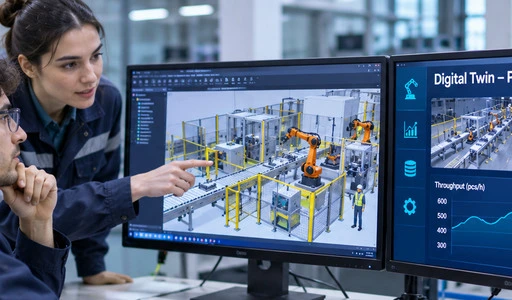
Smart production lines: digital design and simulation enables engineers to develop a production line on a computer screen before they even build a machine. They model equipment, fixtures, conveyors and operator areas in 3-D. The models also indicate where people need to be and which station will work initially. These models are initiated with CAD data and vendor equipment libraries. All modifications to the plan will be noticed everywhere as everything is in a single common file set. This manner allows teams to catch space and path problems early, rather than on delivery day.
How Simulation and Digital Twins Work
When you make a simulation of something, the model behaves in a certain manner. It keeps a record throughout time of the interactions between parts, tools and people, identifying where people are waiting and where stations are unoccupied. Robot models can also be used for collision and reach checking. A digital twin takes this one step further and stays connected to the physical system through data, commonly via OPC UA standards. The ISO 23247 series describes the operation of digital twins in production. It was published in 2021. Michael Grieves originated the twin concept in the early 2000s. It's not only about viewing objects in 3D. Logic and facts are applied to solve "what if" issues.
Software Platforms Teams Use Today
This software is sold by several firms. Siemens has Tecnomatix tools like Plant Simulation and Process Simulate. DELMIA is a digital production tool from Dassault Systèmes. PTC, Autodesk and Ansys provide tools for product data, factory layout and physics-based data. Many products operate in the cloud or on local servers and can hook up to current CAD, PLC and MES systems. As you look at choices ask whether the gear you have works with it, if it imports your CAD files, how it interfaces to your controls and if your personnel can learn it in a reasonable period.
Key Benefits of Digital Design and Simulation for Factory Efficiency
Fewer Bottlenecks and Less Downtime
Digital design and simulation for smart production lines shows you which station is slow before you build it. A slow station can make or break the performance of a queue. In Overall Equipment Effectiveness (OEE) there is often a hidden bottleneck that limits availability, speed and quality. Run the queue virtually, then play with different buffer sizes, station numbers and shift patterns to find the structure that keeps parts flowing. Teams can try product changeovers. Idle time on a robot of two seconds every cycle costs around 5.5 hours over 10,000 cycles, therefore simulations can help find these losses early.
Faster Commissioning Through Virtual Testing
Virtual commissioning enables the robot and PLC code to be tested on a computer model before the actual machines are delivered. In hardware-in-the-loop setups you can run a genuine controller against a simulated line. Logic problems, signal errors or interlock errors appear on a computer, not on the work floor. Depending on the quality of the model and the size of the project, typically 30-40% of the physical commissioning time is eliminated. If a machine is late by one day, that can mean a day of lost work and a technician tied up, so even a small reduction in commissioning time makes a difference. Testing is safer, because if there is a crash in the simulation, nothing gets broken.
Lower Waste and Smarter Maintenance Planning
Digital models eliminate the need for some test runs and physical samples, resulting in less waste, test materials and extra work. They also help in maintenance planning. By connecting a twin to live machine data you may confirm that it performs as planned and catch drift before a break. You may give the program reliability numbers like MTBF, MTTR and planners can observe the effect of failures on output. No assumptions, just numbers behind the strategy. Fewer production surprises means fewer design defects on the floor, which cuts capital and operating spending.
Comparing Digital Simulation with Traditional Physical Production Line Methods
Speed, Cost, and Flexibility
Physical prototyping means building real hardware to test an idea. This can take weeks or months and cost a lot of cash. If the arrangement is not working you have to shift machines, reconnect panels and lose production time. But in digital design and simulation for smart manufacturing lines, you may perform the same test in hours or days, and repeat it with varied inputs as many times as you like. You simply change the model to alter things like conveyor length or robot position. Still, physical testing will be needed for ultimate clearance with real equipment, but the idea is to get fewer, better-prepared designs to the floor.
Accuracy Limits and the Digital Twin Question
Engineers and academics are often comparing a prototype to the actual system. Its accuracy depends on the quality of the data and assumptions used to build it. Kinematic limits, cycle times and PLC behaviour must be representative of the genuine machine. Teams check and validate this by testing controller logic in hardware-in-the-loop settings and comparing simulation findings to historical production data. VDI 3633 is a guideline describing the usage of models for transportation and production. If the model does not perform these checks, it may be wrong. It’s good practice to validate the model against a real machine, and that’s why a combination of virtual and real-world training is beneficial.
Costs, Training, and Tool Selection
Simulator tools are expensive and need time to understand. It may take projects a little longer initially, because teams need to build models and collect data. When selecting tools, you need to consider your budget, how easy they are to use, how they connect to PLC and MES systems, and if you can add more stations or lines later on. Many sellers may let you pay in instalments over time. And don't forget the cost of training. A powerful instrument in the hands of an untrained individual will not be successful while a modest tool utilised by a skilled person can pay off rapidly. The skills budget should be designed in line with the software budget.
Real-World Applications of Smart Production Line Simulation
Automotive Body Assembly: Robot Reach and Collisions
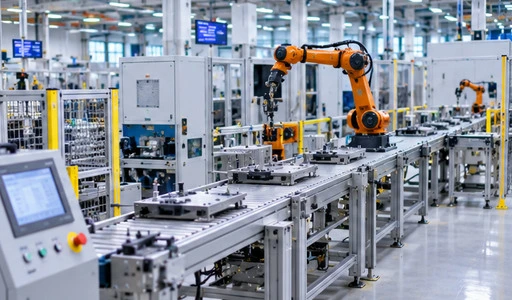
Many welding robots are clustered in body-in-white lines. Engineers develop smart manufacturing lines by applying digital design and simulation before creating the cell to ensure that every robot can reach, avoid collisions and remain away from others. Siemens and Dassault Systèmes both provide planning tools for this robotic procedure. The scenario shows programmers if two robot routes meet at the wrong time so they can fix tracks or timing. It’s cheaper to fix this on screen than to fix broken equipment. The team can also schedule robot paths using off-line programming while the cell is being built.
Electronics Plants with Frequent Changeovers
In a high mix/low volume electronics firm there are always new goods, sometimes daily. Planners employ simulations to test potential AGV routes, station loads and buffer sizes. Teams without a model prefer to size their buffers by gut feel, and only find the faults during production. It allows them to test several situations and evaluate how different layouts function with change. They do the same thing to see if a new item will make a station too busy. This can be tested by large and small makers utilising cloud-based technologies without the hire of numerous engineers.
Pharmaceutical Packaging and Other Regulated Lines
Regulated industries have very strict rules that slow things down. Simulations are useful because they allow you to test cycle speeds and handling stages for quick secondary packing lines in pharmaceutical packaging without physical risk through digital design and simulation for smart production lines. Formal validation is still required for regulated processes. This makes it easier to deal with layout and flow issues before formal validation begins. So a better design provides a stronger starting point for formal validation. Aerospace firms employ similar techniques to organise resources and guarantee designs fit. It always costs less to change an idea if the team tries it out fast.
Practical Steps for Implementing Digital Design and Simulation in Smart Production
Start with an Assessment and a Pilot
Start with a known line or cell or problem. Write your goals down, e.g., reduce starting errors, reduce changeover times. Get the CAD files, cycle time goals, reliability info, and process rules. Build a little model, then check it with real production figures. Fill in the blanks before you move on. Run a small test to verify the value of the approach and identify what data or skills are missing before a major deployment. Once the pilot works in reality, the method should be applied to other lines.
Protect Plant Data and Check Licensing
Simulation models contain exclusive knowledge of how a process operates. Sign a non-disclosure agreement and set explicit rules about how the data will be handled before you give it to a training partner. Use masked or simplified data when possible. Ask each provider about information security practices including recognised standards such as ISO 27001. Also, check the software licenses to see if they permit instructional or corporate use and who is permitted to use them. Bring these questions to the initial meeting with E.C.R. Academy so that we can discuss your needs prior to starting a project.
Build Team Skills with a Hands-On Course
Tools are only valuable if people know how to utilise them. In the course of "Digital Design and Simulation for Smart Production Lines", we employ AI+ Smart Production Line Digital Technology Application Training System. We can educate you how to build production lines, PLC Siemens TIA Portal programming, instruct robots with a pendant, offline programming, AI visual recognition, voice interaction, MES setup and network DNC programming. Students create a digital twin and connect it to tools in the real world. The platform allows you to learn anywhere, online or offline, without complicated software. Business and education teachers co-teach according to technical criteria. We support businesses, schools and trade associations. Since 2010, we have trained nearly half a million people in China and 28 other countries.
Track KPIs After Launch
From the beginning, monitor return on investment, downtime, flow, switching time and first-pass yield. Look at the baseline -- before the project -- and compare to the results. Review them on a monthly basis and update the model when equipment or items change. Sharing findings with builders and engineers shows them the value. When people perceive their own improvement, they are more likely to keep the model up-to-date. These reviews tell us what worked and what didn’t.
Conclusion
Digital design and simulation for smart production lines can improve the performance of plants, as long as they build reliable models, validate them against real data, and train workers to use them. Virtual models help identify sluggish spots, decrease starting risk, minimise waste, and plan maintenance. Software needs to be verified, and competent users employed, but simulations are quicker and cheaper to amend than physical testing alone. In automotive assembly, electronics, and pharmaceutical packaging, the earlier testing is done, the cheaper it is to make changes. A rollout needs a test, data protection, and explicit KPIs. Structured training with practice online and offline is as crucial as the software because it is people who decide how well tools perform.
FAQ
1. Does simulation replace physical testing?
No. It decreases the amount of real testing needed. But you still need final equipment for final clearance. Try out the idea in a simulation and then see how it works in real life.
2. Do I need programming experience for your course?
No. The training begins with introductory packages on basic equipment operation, fundamentals of digital twins and AI. It also discusses project practice in Python, C#, and other languages.
3. How is the training platform deployed?
It allows online and offline learning without the need for installing sophisticated software.
4. What data do I need to start a simulation project?
You need CAD files of your assets, targets for cycle time, reliability statistics like MTBF and MTTR, and process flow logic.
Talk to E.C.R Academy About Digital Design and Simulation for Smart Production Lines
Is your team prepared to build smart manufacturing skills? E.C.R. Academy trains companies, schools and industry organisations on digital design and simulation for smart production lines. Tell us your goals and team size before you choose a supplier. Email ecr2008@enteredu.com or visit enteredu.com for specifics and we will send you a training plan.
References
1. ISO 23247-1: Automation Systems and Integration, Digital Twin for Manufacturing, Overview and General Principles, 2021
2. VDI 3633 Part 1: Simulation of Systems in Materials Handling, Logistics and Production, Fundamentals, 2014
3. Grieves, M., and Vickers, J., "Digital Twin: Mitigating Unpredictable, Undesirable Emergent Behavior in Complex Systems," Transdisciplinary Perspectives on Complex Systems, 2017
4. Tao, F., et al., "Digital Twin-Driven Product Design, Manufacturing and Service with Big Data," The International Journal of Advanced Manufacturing Technology, 2018
5. Negri, E., Fumagalli, L., and Macchi, M., "A Review of the Roles of Digital Twin in CPS-Based Production Systems," Procedia Manufacturing, 2017
6. Lu, Y., et al., "Digital Twin-Driven Smart Manufacturing: Connotation, Reference Model, Applications and Research Issues," Robotics and Computer-Integrated Manufacturing, 2020