A Practical Guide to Virtual Reality Interactive Application Development in Industry 4.0
Virtual reality interactive application development represents a transformative approach to creating immersive digital environments that bridge physical and virtual industrial operations. In Industry 4.0 contexts, this development process combines advanced PLC programming, digital twin visualization, and real-time synchronization technologies to simulate smart manufacturing workflows. Unlike conventional software solutions, immersive applications enable engineers and technicians to interact with virtual production lines that mirror actual equipment behavior, drastically reducing commissioning time and operational risks while accelerating workforce competency development in intelligent manufacturing scenarios.
Understanding Virtual Reality Interactive Application Development in Industry 4.0
What Makes Industrial VR Development Unique
The way interactive technologies are used in industry is very different from how they are used in games or entertainment. Precision, dependability, and easy connection with current automation systems are all things that are needed in manufacturing settings. When we talk about virtual reality interactive application development for smart workplaces, we're talking about systems that use industrial standards like OPC UA and Modbus TCP to talk directly to programmable logic controllers, sensors, and SCADA platforms.
Browser-based designs built on HTML5 and WebGL technologies are used in modern industry immersive platforms. This means that heavy client installations are not needed. This simple method lets engineers access digital twin environments from any workstation without worrying about compatibility issues. This is a huge benefit when managing teams from different countries or doing commissioning work from afar. The move to B/S (Browser/Server) architecture has made it easier for more people to use advanced simulation tools that were once only available on high-end workstations.
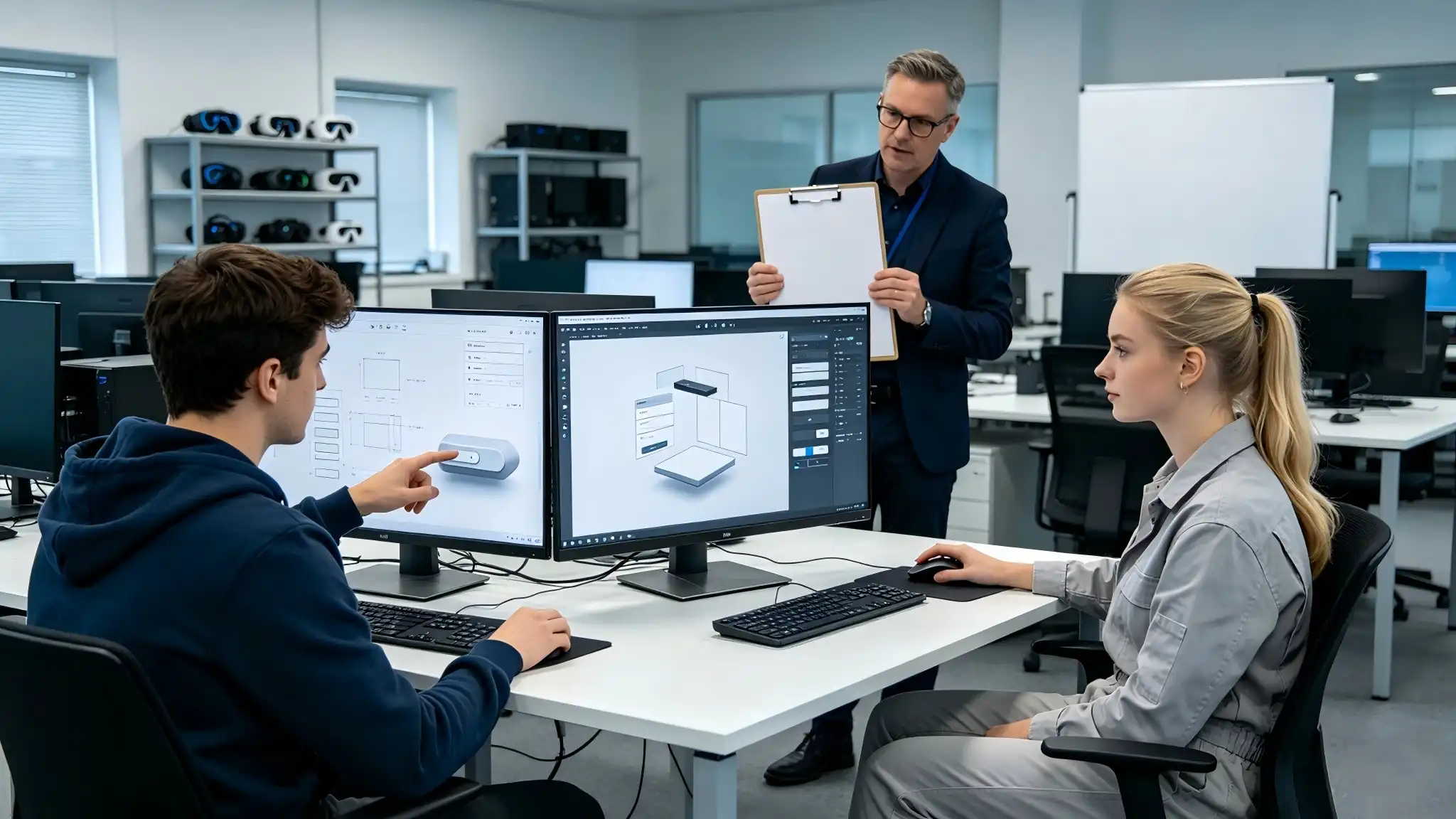
Core Technologies Powering Industrial Immersive Systems
Putting together different technical areas is what makes virtual reality interactive application development work well. PLC code on platforms like TIA Portal is what makes the control logic work, and 3D scene building tools make it possible to see how equipment and production lines look. Often the most difficult part to code, the synchronization layer makes sure that changes in the real state of a device are immediately reflected in the virtual world and the other way around.
Automation systems and visualization engines can talk to each other in both directions thanks to real-time data sharing methods. When a virtual operator presses a start button in the immersive interface, the PLC that button controls receives the command and follows the set of steps that were programmed. The virtual representation is always being updated by sensor input from physical devices, such as temperature readings, conveyor speeds, and the positions of robotic arms. This creates a true digital twin that can be used for both training and tracking.
Educational Pathways for Workforce Development
To become good at industrial immersive application development, you need an organized program that covers everything from the basics of automation to more complex system integration. According to ECR Academy (2024), their method starts with basic PLC programming using S7-1200 series controllers, then moves on to building virtual scenes, and ends with complicated projects like smart factory material sorting systems and multi-liquid mixing process simulations. This progression makes sure that students understand both the theory behind industrial automation and the visualization methods that are needed to make virtual reality interactive application development work well.
Hands-on project finish is more important than academic abstraction in this learning path. Students set up communication protocols, debug ladder logic, setup I/O allocations, and build 3D industrial environments—all in a single platform that looks like professional development processes. This focus on the practical directly addresses the skills gap that manufacturers are facing as they move to operational models for Industry 4.0.
Benefits and Business Value of VR Interactive Applications in Industry 4.0
Accelerating Commissioning and Reducing Downtime
There is a lot of pressure on manufacturing sites to keep production going as smoothly as possible while they install new tools or change the way they do things. In traditional commissioning methods, the actual equipment has to be there and working before the control programs can be fully tried. This means that there is a lot of expensive downtime. This problem is solved by immersive simulation environments that allow virtual commissioning. This means that engineers can test and improve PLC programs against a digital twin long before the actual installation starts.
A recent analysis by the Manufacturing Leadership Council found that virtual commissioning reduces traditional startup times by 30-40% while identifying programming errors that would otherwise emerge during physical testing (Manufacturing Leadership Council, 2023). This speeding up has a direct effect on the company's finances, as production lines hit their full output faster and investments start paying off faster.
Transforming Workforce Training and Competency Development
The development of skills is another area where virtual reality interactive application development can be useful. There are risks that come with teaching new techs how to use complicated automated systems. Mistakes in the setting can damage equipment, and new operators may make mistakes that cost a lot of money while they are learning. Immersive training settings let students try things out, fail, and make changes until they get it right without putting real production assets at risk.
The cognitive benefits go beyond concerns about safety. When compared to classroom instruction or video tutorials, immersive training helps people remember things better, according to a study published in the Journal of Manufacturing Systems (Chen & Zhang, 2023) for tasks that require spatial reasoning and following a set of steps that are common in the workplace. When trainees practice emergency shutdown or changeover procedures in realistic virtual environments, they are better able to use those skills on real production floors.
Enabling Remote Collaboration and Expert Access
It can be hard for globalized manufacturing operations to coordinate the knowledge of sites that are spread out. For a Southeast Asian company to solve a problem with a process, they might need to talk to experts in Europe or North America. This would mean traveling and dealing with time zones. Browser-based immersive platforms let people work together at the same time in shared virtual settings. Experts can watch how equipment works, make changes, and walk local teams through fixing steps as if they were there in person.
This skill came in very handy during recent global problems that made it hard to move between countries. Manufacturers who kept immersive digital twins of their production lines were able to keep up with commissioning and technical support tasks even though they couldn't move around as easily as competitors who relied on traditional on-site engineering methods.
Choosing the Right VR Interactive Application Development Partner
Evaluating Technical Capabilities and Platform Architecture
Companies that want to invest in industrial immersive systems need to look at potential partners from a number of technical angles. Platform architecture is the most important thing to think about. Can the system talk to your current automation infrastructure in real time? Can it handle the specific industry standards that your business uses? Browser-based solutions are easier to set up, but make sure that the performance is still good enough for your network and the number of users who are using it at the same time.
For long-term sustainability, the development workflow is very important. Platforms that need specific programming skills lock you into one provider and make it harder for your team to make changes to apps on their own. On the other hand, systems with visual configuration tools and easy-to-use logic builders let your current automation engineers maintain and add to applications without having to rely on outside sources. This lowers the total cost of ownership over the lifecycle of the solution.
Assessing Content Libraries and Customization Flexibility
Industrial settings are very different from one another. For example, putting together cars has a lot in common with pharmaceutical batch processing or food packing. Partners who are good at virtual reality interactive application development offer large libraries of equipment models that include conveyors, robotic arms, sensors, valves, motors, and process tanks. When compared to making every part from scratch, using pre-built, customizable assets speeds up project timelines by a huge amount.
Customization options are also very important. Generic simulations aren't very useful; your team needs environments that are exact copies of your equipment setups, product flows, and operational procedures. Check to see if the platform lets you load CAD models from your engineering systems, change the properties and actions of materials, and add unique tools that might not be in standard libraries.
Understanding Support Models and Knowledge Transfer
How well knowledge is shared determines whether technology adoption works or not. When looking for virtual reality interactive application development partners, you should look at how they train their staff and how they provide ongoing help. Do they offer structured courses that build skills over time, or do they just give you technical information? Can they provide specialized training that is tailored to your unique needs and work environment?
Real-world project success is a big part of ECR Academy's plan for building skills. Instead of learning from vague tutorials, students create real-world industrial apps like sorting systems for materials, processes for mixing liquids, and models of production lines that are similar to things they'll see at work. The ECR Academy (2024) says that this method, which has been improved by training nearly 500,000 people around the world since 2010, makes sure that your team doesn't just understand the technology in a general way, but can also use it to solve real business problems.
Trends and Innovations Shaping VR Interactive Development in 2026 and Beyond
Integration with Artificial Intelligence and Predictive Analytics
Bringing together immersive technologies and machine learning algorithms is a big change in the way things are used in industry. More and more, modern platforms have AI-powered features that go beyond simple visualization. Predictive maintenance algorithms look at sensor data streams from both real equipment and digital copies to find trends that don't make sense that mean something is about to break. When immersive interfaces are added, technicians get visible alerts that show them which parts need to be fixed along with maintenance instructions and the state of their parts inventory.
Generative design tools that are driven by AI are starting to change the way virtual reality interactive application development is done. Engineers can set performance limits and optimization goals, and then look at AI-generated equipment layout options in environments that feel like they are really there. This mix of computer design research and spatial visualization speeds up the process of finding the best setups for production systems.
Expansion of Cloud-Based Development and Deployment
The infrastructure for cloud computing is changing how businesses build, launch, and manage industrial immersive apps. Cloud-based development platforms let teams that are spread out work on big projects at the same time, and all of their changes are synced in real time. This model is especially helpful for companies with different locations or that use outside development partners because it gets rid of version control problems and makes sure that everyone works from the most up-to-date versions of the project.
Deployment through cloud technology also has benefits for operations. Organizations can change the size of their computing resources based on how they are being used. For example, they can add more rendering power during times of heavy training and lower costs during off-peak times. Cloud platforms also make it easier to update apps and send content to users; changes are sent automatically to all user endpoints, so users don't have to install anything or change their settings by hand.
Emergence of Standardized Frameworks and Interoperability Protocols
Industry efforts to standardize are slowly making the world of immersive technology less fragmented. Adopting OpenXR as a cross-platform standard lets apps work with a variety of hardware ecosystems without needing to be specially designed for each device. Standardization is especially helpful in industry settings because it keeps technology investments from becoming useless over time. Apps made today will still work even as hardware systems change.
There are also new guidelines that are specific to manufacturing. AutomationML (Automation Markup Language) can be easily imported from plant design systems into virtual reality interactive application development environments when these languages are combined with immersive platforms. This interoperability gets rid of the need to enter the same information twice and keeps virtual models and engineering paperwork in sync throughout the lifecycle of an item.
Best Practices for Successful VR Interactive Application Procurement and Deployment
Establishing Clear Objectives Aligned with Operational Needs
Successful industrial virtual systems require clear, measurable goals tied to business outcomes, such as faster commissioning, improved operator skills, or reduced downtime. Involving engineers, technicians, training managers, and maintenance staff early ensures solutions address real operational needs, reduces assumptions, and strengthens organizational support for successful implementation.
Implementing Phased Rollouts with Pilot Projects
Large-scale deployments of technology come with risks that can be reduced by putting them in place in stages. Before a wider rollout, your company can test capabilities, improve workflows, and build internal expertise by starting with a pilot project that focuses on a single production line, process, or training application. During the pilot phase, problems with merging, tweaks to the user interface, and content development needs become clear that might not be apparent during the review phase.
Choose a pilot project that strikes a mix between strategic importance and manageable scale. Pick applications that are big enough to show business worth but small enough to finish in a fair amount of time. A successful pilot builds momentum for the organization, builds trust among stakeholders, and gives solid proof that expanding to more apps and locations is a good idea.
Developing Internal Competency and Knowledge Transfer Plans
The long-term viability of technology relies on the growth of internal competencies. External partners may help with the initial setup, but for long-term success, your team will need to maintain, change, and add to applications on their own. Put knowledge transfer at the top of your list during procurement and implementation. As part of the contract, make sure that comprehensive training is included, that documentation meets the needs of your team, and think about co-development approaches where your engineers work with outside experts on initial projects.
The training programs at ECR Academy are designed to specifically address this need to build skills. People who take the course learn everything they need to know about virtual reality interactive application development, from the basics of PLC to creating virtual scenes, setting up communication, and integrating the whole system. Graduates can make new apps on their own, change existing content to fit changing needs, and help organizations use immersive technology more without having to rely on a single vendor.
Conclusion
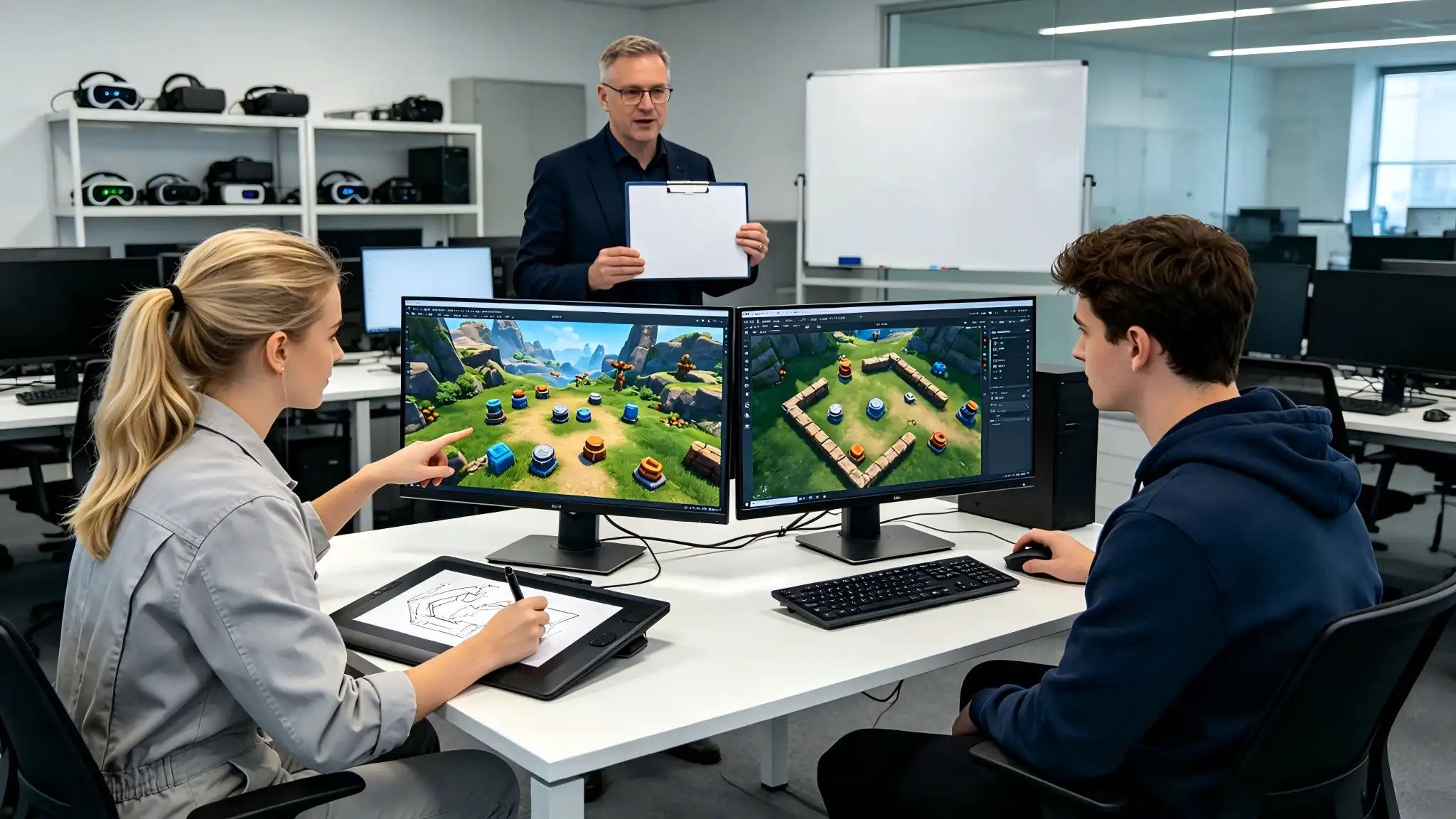
Immersive technologies in industry have grown from experimental ideas to useful tools that have measurable operational value across all manufacturing sectors. Virtual reality interactive application development, especially when used for creating digital twins and virtual commissioning processes, solves some of the most important problems in Industry 4.0, like a lack of skills, inefficient commissioning, and problems with working together across borders. When businesses look at these technologies, they should focus on the ones that offer easy connection with automation systems, access through browsers, and thorough training paths that build long-lasting internal skills. Combining knowledge of PLC programming with immersive visualization skills is an important set of skills for the changing industrial scene. This means that developing the workforce is just as important as choosing the right technology for successful adoption strategies.
FAQ
1.What timeline should organizations expect for virtual reality interactive application development projects?
The length of a project depends on how complicated and large it is. From figuring out what needs to be done to putting it into action, a focused training exercise or equipment show usually takes 4 to 8 weeks. It usually takes between 3 and 6 months to build a full digital twin system that copies an entire production line and integrates it with the PLC. These times are based on the idea that there are clear requirements, technical documentation for the equipment is available, and operational stakeholders are willing to work together. When you use a phased method, you can get small amounts of value sooner by deploying the first sections while you work on the next ones.
2.How do browser-based immersive platforms compare to native applications for industrial use?
Browser-based architectures are much easier to set up and keep up to date because they don't require client installations, receive automatic updates, and work on all platforms. As WebGL features have grown, performance has gotten a lot better, letting computers do advanced 3D drawing directly. Native applications may still have small performance advantages in scenes with a lot of moving parts, but for most industrial applications, browser platforms are fast enough and make IT administration and user access across a wide range of computers much easier.
3.What hardware infrastructure is required to support industrial immersive applications?
Modern browser-based platforms don't need a lot of hardware. Standard engineering computers with 8GB RAM, WebGL-compatible graphics, and mid-range processors (Intel i5 or a similar) usually work well enough. You don't have to use a specialized VR headset; many industrial apps work well on normal screens for training and virtual testing. The network infrastructure should allow visualization platforms and automation systems to connect reliably, with latency taken into account for real-time synchronization uses.
Partner with ECR Academy for Industrial Immersive Training Solutions
ECR Academy has 16 years of experience in developing technical skills and can help companies that want to use virtual reality interactive application development to improve their staff and make their operations run more smoothly. Our thorough training programs teach you both how to program PLCs and how to visualize digital twins. They are delivered through an easy-to-use Industrial Digital Twin Engine Platform that lets you develop and deploy software in your browser. As a reliable provider of industrial metaverse curriculum to businesses, schools, and industry groups in 28 countries, we've led almost 500,000 students through hands-on projects in smart manufacturing, industrial automation, and digital twin applications.
Our method focuses on building practical skills through real-life projects, such as smart workplace material sorting systems and complex multi-liquid mixing process simulations. This way, people learn skills that they can use right away instead of just learning facts. Whether you're setting up a demonstration training lab, improving your own technical skills, or starting programs that bring together industry and academia, ECR Academy has the curriculum framework, platform technology, and expert faculty you need to make it work. Get in touch with our team at ecr2008@enteredu.com to find out how our industrial virtual training solutions can help you meet your unique workforce development goals and speed up your transition to Industry 4.0. You can find full information about the curriculum and partnership possibilities at enteredu.com.
References
1. Chen, L., & Zhang, W. (2023). Effectiveness of virtual reality training in manufacturing skills development: A comparative study. Journal of Manufacturing Systems, 68, 245-258.
2. ECR Academy. (2024). Industrial digital twin and virtual reality interactive application development curriculum. ECR Academy Course Catalog.
3. Manufacturing Leadership Council. (2023). Virtual commissioning: Reducing time-to-production in smart manufacturing. Manufacturing Leadership Council Research Report.
4. Mourtzis, D., Angelopoulos, J., & Panopoulos, N. (2022). Digital twin implementation in manufacturing: A review of framework, applications, and challenges. International Journal of Computer Integrated Manufacturing, 35(6), 565-590.
5. Stark, R., & Damerau, T. (2019). Digital twin in Industry 4.0. In Advances in Production Management Systems (pp. 3-11). Springer.
6. World Economic Forum. (2023). The future of jobs report 2023: Manufacturing sector insights. World Economic Forum Publications.


_1781601799781.webp)