Why Engineers Need Industrial Robot Training Course for Smart Manufacturing
Industrial robots now run welding, assembly, and material handling lines, and every unplanned stop costs production time. That's why engineers need to take a course on industrial robots. Sensor data, alarms, and repair history are converted into early warnings by industrial robot intelligent operations & maintenance. Only trained personnel can check such signals and do anything about it. Hands-on practice is a good way to learn mechanical, electrical and control skills and also how to find faults and to watch the cloud. It's weak in certain areas, engineers need to understand some things and you should be able to appraise a software before you put money into it.
Why Traditional Robot Maintenance Falls Short
Reactive Repairs Cost More Than Downtime Alone
To do reactive maintenance, something has to break down before it needs to be fixed. It looks like a simple plan, but a robot that gets stuck can slow down a whole cell, and every station that is behind it has to wait with it. For emergency repairs, you also have to pay for fast parts and service calls from outside the area. Plan ahead better with fixed preventive schedules, but they work with the calendar instead of the machine. A group might quickly switch out a healthy belt but miss a bearing that wears out faster than planned. There is a schedule, but it doesn't show how the robot is really doing. Engineers learn how to read that condition on their own through training.
Skill Gaps and Incomplete Records
No matter how effective the monitoring system is, if the team cannot comprehend it, then it is useless. Alarm codes that don’t make sense, missing maintenance records and inconsistent repair notes all add time to problem solutions. If the technician can not tell if the fault is in the hardware, the software or both, they will often merely swap out components until the alert stops. That is more expensive and the defect typically comes back. This means plants have to rely on their equipment suppliers for all their complex maintenance. Structured training teaches engineers how to document defects consistently, follow a repeatable route to diagnose them, and build a fault history that can be utilized by the following shift.
A Workforce Challenge in the United States
The more robots there are, the more talents are needed. International Federation of Robotics says 541,000 new industrial robots were deployed throughout the globe in 2023. That pushed the number of robots in operation to roughly 4.3 million. Of these stations, around 34,000 were in the United States. A 2024 report by Deloitte and The Manufacturing Institute said that U.S. manufacturers would require 3.8 million additional workers from 2024 to 2033, yet 1.9 million of those positions might go unfilled. With more robots and fewer skilled workers available, it makes sense to train employees to do industrial robot intelligent operations & maintenance work in-house.
What Engineers Need to Learn Before Intelligent Maintenance Works
Mechanical, Electrical, and Control Fundamentals
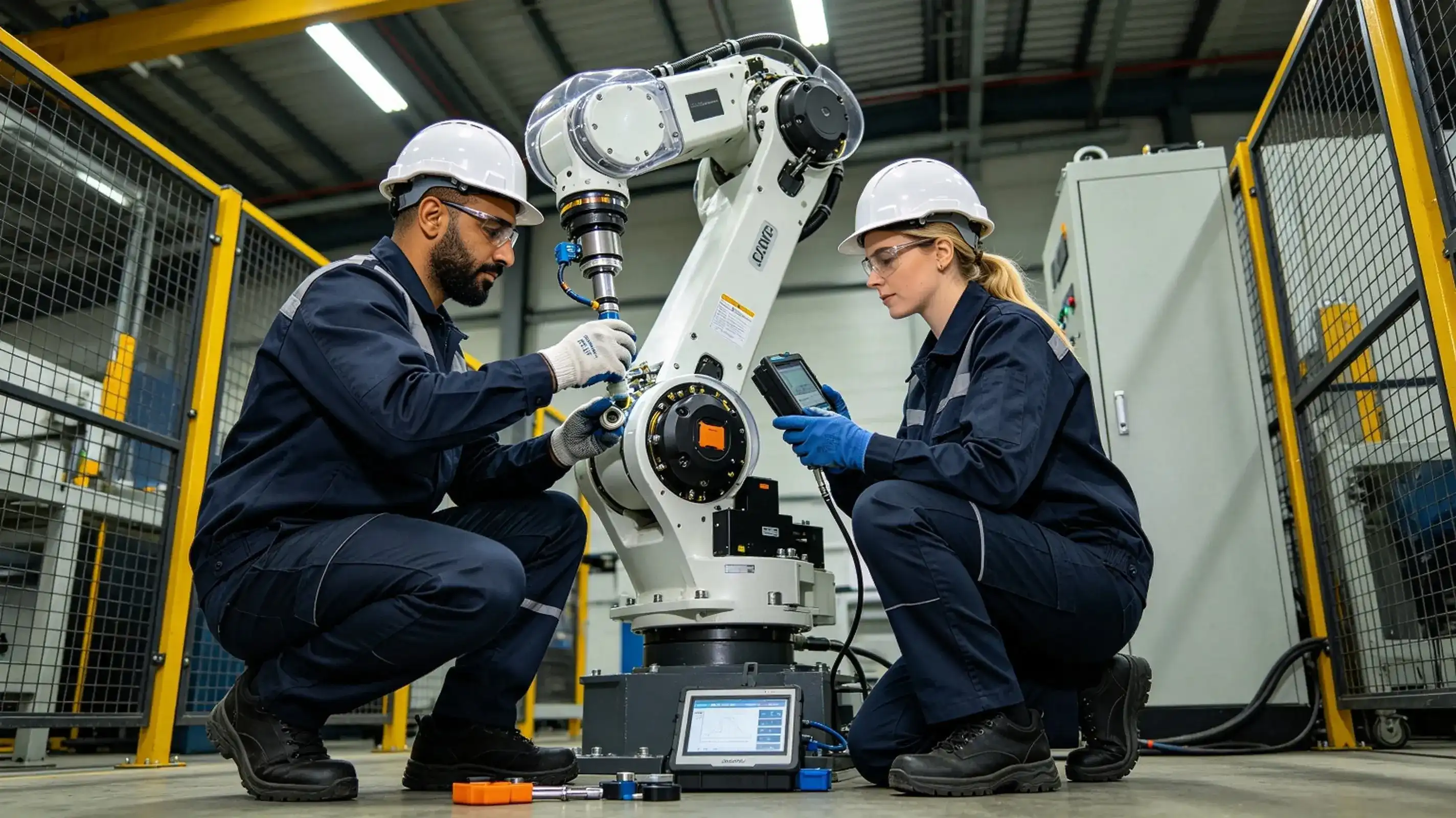
A excellent course begins with the portions that get stuck the most. From a mechanical standpoint, engineers learn how to disassemble and re-assemble a robot, install and troubleshoot motors, inspect and replace synchronous belts, and perform precise calibration. On the electrical side, they uncover hardware and software flaws that create electrical difficulties. Control systems provide duties such as network setup, zero point calibration, coordinate system setup and vision system programming. All skills may be linked to uptime and accuracy. A worn out belt or a zero point that has migrated might seem like a software fault unless someone understands where to check. Safe work is crucial in all steps. ISO 10218 defines the guidelines on how industrial robots must be safe.
Fault Diagnosis and Root-Cause Analysis
Knowing what the parts are is not the same as finding a fault. They need a manner of doing things. They read the alert, check recent modifications, determine what went wrong with the mechanics, electrical, software and communication, test one item at a time and make sure the repair was done properly. This habit comes from utilizing diagnostic equipment to test electrical systems, to know what is wrong and to make sure that repairs were done properly. This is very crucial if the procedure keeps failing. When a team lays down the issue and how to remedy it the next engineer may fix it quicker and pieces that don't need to be changed as frequently are reduced down. Over time this competence helps a plant become less reliant on requests for servicing from the outside.
How Condition Data Becomes a Maintenance Decision
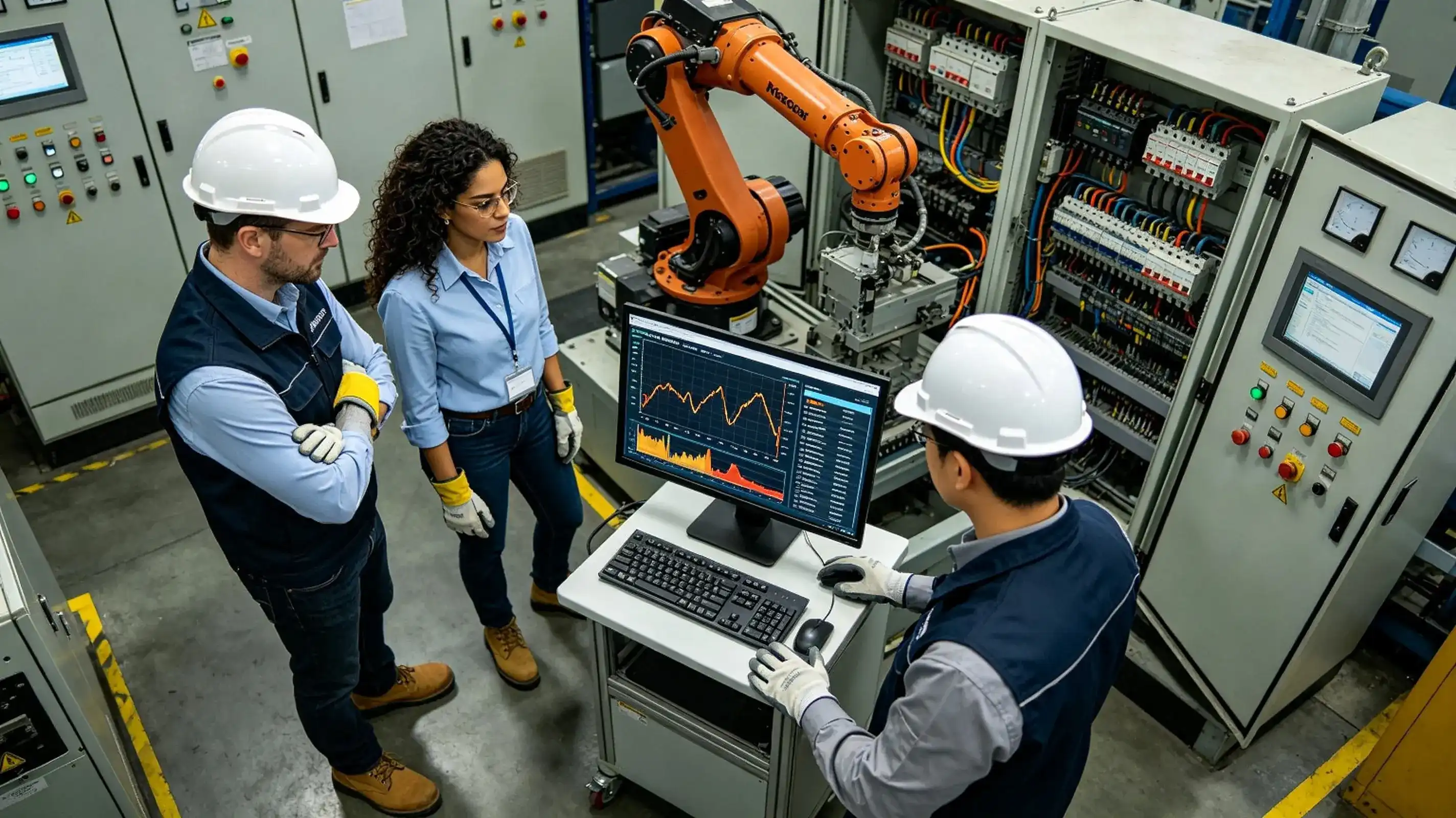
The robot is equipped with sensors, controller data and smart maintenance software. The edge gateways capture data about operations, the cloud platforms present the data, and remote tools enable engineers check out a system without having to travel to the cell. IEC 62443 is a standard for security of industrial control systems, while ISO 13374 is a standard for collection and display of condition monitoring data. Data may also be sent to MES, ERP and CMMS applications that can translate a warning into a work order. “AI is very good at detecting anomalies, whether it’s torque, temperature or vibration, but an engineer still has to determine what’s happening and what to do about it.” No matter how you slice it, a dashboard is simply another screen.
Where Trained Engineers Make a Difference on the Factory Floor
Welding, Assembly, and Material Handling
The emphasis of the monitoring varies with the process. When welding cells, you need to pay attention to the servo load, cable wear and the precision of the position. Assembly lines are dependent on communication status, cycle time and how effectively the grippers are working. For moving objects around it relies on the ability of robots and other devices to communicate with one other and move seamlessly . In auto factories, if one robot goes down a synchronized line may go down, so engineers have to be able to determine what's wrong fast and accurately. The E.C.R. Academy course is about how to run and maintain robots that move and assemble items in an intelligent way. A competent engineer understands which signals are vital for each operation and which ones they may safely disregard.
Comparing Maintenance Models
Varying maintenance models know varying quantities about the machine. Reactive maintenance is used to repair a robot when it breaks down. Preventive maintenance is on a regular calendar or running-hour basis. If the measured values exceed a particular limit, condition-based maintenance will be initiated. In predictive maintenance we use historical and current data to anticipate the likelihood of failure. Intelligent operations and maintenance — monitoring, analytics, work orders and production data. You can’t force all assets into one model. A inexpensive gripper could be helpful for preventive inspections, a robot at a station that causes a lot of delays might be good for continual checks. Engineers who understand the principles may adapt the procedure to the risk, the quality of the data, and the team's talents.
Measuring Results After Training
Before the first class, you should set a baseline. Keep track of unplanned downtime, the mean time to repair (MTTR), the mean time between failures (MTBF), the rate of repeat failures, the rate of first-time fixes, and the cost of industrial robot intelligent operations & maintenance per robot. Use the same method to compare the same numbers after training. Response time and the number of alerts that were closed with a known action also show if the data is being used. Since training doesn't promise a certain number, I see these measures as proof rather than promises. Before putting the program into all of the plants, you can do a small test run on one key cell to see how it works.
How E.C.R Academy's Industrial Robot Intelligent Operations & Maintenance Course Works
The BN-R365 Training Platform
The course employs the BN-R365 Industrial Robot System Operation and Maintenance Training and Assessment System and ROS-based smart mobile robots. The platform integrates industrial robots, VR training simulations and technologies for monitoring industrial networks. Students get hands-on experience with projects like electrical inspection, programming and debugging, intelligent monitoring, and commanding mobile robots. The technology allows you to acquire data in real-time, see it on the cloud and operate and service it remotely. The training is conducted by industry engineers and faculty with expertise in robotics and automation. It follows worldwide technological standards and the latest in smart manufacturing. Students practice in real life but also via online simulations where they may repeat a mistake situation as many times as needed.
Skills You Will Practice
Here are the main skills that students work on during the course.
- Mechanical maintenance and calibration: Learners disassemble and assemble robot mechanical systems, install and debug motors, inspect and replace synchronous belts, assemble housings, and complete precision calibration tasks. These exercises build the hands-on skill needed to restore accuracy after a repair and to adjust a robot system with confidence on the shop floor.
- Electrical and control systems: Learners identify electrical hardware faults, troubleshoot software-related electrical issues, and complete repair verification with diagnostic tools. They also configure robot networks and communication, perform zero-point calibration, establish coordinate systems, and apply vision system programming methods for control and debugging tasks. These tasks cover problems that commonly interrupt production.
- Intelligent operation and mobile robots: Learners configure and deploy edge gateways, collect and analyze robot operation data, monitor systems through cloud platforms, and perform remote operation and maintenance tasks. They also learn ROS-based mobile robot programming, navigation, and motion control, including delivery functions and basic application development for intelligent mobile robots.
With these skills, engineers can find, fix, and record robot problems in a way that works every time.
What to Check Before Choosing a Program
Test any training against your own line before you give it the green light. Check to see if the practice platform and tasks are compatible with the robot brands and tasks on your floor. If they are not, it will be harder for skills to transfer. Make sure that the students don't just look at slides while they deal with real faults. Look for content about cloud monitoring and remote maintenance, an easy-to-understand way to grade, and a delivery format that works with shift schedules. Make sure the provider keeps the content up to date as robot technology changes, and find out what kind of computers students will need. It saves time for procurement teams and technical managers to ask these questions early on.
Why Teams Choose E.C.R Academy
Since 2010, E.C.R. Academy has given professional training and testing to more than 500,000 people in China and 28 other countries. More than 300,000 of these students have earned recognized skills certifications. We've put together more than 150 skill competitions, worked with over 3,300 experts and more than 500 businesses, and made more than 60,000 learning resources, such as test banks, standards, courseware, and case studies. We base each course on real-world work processes so engineers can practice tasks they will see at work. This record from 16 years ago gives procurement teams and academic leaders a history to look at.
Conclusion
Industrial robots are being used in more and more factories, but it's still hard to find skilled industrial robot intelligent operations & maintenance workers. Plants that depend on reactive and calendar-based maintenance have downtime that they could have avoided, weak records, and a lot of reliance on outside service. This is covered in a practical training course that teaches the basics of mechanical, electrical, and control systems, as well as a method for finding faults that can be used again and again, and how to use condition data from edge gateways and cloud platforms. Certain rules, like ISO 10218, ISO 13374, and IEC 62443 cover security, monitoring, and safety. Trained engineers use these skills for things like welding, putting things together, and moving things around. They also pick the best maintenance model for each asset and check AI alerts before acting. Baseline measures like MTTR, MTBF, and repeat failures then show if training works or not.
FAQ
1. Can I take this course with zero background knowledge?
Trainees in mechatronics, automation, mechanical manufacturing, and related fields will benefit from this course. It is suggested that you know the basics of both electrical engineering and mechanical engineering. From simple operations to full applications, teaching is done step by step so that beginners can learn by doing with help. If you're not sure if your team's background fits, just ask us.
2. What positions can I pursue after completing the course?
Industrial Robot System Operation and Maintenance Technician, Industrial Robot System Operator, Service Robot Application Technician, Robot Engineering Technical Personnel, and Automation Equipment Maintenance Engineer are some of the jobs that trainees can learn how to do. In the field of intelligent manufacturing, people want to fill these roles.
3. What are the minimum computer requirements for study?
It is suggested that you use Ubuntu 22.04 or later. You also need a processor that is at least as fast as an Intel Core i7, at least 16 GB of memory, a hard drive that is at least 1 TB in size, and a graphics card that has at least 4 GB of VRAM. Check these minimums before you sign up.
Request Industrial Robot Training Details from E.C.R Academy
E.C.R. Academy can be Contacted by teams looking to compare industrial robot intelligent operations & maintenance suppliers. Tell us about your robot brands, team size, and training goals in an email to ecr2008@enteredu.com. We'll get back to you with information about the course and the next steps. Engineers can learn how to diagnose, calibrate, and monitor the cloud in our BN-R365-based course. To find out more, go to enteredu.com.
References
1. International Federation of Robotics, World Robotics 2024 – Industrial Robots (2024)
2. Deloitte and The Manufacturing Institute, Taking Charge: Manufacturers Support Growth with Active Workforce Strategies (2024)
3. ISO 13374-1, Condition Monitoring and Diagnostics of Machines – Data Processing, Communication and Presentation – Part 1: General Guidelines (2003)
4. IEC 62443-3-3, Industrial Communication Networks – Network and System Security – System Security Requirements and Security Levels (2013)
5. Jardine, Lin, and Banjevic, "A Review on Machinery Diagnostics and Prognostics Implemented on a Condition-Based Maintenance," Mechanical Systems and Signal Processing (2006)
6. Lee, Bagheri, and Kao, "A Cyber-Physical Systems Architecture for Industry 4.0-Based Manufacturing Systems," Manufacturing Letters (2015)