What Does an Intelligent Connected Vehicle Technology Course Teach?
The automotive industry stands at a pivotal transformation point, where connectivity meets automation. An Intelligent Connected Vehicle Technology course equips learners with comprehensive expertise in integrating advanced sensors, computing platforms, communication systems, and AI-driven decision-making frameworks essential for next-generation mobility solutions. These programs blend automotive engineering fundamentals with cutting-edge information and communication technologies, preparing professionals to assemble, calibrate, debug, and test sophisticated vehicle systems that communicate seamlessly with infrastructure and other road users.
Understanding the Fundamentals of Intelligent Connected Vehicle Technology
Modern cars have changed from simple machines for getting around to complex computers for handling data. At ECR Academy, we know that understanding the basic architecture is what sets skilled technicians apart from truly effective professionals in this field that is growing quickly.
Core System Architecture and Components
Perception, computation, transmission, and control systems all work together in a layered design that makes connected cars possible. Several types of sensors are in the awareness layer. LiDAR units make accurate 3D maps of the environment, millimeter-wave radar tracks objects through bad weather, cameras allow for visual detection, and ultrasonic sensors find obstacles in the close range. GPS, inertial measurement units, and odometry are all used together in combined guidance systems to accurately locate a car (National Highway Traffic Safety Administration, 2022).
Communication Technologies Enabling Real-Time Connectivity
Vehicle-to-Everything (V2X) communication is what makes connected mobility ecosystems work. Based on cellular networks, C-V2X technology lets vehicles send and receive important safety messages with infrastructure (V2I), other vehicles (V2V), and people walking by (V2P). This technology uses specific spectrum bands to achieve delay levels below 20 milliseconds, which are needed to avoid collisions and make planned moves. Compared to older DSRC protocols, C-V2X has a longer range and adapts naturally to 5G networks, making it possible for bandwidth-heavy applications like edge-cloud computing integration and cooperative perception.
The Role of AI in Decision-Making
Artificial intelligence turns sensor data into knowledge that can be used. Deep learning algorithms look at camera feeds to find objects, semantic segmentation tells the difference between surfaces that can be driven on and surfaces that can't, and neural networks guess where people will walk. These algorithms are run in real time by computers with 200 to 2000 TOPS (trillion operations per second) of power. This lets cars do things like adaptive speed control and full self-driving. Training algorithms on a variety of scenario libraries makes sure they can handle edge cases, which are unpredictable situations that don't happen very often but are very important for safety.

Technical Skills and Knowledge Gained from an ICV Technology Course
The only way to put theoretical knowledge to use is to apply it in real life. The curriculum at ECR Academy is based on competency-based learning in eight specialized labs. This makes sure that graduates understand both basic ideas and advanced techniques for integrating them.
Sensor Assembly, Calibration, and Fusion
Learners start by understanding the strengths and weaknesses of each sensor. To get the best field-of-view footage, angle alignment and lens length adjustment must be done very carefully when installing a camera. Millimeter-wave radar needs to have its parameters carefully set up because the settings for detection range, angle resolution, and velocity accuracy depend on the situation. LiDAR tuning includes changing parameters that are not inside the device and lining up point cloud data with the vehicle's coordinate systems. Sensor fusion is the most advanced skill. It includes joining complementary data streams to make up for the weaknesses of individual sensors. This makes environmental models that work in all lighting and weather situations.
Computing Platform Deployment and Algorithm Testing
Different types of computers, like CPUs, GPUs, and AI accelerators, are needed for modern autonomous systems. People who take the course learn how to choose a platform, balance computational throughput, power consumption, and thermal management. Hands-on lessons teach how to setup an operating system, set up middleware, and improve the performance of a data pipeline. Students use perception algorithms, check their accuracy with labeled datasets, and do performance profiling to find areas where they are slowing down. This real-life experience is similar to how developers work at tech giants like Nvidia and Qualcomm, where improving speed has a direct effect on how far a car can go and how reliable the system is.
Drive-by-Wire System Integration
Electronic control systems have taken the place of mechanical connections in Intelligent Connected Vehicle Technology. Steer-by-wire, brake-by-wire, and throttle-by-wire systems use multiple electronic designs to turn driver inputs or self-commands into actuator reactions. The training includes how to put things together, check that the fail-safe system works, and figure out what's wrong. Learners set the steering angle sensors, check how the stopping force is distributed, and test how the car will react in an emergency. It's important to understand these execution systems because even the smartest perception is useless without reliable actuation that turns decisions into motion.
Vehicle-Road Collaboration System Configuration
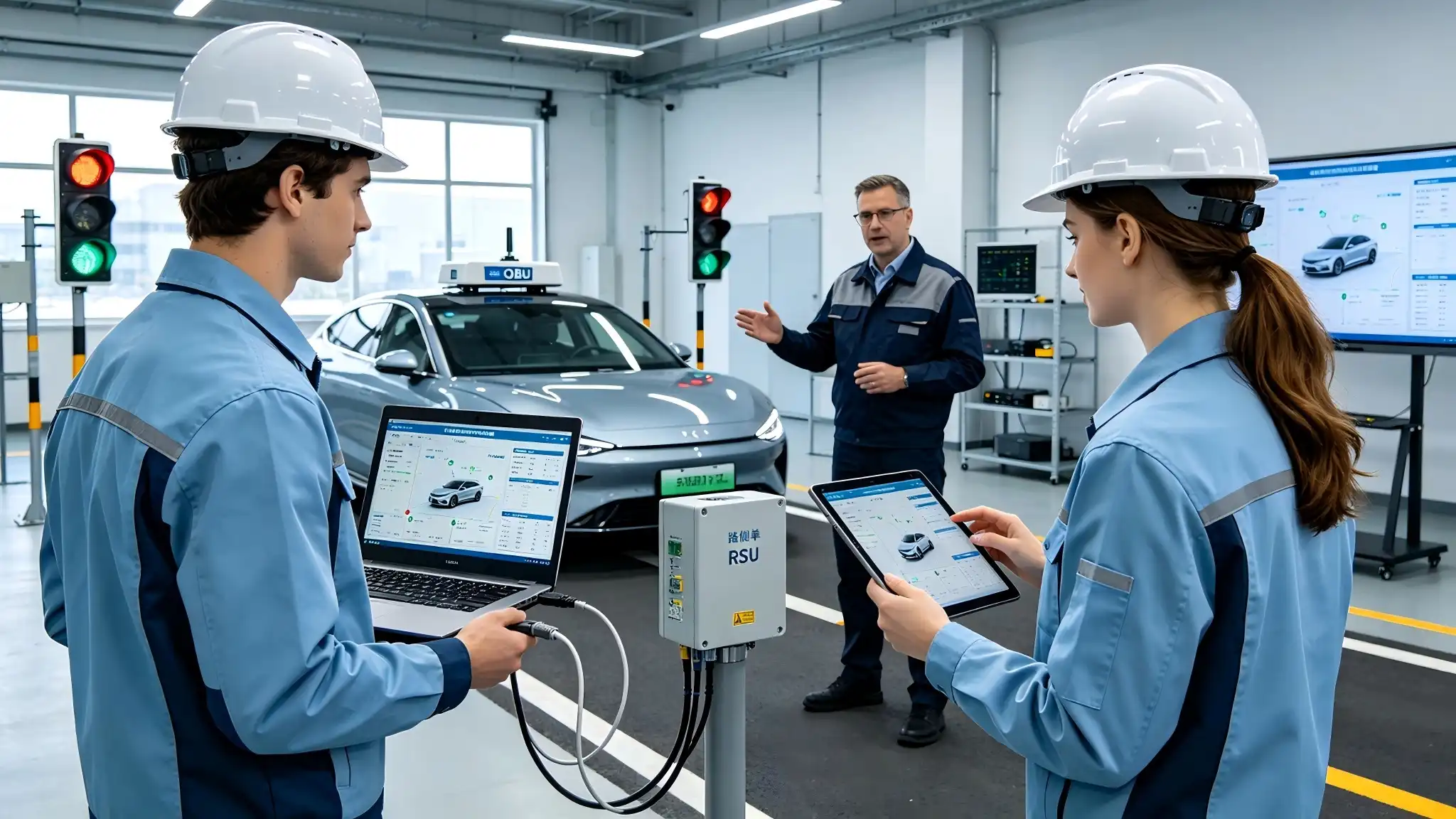
For C-V2X deployments, both on-board units (OBU) and infrastructure at the roadside are needed. Modules in the course walk students through OBU installation, including where to put the antennas, how to connect the power supply, and how to set up the communication stack. Setting up a roadside unit (RSU) includes a site study, deploying edge computing servers, and connecting the network backbone. After setting up message sets like Basic Safety Messages (BSM), Signal Phase and Timing (SPaT), and MAP data, participants test the reliability of communication in simulated urban settings. The C-V2X traffic simulation area at ECR Academy offers real testing settings that are like real-life deployment situations.
Business and Market Insights Covered in the Course
Technical knowledge alone isn't enough to guaranty that implementation will work. Market data helps procurement managers and institutional decision-makers find their way around vendor communities, figure out how mature a technology is, and make sure that investments are in line with strategic goals.
Market Dynamics and Regulatory Landscape
The market for linked vehicles is different in different parts of the world because of differences in regulations and the ready of infrastructure. The US follows NHTSA rules that stress hacking and practical safety standards like ISO 26262 (Society of Automotive Engineers, 2021). Knowing these rules helps procurement teams look at source certifications and figure out what the legal effects might be. Market research tools look at usage curves and compare entry rates across passenger cars, business fleets, and specialized uses like mining automation, where harsh conditions speed up the approval of technology.
Supplier Evaluation and Strategic Procurement
Choosing technology partners is a very important choice. The course shows you how to evaluate suppliers based on their technical skills, how well their product roadmaps match up with your needs, their support infrastructure, and their overall cost of ownership. Comparative research looks at hardware solutions from well-known car parts makers like Bosch and Continental and new companies that are making specialized parts. When evaluating a software platform, the security posture, middleware flexibility, and over-the-air (OTA) update architectures are all taken into account. Case studies show how automotive OEMs set up co-development agreements, negotiate IP ownership, and set quality standards to ensure long-term success of their collaborations.
ROI Optimization Through Technology Selection
Because of limited funds, smart planning is necessary. Participants in training modules are led through phased implementation strategies, starting with basic ADAS features and gradually adding connectivity and autonomy features as the organization's capabilities improve. Fleet workers learn how to measure the benefits of things like platooning, which saves fuel, safety features that lower insurance premiums, and predictive repair, which makes operations run more smoothly. In 2023, Automotive News reported that educational institutions are learning how to set up labs so that they can support multiple training programs. This makes the best use of equipment and shows that capital investments were worthwhile because they can be used in a variety of ways.
Addressing Challenges and Solutions in Intelligent Connected Vehicle Technology
There are many problems with application in the real world. Recognizing these problems and giving practical ways to solve them builds trust among people who are deciding whether to spend in training.
Sensor Limitations and Environmental Robustness
There are certain weaknesses in each type of sensor. Cameras don't work as well in bright sunlight or low light, LiDAR doesn't work well in rain or fog, and radar picks up on metal items on the side of the road as real threats. Multi-modal fusion gets around these problems by changing the weightings of sensors based on the environment. When working at nite, visible-spectrum cameras are paired with thermal image cameras. When optical devices fail, radar is a safe way to measure speed. Diagnostic skills—finding sensors that aren't working as well as they should and putting in place fixes that make the system resilient in all operating conditions—are emphasized in training.
Cybersecurity Threats and Defense Strategies
Connected vehicles give attackers more places to hit in Intelligent Connected Vehicle Technology. Remote exploitation is possible through wireless connections that aren't properly protected; if an ECU is hacked, it could change how a car acts. The course covers defense-in-depth strategies such as secure boot processes that stop unauthorized firmware from being installed; encrypted communication channels that keep V2X messages safe; and intrusion detection systems that watch for strange network activity (ISO/SAE 21434, 2021). Through hands-on exercises that mimic penetration testing scenarios, participants learn how to find holes in OTA update systems and T-Box interfaces before attackers do.
Integration Complexity Across Diverse Platforms
Different electrical systems and software tools are used by automakers. For aftermarket integration to work, adapters need to be made so that new systems can easily connect to current CAN, LIN, and Ethernet networks. Through hands-on activities like reverse-engineering vehicle communication protocols, creating translation layers, and testing functionality across model years, the course deals with problems related to compatibility. This skill is very useful for Tier 1 sellers who work with many OEM clients each with their own unique technical needs.
Practical Applications and Future Prospects for Course Graduates
Putting money into improving your skills must lead to real job progress and better organizational performance. ECR Academy bases its course goals on real skills that are in line with what employers want.
Career Pathways and Role Diversity
Graduates go in a lot of different directions in the car industry. Setting up production lines, checking for quality, and working on projects to make things better all the time are all part of manufacturing jobs at assembly plants. R&D jobs help make prototypes, test them to make sure they work, and keep records of how well the system works so that government agencies can see them. After-sales technical support specialists look into problems in the field from afar, installing software patches and walking service technicians through difficult repair steps. Graduates are hired by testing centers to do homologation testing, which makes sure that cars meet safety and electromagnetic compatibility standards before they go on sale.
Emerging Application Domains
Besides changing private cars, connected vehicle technologies also change fields that are close by. Logistics companies often don't have enough drivers, but platooning technologies can help by cutting fuel use by 10-15% through efficient drafting. Autonomous haul trucks are used in mining activities and are watched from a distance. This keeps people out of dangerous underground environments. Port automation uses coordination between vehicles and equipment to move containers between terminals with a level of accuracy that would not be possible with human operation. According to McKinsey & Company (2023), smart city projects connect connected cars to larger systems for managing cities. These systems then adjust the speed of traffic lights based on real-time flow data and give priority to emergency vehicle paths.
Future-Proofing Through Continuous Learning
As technology changes, people need to keep their skills up to date. The flexible structure of the curriculum at ECR Academy encourages lifelong learning. Professionals come back from time to time to learn new skills like making HD maps, slicing 5G networks for use in vehicles, or using quantum-resistant security to protect next-generation communication systems. This partnership model makes sure that companies stay on the cutting edge without having to keep hiring new people, and it also makes sure that employees can keep their jobs in an industry that is changing quickly.
Conclusion
Mechanical engineering, software development, telecommunications, and artificial intelligence have all come together in Intelligent Connected Vehicle Technology. Structured, hands-on training in sensor technologies, computer platforms, communication systems, and integration methods is part of comprehensive training programs that make this complexity easier to understand. The method used by ECR Academy combines theoretical background with hands-on experience, using eight specialized labs and C-V2X simulation environments to develop skills that are ready for certification. Whether you are in charge of purchasing for an automobile institution, training employees at a vehicle maker, or coordinating standards projects through an industry group, understanding these technologies will put your company at the forefront of changing the way people move around.
FAQ
1.Who Benefits Most from Intelligent Connected Vehicle Technology Training?
Getting specialized training in connected vehicle systems is helpful for many groups of people. Automotive engineering students at vocational schools and applied universities learn basic skills that get them ready for technical jobs at the entry level. Professionals who already work for automakers and Tier 1 suppliers improve their skills to help with the launch of new models with advanced driving aid and connectivity features. The technical fluency of procurement managers who are in charge of choosing lab equipment helps them evaluate vendors more accurately and make the best use of their budgets. People who are switching careers from related areas, like consumer electronics or telecoms, use their transferable skills to learn more about the automobile industry.
2.How Does Understanding These Systems Improve Procurement Effectiveness?
Technical knowledge changes sourcing from just buying things to building effective partnerships. When you know about sensor fusion architectures, you can have more useful talks with suppliers about how to integrate the system and test its performance. Knowing about communication protocols makes infrastructure dependencies clear, which stops expensive deployment delays caused by problems that were missed during testing. Knowing about cybersecurity frameworks makes sure that RFP specifications cover important security needs, keeping institutions safe from implementations that aren't secure. In the end, knowledgeable procurement teams are able to negotiate better terms, choose the right level of technology for the organization's needs, and form relationships that produce long-term benefits beyond the initial purchase of equipment.
3.What Industry Trends Should Stakeholders Monitor?
Over the next few years, connected vehicles will go in a number of different directions. AI model changes that make sensing more complex can be done with less computing power, which lowers system costs and energy use. 5G network densification increases reliable V2X coverage, which opens up safety applications that need very reliable, low-latency communication. Harmonization of regulations across areas makes it easier for global providers to follow the rules and sets minimum safety standards. Open-source software frameworks shorten the time it takes to make new software, but they also bring new supply chain risk management issues to light. By continuing their education, organizations can stay up to date and adapt to these changes before they happen.
Transform Your Organization with Advanced ICV Training Solutions
Since 2010, ECR Academy has given nearly 500,000 workers in 28 countries the tools they need to do their jobs better by using real-world challenges to teach them a wide range of skills. Our Intelligent Connected Vehicle Technology program offers flexible, project-based training that is in line with international standards for testing and commissioning. It is backed up by eight core labs and C-V2X simulation areas. Our school-enterprise co-development model makes sure that training solutions are tailored to your specific operational context, whether you are an automotive institution looking for laboratory platform authorization, a business needing customized workforce development, or an industry association setting regional certification standards. As a reliable provider of technical education that leads to certification, we use experienced teachers, enterprise experts, and industry consultants, along with cutting-edge training systems that simulate real-world work environments. Visit enteredu.com or email ecr2008@enteredu.com to talk to ECR Academy about partnership possibilities that fit your company's strategy goals in connected mobility.
References
1. Automotive News. (2023). Fleet Electrification and Connected Vehicle ROI Analysis. Detroit: Crain Communications.
2. ISO/SAE 21434. (2021). Road Vehicles — Cybersecurity Engineering. Geneva: International Organization for Standardization.
3. McKinsey & Company. (2023). The Future of Autonomous Trucking and Smart Logistics. New York: McKinsey Global Institute.
4. National Highway Traffic Safety Administration. (2022). Federal Automated Vehicles Policy Update. Washington, DC: U.S. Department of Transportation.
5. Society of Automotive Engineers. (2021). Taxonomy and Definitions for Terms Related to Driving Automation Systems for On-Road Motor Vehicles (J3016). Warrendale, PA: SAE International.
6. U.S. Department of Transportation. (2023). Vehicle-to-Everything (V2X) Communications Technology Deployment Guidance. Washington, DC: Intelligent Transportation Systems Joint Program Office.


_1781601799781.webp)