Managing Solar Assets with Photovoltaic Engineering Technology Practices
Managing solar assets well starts with people who understand photovoltaic engineering technology from the cell to the grid. Good asset management keeps a plant's output high and its costs low for 25 years or more. That takes sound design, careful commissioning, steady monitoring, and fast fault repair. Teams that know module physics, inverter behavior, and data tools catch small problems before they become costly losses. In this article, I explain the main risks, how to choose technology and training, and how to improve field performance. I also cover trends that shape solar asset management in the United States.
Understanding Photovoltaic Engineering Technology in Solar Asset Management
What Photovoltaic Engineering Technology Covers
Photovoltaic engineering technology is used in every step of a solar project. Making the cells and modules is the first step. The next step is designing and installing the system. The last step is running and maintaining the system. Someone who is good at their job can read engineering plans, test electrical systems, and know how to change DC power into AC power that can be used on the grid. The IEA Photovoltaic Power Systems Programme says that more than 400 GW of solar PV was put in place around the world in 2023. This means that more and more things need to be taken care of by professionals. People who own homes need to know this because the choices they make during construction will affect how much energy they use for many years to come. It can cost you money for a long time after the system is put into use if the generator or frames aren't strong enough.
How System Design Shapes Long-Term Asset Performance
What a plant does during planning determines how well it will do in the future. First, engineers check out the site and see what kinds of solar resources are there. Then they pick out the modules, inverters, and mounting structures, and figure out how to connect them in straight lines and loops so the string voltage stays within the inverter's limits. A cost-benefit study is done before the building process begins. This choice is based on module datasheets. These days, N-type modules sold in stores can convert more than 24% of their power, and their temperature coefficients are usually between -0.29% and -0.35%/°C. Lower power losses on hot days indicate a lower temperature-related performance penalty, which is important in warm places like the southwestern United States. Access paths are also well thought out so that crews can check out and fix equipment without risk.
Why Skills Matter for Monitoring and Maintenance
Having gear doesn't protect something by itself. People who have been taught do. The operators check the tracking screens to see if a drop is due to weather, dirt, or a problem. They then compare the actual output to what was planned. There are people who work in maintenance who check the transformers, power lines, modules, and mounting frames. The National Renewable Energy Laboratory's O&M guide says that keeping full records and doing preventative maintenance are important parts of running PV and energy storage plants. So, I train my staff as part of taking care of my assets, not as something extra. When people on a team know why something happens, they can fix the cause instead of just the effect. In turn, this habit keeps people from coming back, which protects sales.
Challenges and Solutions in Managing Solar Assets with Photovoltaic Engineering Technology
Equipment Degradation and Module Defects
Over time, each cell loses some of the things it can do. Some field studies from the National Renewable Energy Laboratory were looked at by Jordan and Kurtz. They found that all of them showed an average decline rate of about 0.5% per year. Newer N-type items are said to lose no more than 0.4% of their value each year. There are flaws that can speed up the loss. Small cracks, finger defects, and broken bypass diodes all lower the output. You can't see a lot of these problems. With electroluminescence (EL) tests, tiny cracks and areas of cells that aren't working can be found. Drone-based infrared scans find hot spots all over the place. By setting up these checks, owners have proof to back up their guarantee claims. The pictures are easier to understand for engineers who know how the parts are put together. This cuts down on arguments and keeps costs stable.
Environmental Stress and Site Conditions
All plants are put to the test by the weather in photovoltaic engineering technology. Hail, snow, wind, heat, humidity, and salt mist all do a lot of damage to hardware. And IEC 61730 is about making sure that PV modules installed on land are safe. IEC 61215 is about building PV modules that are safe. People test structures for strength by putting them under snow loads of up to 5400 Pa and wind loads of up to 2400 Pa. 25 mm ice balls moving at 23 m/s are used to test hail. Potential induced degradation (PID) tests are done at 85°C and 85% relative humidity. IEC 61701 says that plants that float must also be able to handle humidity and salt mist. I think the standards should be matched to the situation. Load rates need to be high in places where it snows a lot, and they need to be strong for places that are humid or close to the coast.
Data Handling and Predictive Maintenance
A large plant sends info all the time from transformers, string monitors, and weather stations. If you can't see how to use that information, it's just noise. Tracking at the string level gives you more thorough analytics than tracking at the central level. Faults are found at the string level, like a single dirty string. Internet of Things (IoT)-enabled devices add temperature and light level readings. When predictive maintenance looks at those numbers, it compares them to what it thinks will happen. After that, it looks for patterns before a problem stops work. But software only shows a sign. A technician needs to know if a low current is because of darkness, a broken wire, or a diode that isn't working right. I think that teams get the most out of their tracking tools when they work with people who can find issues at both the string and system levels.
Choosing the Right Photovoltaic Engineering Technology for Your Solar Assets
PV Versus Solar Thermal Systems
Sunlight is used in both of these processes, but they use it in different ways. In a direct way, PV panels turn light into power through semiconductor cells. In other words, they can be used on rooftops, plants that are set up on the ground, and sites that float. Heat is used to power engines in concentrating plants, and heat is stored in solar thermal systems. You can heat water with this heat or use it to heat up factory processes. Maintenance is also not the same. The modules, inverters, and wires are all checked by PV teams. Teams in charge of heat take care of the fluids, fans, screens, and collection or fluids. The International Renewable Energy Agency says that between 2010 and 2022, the price of energy from large-scale solar PV dropped by 89%. This shows that PV is getting cheaper as a way to get power. For most people, PV is the best way to connect to the power grid.
Cell and Module Technology Options
Cell technology went from PERC to TOPCon and HJT in just a few years, and perovskite is still being studied. A lot of energy can be stored in N-type TOPCon and HJT cells, even when there isn't much light. It is possible for the LCOE to go down at high-albedo sites like snow or white dirt if the bifaciality factor is 80% or higher. On the back of bifacial modules, they also gather light. It is also important to encapsulate. PID can be stopped with polyolefin elastomer (POE). Module datasheets provide information on degradation rate, temperature coefficient, efficiency, and compliance with standards such as IEC 61215 and IEC 61730. I compare these figures and write down my thoughts. It's not the highest number on a brochure, but it's the best number for the site.
Evaluating Training and Service Providers
It doesn't matter what tool you choose if you don't have skilled workers. When I look at different training providers, I notice four things: the standards, the program, the teachers, and the buildings. Make sure that the lessons are based on real-life situations, that the content meets international standards for technical skills, and that college experts and business engineers teach together. Try to find labs with real tools where you can do things. A lab for making PV modules should have laser scribing machines, soldering stations, EL testers, laminators, and a training station that is connected to the grid and has at least 60 kW of power. You should pay more attention to companies who tell you a lot about the labs, teachers, and course material. From vague statements, you can't really tell what your team will work on.
Improving Solar Asset Performance Through Photovoltaic Engineering Practices
Shading, Soiling, and Module-Level Power Electronics
Each module in a string shares the same current, so a shade on one module can make the current of the whole string go down. Power optimizers change DC power back to DC power so that each module works at about 80% of its full power. One darkened module won't slow down the string this way. Bypass diodes stop the loss, but if one of them breaks, hot places can appear. Take care of the soil too. Monitoring down to the string level shows that there is only one dirty string. This lets crews clean the areas that need it the most. Before adding electronics to a circuit, engineers figure out how much they will cost and how much energy they can save. A site shade study and a good array plan are often the first things that fix the problem.
Inverter Faults and Electrical System Checks
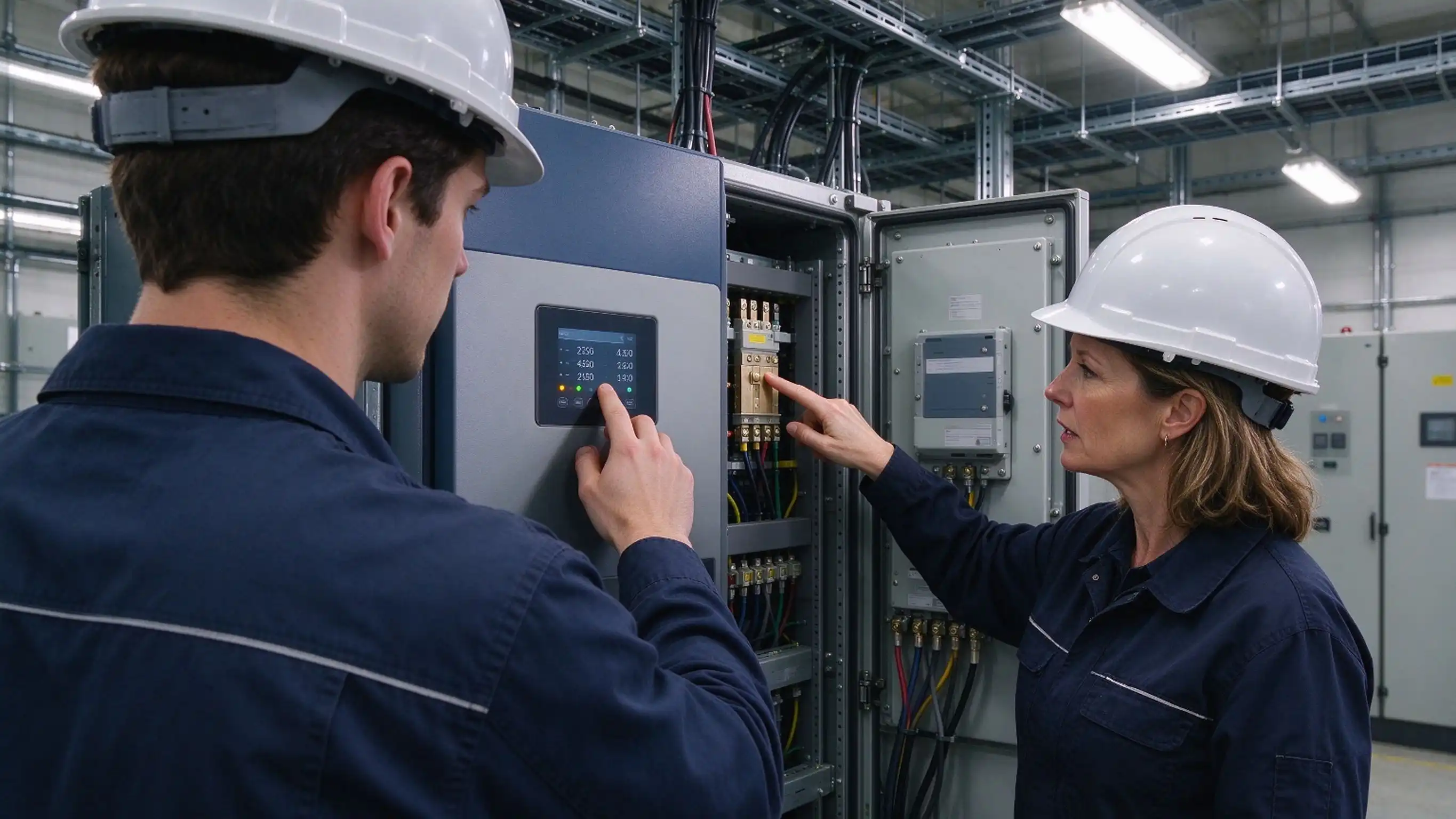
In photovoltaic engineering technology, inverters keep the link to the grid open and change DC to AC. In other words, one fault can stop a whole block of generation. It is the job of technicians to check problem logs, clean dust out of cooling paths, fix connections, and make sure that all settings are correct. Aside from that, they check the power lines that bring energy to homes and businesses. They also test both major and secondary equipment, like safety and control systems. Safety rules have shaped this work. The National Electrical Code in the United States says that PV systems on buildings need to be able to turn off quickly. Technicians need to know how these rules change the way they check things and fix things. The process is to separate the problem, identify what is wrong, fix the issue, and keep a record of the work. This is also how you solve a problem. It is easier to fix the next mistake when there is a written record. Asset managers can also trust the past.
Inspection and Monitoring Routines
When you follow through on your plan, you find problems early on. Any plan for maintenance should include these three checks.
-
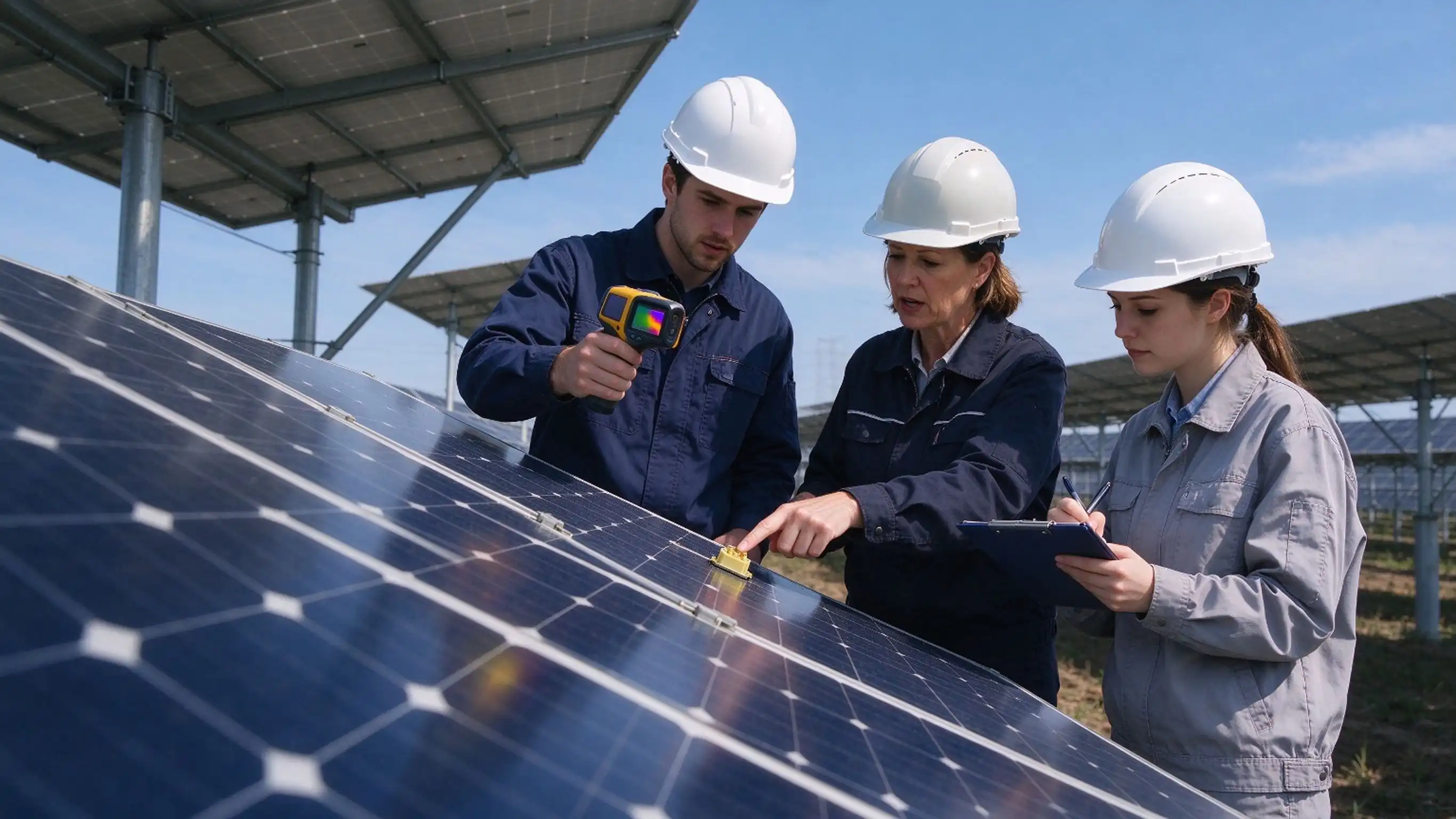
Infrared thermography: You can use a drone or a hand-held infrared camera to find hot spots that are caused by a failed bypass diode, shading, or broken cells. Before heat damage gets worse, the teams look at old photos, mark the strings that need work, and plan how to fix them. Aside from that, regular scans keep track of the state of each module over the life of the plant, which is useful for warranty talks and reviews of the value.
-
EL testing: Electroluminescence imaging finds cracks, flaws, and dead cell areas that are too small for the human eye to see. Owners can scan modules twice, once before they are shipped and again after they have been installed. This lets them tell the difference between ship damage and manufacturing flaws. When techs are taught to read the images, they do it regularly and properly. This means that choices about replacements are based on clear, documented proof.
-
Commissioning and baseline tests: IEC 62446-1 tells us how to record, examine, and test grid-connected PV systems. String voltage, string current, and insulation resistance are some of the tests that give the plant a place to start. To see how it changes, later tests will compare the plant to that norm. This makes it easier to see when wiring is breaking down or slowly getting worse.
Together, these checks build a history of plant health, so teams can spot trends and back repair requests with evidence.
Future Trends and New Developments in Photovoltaic Engineering Technology
AI and Machine Learning in Predictive Analytics
Transformer, temperature, and string data are used by AI tools to learn how plants usually act and then mark any changes that aren't normally seen. AI can put together groups of the most likely reasons for poor performance, which helps crews bring the right parts. Good data and people who can check the results are needed for these tools to work. Low power could be due to shade, dirt, or an electricity problem, but an expert checks to make sure. AI and other technologies are used in project-based learning and other parts of E.C.R. Academy's photovoltaic engineering technology training to help with the digital change. Lots of data, virtual simulation, and the cloud are used in its training tool to get people ready for the smart growth of the PV business.
Storage and Intelligent Microgrids
Solar power plants are being built next to batteries more and more. Energy storage can help keep the balance between making power during the day and using it at night. Smart microgrids give loads in the area more power choices, such as grid power, solar power, and power from storage. They also keep them safe and figure out how much energy they use. You need to know how storage systems work and how to set their capacity. You also need to know about microgrid security, system modeling, planning, and design. People who are in charge of mixed assets need to be able to read data from both PV and storage and fix issues in both. Students at E.C.R. Academy also learn how to keep track of carbon emissions and figure out how much carbon can be bought and sold for PV power plants.
Building Teams Through Project-Based Training
The lessons at E.C.R. Academy are based on real production projects and jobs that people do at work every day. The lessons teach the basics of PV generation, how to make cells and modules, how to change power, and how to use engineering drawing and CAD. Engineers in business and college experts work together to teach. They can practice in a lab for making modules, a construction lab with at least 60 kW of grid connectivity, a teaching base for the O&M business, and an intelligent microgrid lab. People who want to learn can prepare for jobs like O&M engineer, design engineer, and project management engineer. The course can be used by businesses, schools, and industry groups. Since 2010, E.C.R. Academy has helped almost half a million people in China and 28 other countries get trained and pass tests.
Conclusion
Teams can handle solar assets well if they know how to use photovoltaic engineering technology to plan, build, run, and support them. Wear and tear, module flaws, weather stress, and having too much info are the major risks. By letting people compare, standards like IEC 61215 and IEC 61730 help people buy things. When it comes to meeting grid energy goals, PV is better than solar thermal. The site conditions, datasheet figures, and certifications should help you choose which technology to use. Infrared and EL inspections, baseline tests, and checks on the inverter make sure that performance stays on track. Things are getting trickier with AI, storage, and microgrids, but they still need people who understand how electricity systems and module physics work. Skilled and well-trained staff is still the best way to protect long-term energy yield and asset value.
FAQ
1. How long do solar modules keep producing power?
If a module meets the standards of IEC 61215 and IEC 61730, it should last for 25 to 30 years and lose less than 0.4% of its value each year. The National Renewable Energy Laboratory found that the median rate of field decline is about 0.5% per year. This means that there is a spread of real statistics. Always read the guarantee terms on the datasheet.
2. What should a total cost of ownership review include?
I talk about how much it costs, how efficient it is, the temperature coefficient, how quickly it breaks down, the inverter service, monitoring tools, planned maintenance, and staff training. If the price is low at first but the work takes longer or the output drops, it's not worth it. Training belongs on the list because skilled teams work faster.
3. Which maintenance routine protects system efficiency?
Visual checks, infrared scans, EL testing when problems are suspected, inverter checks, and monitoring at the string level should all be done at the same time. After each result, you should compare it to the beginning and fix the issue that led to it. The routine should be planned based on the season and the weather at the location, such as dust, snow, or humidity. This kind of comparison is faster and more accurate when it is done by professionals.
Connect with E.C.R Academy for Photovoltaic Engineering Technology Training
Planning staff training for your solar portfolio or program? E.C.R. Academy offers photovoltaic engineering technology courses built on project-driven learning, international skill standards, and joint teaching by enterprise engineers and college experts. If you are comparing a photovoltaic engineering technology supplier, send your questions to ecr2008@enteredu.com. You can also visit enteredu.com for course details and partnership options.
References
1. International Energy Agency Photovoltaic Power Systems Programme, Snapshot of Global PV Markets, 2024
2. Jordan, D. C. and Kurtz, S. R., Photovoltaic Degradation Rates—An Analytical Review, Progress in Photovoltaics, 2013
3. National Renewable Energy Laboratory, Best Practices for Operation and Maintenance of Photovoltaic and Energy Storage Systems, 2018
4. International Renewable Energy Agency, Renewable Power Generation Costs in 2022, 2023
5. International Electrotechnical Commission, IEC 61215-1: Terrestrial Photovoltaic (PV) Modules – Design Qualification and Type Approval, 2021
6. International Electrotechnical Commission, IEC 62446-1: Photovoltaic (PV) Systems – Requirements for Testing, Documentation and Maintenance – Grid Connected Systems, 2016