Industrial Robotics Technology: Offline Programming Training Guide
Manufacturing floors worldwide face a persistent challenge: downtime costs money, skilled labor is scarce, and precision tolerances shrink year after year. Industrial Robotics Technology addresses these pain points head-on by combining mechanical precision with digital programming workflows. Offline programming—a method where robot paths are designed and verified in simulation before deployment—has transformed how integrators and educational institutions approach automation training. This guide walks through the essentials of offline programming training, from foundational concepts to procurement strategies, equipping decision-makers with actionable knowledge to elevate their automation capabilities.
Understanding Industrial Robotics and Offline Programming
The mechanical arms, controls, sensors, and software that handle dangerous or repetitive factory jobs are all included in Industrial Robotics Technology. Common types of robots are articulated six-axis arms for welding, SCARA units for high-speed assembly, and delta robots for picking up and putting things down. Even though each setup is used for different things, they all need to be able to follow an exact path (Manufacturing Technology Insights, 2023)[^1].
Online vs. Offline Programming
In traditional online programming, which is also known as "teach pendant programming," production stops while an operator walks the robot through waypoints by hand. This method puts people at risk and stops useful tools from being used. Offline programming, on the other hand, creates, tests, and improves robot routes in a virtual world using 3D modeling software. The robot's programs are then downloaded, which cuts down on downtime and gets rid of the need for workers to work near live gear. According to research (Robotics Business Review, 2022)[^2], offline ways can cut writing time by as much as 60% while also making paths better.
Key Software Platforms
ABB RobotStudio, FANUC ROBOGUIDE, KUKA Sim Pro, and Delfoi Robotics are some of the best offline development tools. These tools can find collisions, analyze cycle times, and do reach studies, which let engineers check the functionality of whole workcells before they are installed. Integrators and trade schools need to know how to use at least one of these tools to stay competitive in smart manufacturing settings.
Step-by-Step Offline Programming Training Guide
To get good at offline computing, you need to go from simple ideas to complicated system integration in a planned way. The curriculum at ECR Academy is based on projects and combines theory with hands-on practice to teach the whole process.
Identifying Programming Challenges and Setting Objectives
Learners start by looking at real-life robotic problems like limited cycle times, overlapping workspaces, or parts that are hard to align. Setting clear goals, like cutting the time it takes to do a weld by 15% or getting repeatability within 0.05 mm, grounds the training in results that can be measured. Critical thought and process mapping are emphasized in this part, which are skills that can be used right away on business projects.
Preparing 3D Models and Workpiece Calibration
The base of every offline program is accurate CAD models of robots, fittings, and workpieces. Trainees learn how to use STEP or IGES files in modeling software, set up coordinate frames, and calibrate workpieces so that the virtual and real worlds match up. Calibration is important for making sure that virtual paths work correctly on the plant floor, which is often hard for new programmers.
Path Planning and Collision Detection
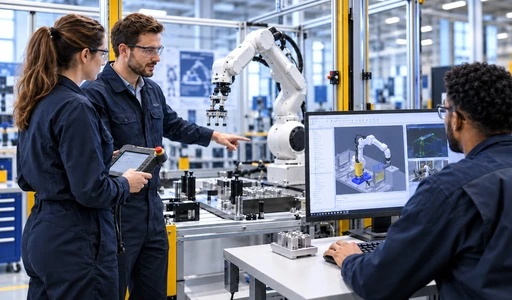
Planning a way well means finding a balance between speed, smoothness, and safety. Students learn finding the center points (TCP) of tools, setting the approach and retract vectors, and finding the best joint setups to avoid singularities. Integrated impact recognition algorithms warn of possible crashes with fixtures or other equipment, which keeps expensive damage from happening. Case studies from body-in-white welding on cars show how zone management and collaboration between multiple robots keep interference from happening in high-density cells.
Virtual Validation and Program Export
Before programs are put into action, they are virtually tested. Cycle-time studies make sure that flow goals are met, reach analysis makes sure that the coverage range is met, and process simulations check the sensor triggers and I/O logic. After approval, the code is changed into a language that the robot understands and sent over a network or USB. One of the best things about Industrial Robotics Technology is that it crosses the gap between digital and real work.
Industrial Robotics Technology Trends and Future Prospects
Automation keeps changing quickly because people want it to be flexible, smart, and connected. Procurement teams can make sure their investments will still be useful in the future by learning about new trends.
AI-Driven Path Planning
Machine vision can now find differences in parts and use artificial intelligence algorithms to improve robot paths in real time. These systems learn from past data and keep improving paths to cut down on cycle time and wear. Integrators that want to get ahead of the competition look at AI-enhanced offline programming as a way to stand out in the bidding process.
AR/VR-Assisted Programming Environments
Augmented and virtual reality interfaces let engineers see how robots move in fully immersive 3D spaces. This speeds up debugging and communication between stakeholders. Early users say that clients can "walk through" planned workcells before building starts, which speeds up project decisions and cuts down on rework cycles (IEEE Robotics & Automation Magazine, 2023)[^3].
Collaborative Robots and Industry 4.0 Integration
Collaborative robots, or cobots, can work safely with humans without guards, which means they can be used in new ways in assembly and inspection. When you create a cobot offline, you focus on force-limited paths and easy-to-use teach modes. Industry 4.0 systems, on the other hand, require robots, PLCs, MES, and cloud analytics tools to be able to share data easily. Fieldbus protocols like EtherCAT, PROFINET, and OPC UA must now be taught in training programs to get students ready for smart factories that are all connected.
Comparing Offline Programming Solutions and Selecting the Best Fit
Which offline programming tool to use depends on the size of the business, the community of robot brands, and the need for scaling. A structured evaluation framework is good for everyone involved in procurement.
Key Evaluation Criteria
- Utilities: Easy-to-use graphical user interfaces cut down on the time needed to get started, which is very important for colleges that have rotating groups of students and integrators who have to finish projects quickly.
- Multi-brand support lets facilities with robot fleets that include ABB, FANUC, KUKA, and Yaskawa Motoman all use the same simulation environment. This makes training easier and cuts down on software costs.
- Scalability: Modular add-ons and cloud-based licensing let companies add more features as the complexity of a project rises, from single-robot cells to digital twins with many lines.
- Efficiency in terms of cost: The costs of licensing, annual maintenance, and training must be weighed against the benefits of increased productivity and fewer mistakes. A five-year study of the total cost of ownership gives a more accurate picture of an investment than just looking at the original price.
- After-Sales Support: Quick expert help, access to knowledge bases, and regular software changes make sure that the product will be valuable in the long run. In mission-critical production settings, how well a vendor handles bug fixes and feature requests is very important.
Comparative Analysis of Leading Platforms
ABB RobotStudio is great for welding and moving things around because it has a lot of libraries and works well with ABB controllers. Because it simulates a vision system well, FANUC ROBOGUIDE is preferred for high-mix, low-volume production. KUKA Sim Pro has advanced kinematics solutions for use in complicated car situations. Universal Robots' UR Sim is designed to help smaller installers program cobots easily. Putting these strengths up against operational needs helps make sure that technology is in line with business goals.
Practical Guide to Procuring Industrial Robots with Offline Programming Capabilities
Successful procurement includes more than just choosing hardware. It also includes checking out suppliers, making sure that the technology will work together, and planning for long-term support.
Assessing Supplier Credentials
Check the certifications of the supplier, like ISO 13849 for functional safety and ISO 9001 for quality management. Ask for client examples and look at case studies from businesses like yours. OEM authorization and white-label flexibility are very important for system integrators who work with Industrial Robotics Technology suppliers to protect their brand and make money.
Technology Compatibility Checks
Make sure that the versions of offline programming tools that work with robot driver firmware are the same. Post-processed code errors can be caused by mismatches, which can delay commissioning. Ask for proof-of-concept models before you buy to make sure that the file sharing processes and support for peripheral devices like vision cameras and servo positioners work as expected.
Cost-Benefit Analysis: Buying vs. Leasing
For high-volume output with known amortization, buying robots and software all at once is the best option. Project-based integrators and educational institutions that are on a tight budget can benefit from leasing because it gives them more options. Subscription-based software rights lower the initial cost, but they require ongoing payments. Find the internal rate of return and net present value to help you decide how to finance the project.
Pricing Benchmarks and After-Sales Training
Six-axis robots for beginners that can be programd offline cost between $30,000 and $60,000. Advanced multi-robot training packages can cost over $100,000. When you add up the prices of tools, commissioning services usually add another 10 to 15 percent. Full training after the sale, including programming, maintenance, and troubleshooting, makes sure that teams can run and change systems on their own, which maximizes return on investment.
Ensuring Safety and Maximizing Efficiency with Offline Programming
In current automation, safety and speed go hand in hand. Offline programming helps with both by letting you do full testing before release.
Improving Workplace Safety Through Virtual Commissioning
Before equipment turns on, virtual approval checks for dangers like pinch points, sudden motion, and not enough guarding. Simulations are used to make sure that international standards like ISO 10218 (for robot safety) and ISO 13849 (for control system safety) are being followed. This lowers risk and protects workers. For trade schools, virtual licensing lets students learn safe ways to do things without putting themselves in danger.
Identifying and Resolving Efficiency Bottlenecks
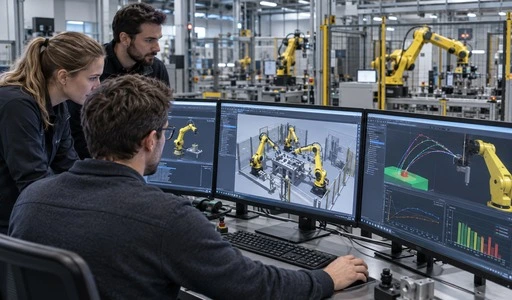
Cycle-time bottlenecks, idle periods, and less-than-ideal tool approach angles can all be seen in simulation data. Engineers make small changes to paths, speed profiles, and the workloads of multiple robots over and over again. Simulation analytics and methods for continuous improvement lead to small increases in productivity that add up over months and years.
Fostering Continuous Improvement and Workforce Skill Development
Offline computing platforms can be used as teaching tools all the time. Teams can try out new ideas—different grippers, rearranged layouts, or adding more sensors—without stopping production. This attitude of trying new things speeds up creativity and makes sure that workers' skills keep up with the changes in automation technologies. Schools that use ECR Academy's Industrial Robotics Technology course say that their graduates can easily move into integrator and OEM jobs and are ready to face problems in the real world right away.
Conclusion
Offline code is a key part of deploying Industrial Robotics Technology in a way that is safe, efficient, and flexible. By virtualizing robot programming workflows, businesses cut down on downtime, lower safety risks, and speed up the commissioning process. This guide covers the basic scientific information, step-by-step training paths, new trends, buying strategies, and safety issues that are important for business-to-business (B2B) users, such as vocational schools and system developers. With this information, people in charge can safely choose platforms, check out suppliers, and create training programs that offer measured value. As the use of smart manufacturing grows, those who are good at offline programming will set themselves apart from those who aren't.
FAQ
1.What is the difference between offline and online programming in Industrial Robotics Technology?
When operators use online programming, which is also called teach pendant programming, they have to walk the robot through each motion by hand while production stops. This method takes a long time and could be dangerous. Offline programming creates and tests robot paths in a virtual world using simulation software. Once the tests are complete, the program is downloaded to the real robot. This method cuts down on downtime, raises safety standards, and makes the way better.
2.How long does it take to train someone in offline programming?
Training times depend on how much experience the person has and how hard the program is. Beginners who know the basics of electrical and mechanical skills can become functionally proficient in 4 to 6 weeks with the help of organized, project-based lessons. Multi-robot coordination, digital twin integration, and vision-guided programming are some of the more advanced topics that need an extra two to three months of hands-on practice.
3.Can offline programming software support multiple robot brands?
Yes, a lot of platforms, like Delfoi Robotics and Visual Components, handle more than one brand. For example, they can work with ABB, FANUC, KUKA, Yaskawa Motoman, and Universal Robots all in the same simulation setting. This feature makes training and managing software easier for places that use mixed robot teams.
4.What are the typical cost savings from adopting offline programming?
Companies often say that programming time has been cut by 50–70%, which means that projects are finished faster and costs for labor are lower. Fewer mistakes during physical commissions mean less money spent on repairs, and less downtime means more money made from production. For medium to large integrators, return on investment often goes over 300% in five years.
Partner with ECR Academy for Comprehensive Industrial Robotics Technology Training
Industrial Robotics Technology can be trusted from ECR Academy, which offers project-based training that combines theory and practice. Our classes teach on-site programming, PLC control, offline simulation, machine vision, digital twins, system integration, intelligent operation and maintenance, and more. They cover the whole process, from programming to deployment. Learners get real-world skills that meet the needs of the smart manufacturing industry when enterprise engineers and academic experts teach together.
Our cutting-edge virtual training tool mimics real-life production settings, so you can try new things without risk and quickly improve your skills. Our licensing and white-label choices are flexible enough to fit a wide range of relationship models, whether you are a vocational school looking for scalable training infrastructure, a system integrator looking to work with an OEM, or a maker of automation equipment building up your own capabilities.
With 16 years of experience working with almost 500,000 people in 28 countries, we offer more than just training. We also offer a full skills environment that includes certifications, competition support, and ongoing expert advice. Contact us at ecr2008@enteredu.com or visit enteredu.com for more information on our programs to talk about how our Industrial Robotics Technology training can improve the skills of your team and speed up your automation roadmap.
References
1. Manufacturing Technology Insights. (2023). The Evolution of Industrial Robotics in Modern Manufacturing.
2. Robotics Business Review. (2022). Offline Robot Programming Reduces Downtime by 60%.
3. IEEE Robotics & Automation Magazine. (2023). Augmented Reality Interfaces for Robot Programming.
4. International Federation of Robotics. (2023). World Robotics Report 2023.
5. Automation World. (2022). Selecting the Right Offline Programming Platform.
6. Journal of Manufacturing Systems. (2023). Virtual Commissioning and Safety Compliance in Robotics.


_1781601799781.webp)