Industrial Production Virtual Simulation & Development: Course Tips for Beginners
Starting your journey in industrial production virtual simulation might feel overwhelming, but here's the truth: this technology is transforming how manufacturers design, test, and optimize production lines without disrupting real-world operations. Industrial Production Virtual Simulation & Development combines digital twin methodologies, 3D modeling, and browser-based platforms to create immersive training environments where learners master equipment recognition, process optimization, and scripting—all essential skills for today's smart manufacturing landscape. Whether you're an educator building a state-level training base or a procurement manager evaluating simulation platforms, understanding the fundamentals and practical pathways into this field will help you make confident, informed decisions that align with both educational standards and industrial needs.
Understanding Industrial Production Virtual Simulation
Virtual simulations are no longer just for practicing theories. It is now the foundation of programs that help people get ready for work in fields ranging from putting together cars to packaging semiconductors. Modern simulation platforms can mimic dynamic production workflows like conveyor systems, robotic cells, and material handling in a risk-free digital environment, while older computer-aided design tools only work with static models.
What Makes Virtual Simulation Different from Traditional Methods
Physical equipment is often used in traditional training, which is expensive and can be dangerous. Virtual simulation gets rid of these problems by letting students connect with 3D models of industrial tools that look and work just like the real thing. Platforms with B/S architecture let users receive training courses directly through web browsers, so they don't have to worry about installing anything or making sure it will work with other programs. This ease of access is especially helpful for organizations that run various training sites or offer choices for learning from home.
Core Workflow in Virtual Simulation Training
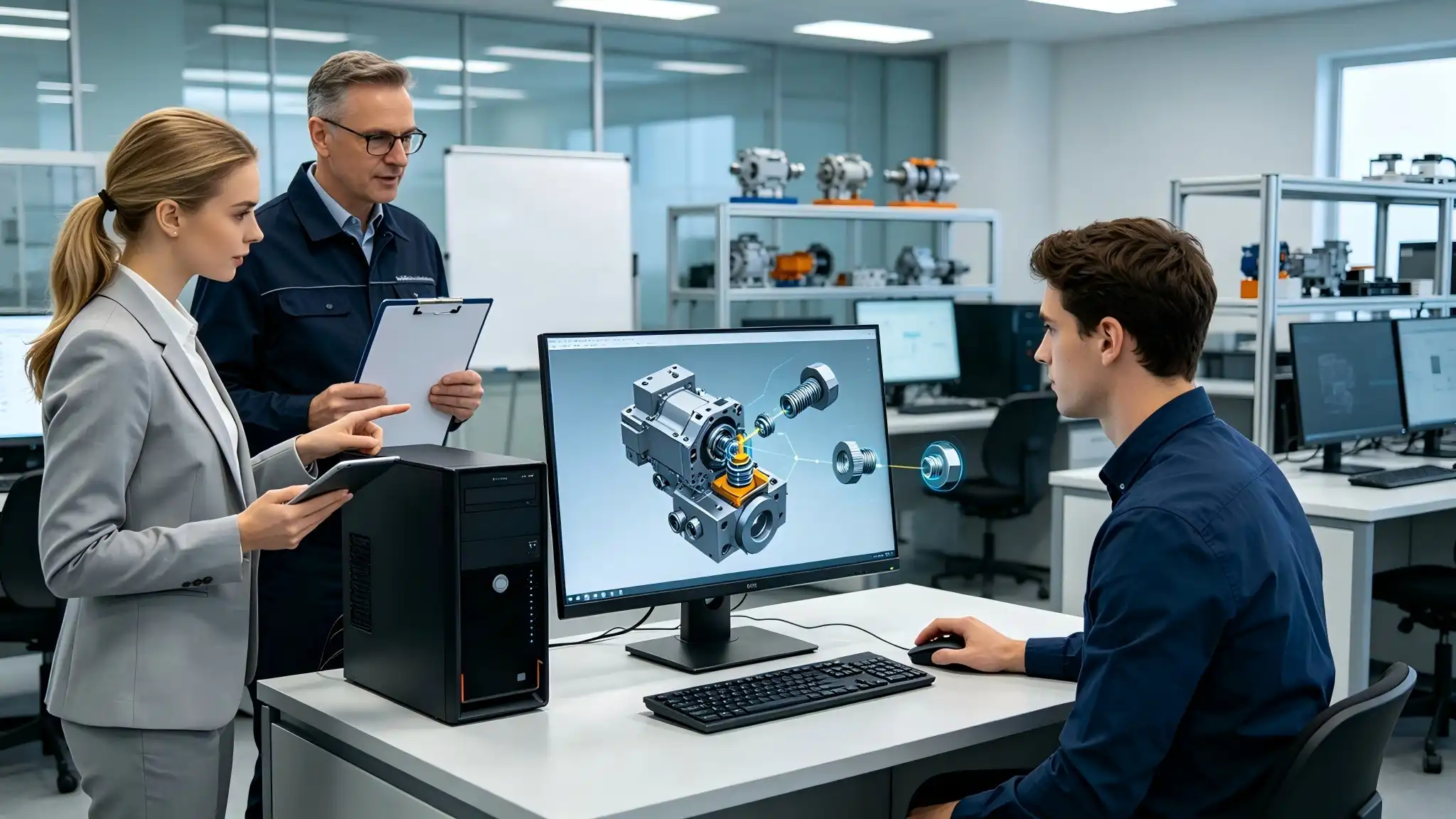
A typical virtual simulation workflow starts with equipment recognition. This is where students learn to recognize parts and understand how they work by interacting with multimedia like pictures, videos, and voice narration. Next is motion control, where students program the actions of objects to act like real-life mechanical processes such as transmission, rotation, and translation. The next step is to create the production process, which combines these separate parts into assembly lines that work well together. Then, more advanced students move on to plug-in development and writing scripts in JavaScript or TypeScript to make their own interaction logic. This prepares them for jobs that need both technical knowledge and creative problem-solving.
Key Applications Across Manufacturing Sectors
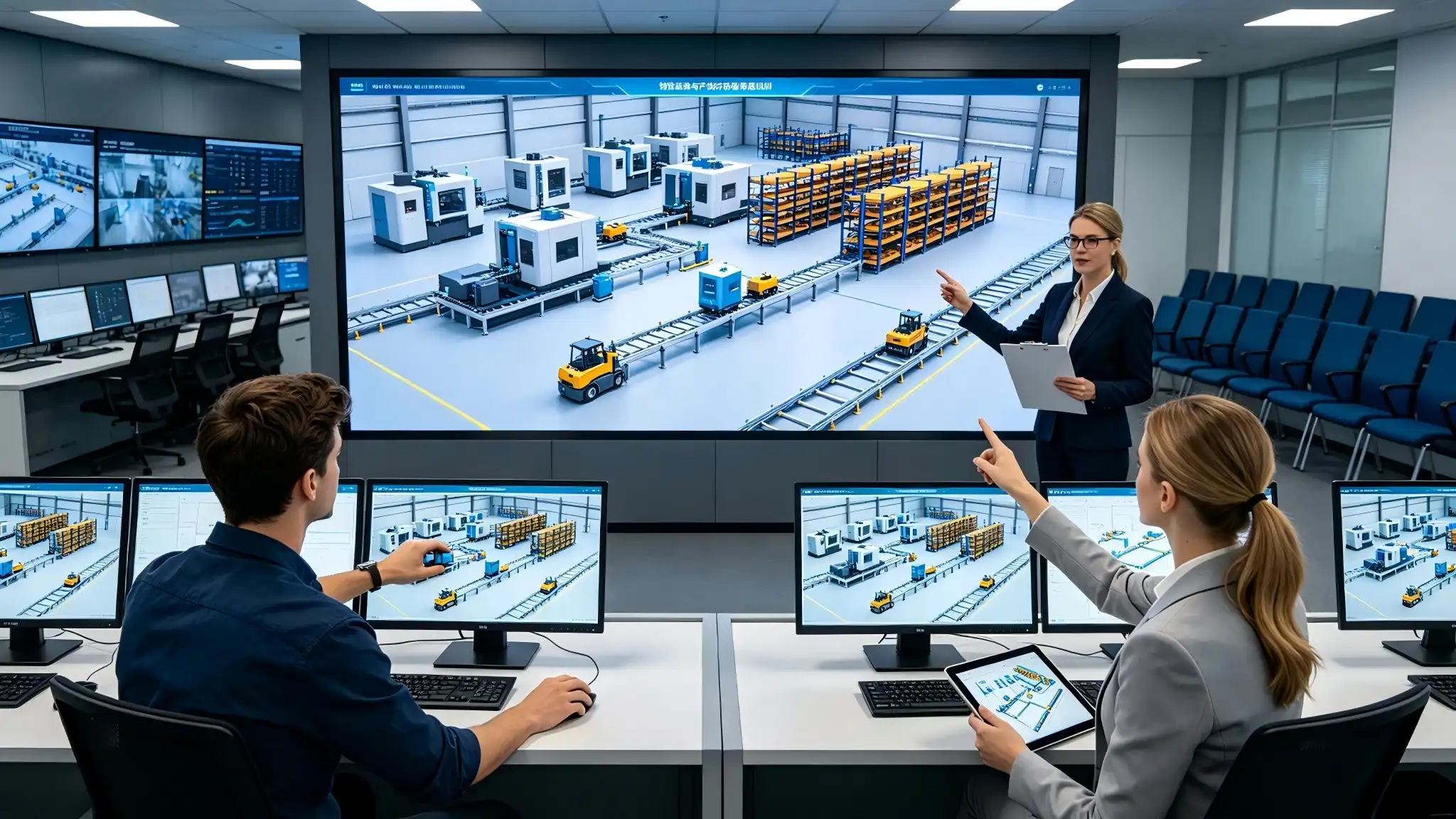
Virtual simulation can be used for many different things. For example, testing the layout of a factory virtually helps manufacturers find inefficient spaces before they start building. Optimizing a production line virtually lets engineers stress-test throughput under different load conditions. And training workers virtually gives them hands-on experience in situations that would be too dangerous or expensive to recreate physically. Simulations are used by auto plants to plan how to use multi-robot welding cells, and electronics companies model high-speed surface-mount technology lines to make sure that timing mistakes and misaligned parts don't cause too much output loss.
Benefits and Business Value of Virtual Simulation in Industrial Production
Putting money into virtual simulation technology pays off in a number of ways, including lower costs, less risk, and more strategic flexibility. When looking at modeling platforms, people who make decisions need to think about more than just the initial costs. They also need to think about the long-term business gains and how well the platform fits with digital transformation roadmaps.
Reducing Costs and Accelerating Development Cycles
It takes time and money to make a physical prototype. For each cycle, you need raw ingredients, work, and machine hours. This cycle is sped up by virtual simulation, which lets engineers test different designs right away and find problems before they get to the factory floor. In the same way, educational institutions benefit: instead of buying duplicate equipment for each training lab, schools use browser-based modeling settings that let any number of people use them at the same time. This scalability greatly reduces the cost of capital while increasing the number of people who can be trained.
Enhancing Risk Management and Quality Assurance
Teams can model failure modes and edge cases that would be too dangerous to try in real life by using simulation settings. For instance, automated guided car traffic management systems can be put through their paces during times of high traffic to find out what might cause traffic jams before they are put into use. Virtual commissioning checks vacuum pick-and-place processes in cleanroom production to avoid contamination risks. Companies can cut down on downtime, warranty claims, and fines for not following the rules by finding bottlenecks and quality problems early on.
Supporting Industry 4.0 and Digital Transformation Initiatives
These days, manufacturing needs to be flexible. Production lines need to be able to quickly change to new materials, goods, and rules. Through the OPC-UA and MQTT protocols, virtual simulation platforms can connect to business systems. This lets digital models and actual assets share data in real time. This closed-loop feedback helps with ongoing growth cycles. Simulation results help change control parameters that make throughput more stable and better use of resources. Professionals in procurement know that simulation tools are in line with the bigger goals of Industry 4.0, which makes them strategic investments rather than tactical purchases.
How to Choose the Right Industrial Production Virtual Simulation Software
When choosing modeling software, you need to think about how well it works, how much it costs, and how technical it is. Teams in charge of buying things have to use criteria that take into account both short-term training needs and long-term goals for the institution.
Core Procurement Criteria: Features and Usability
First, look at the depth of the features. Does the platform let you edit and preview scenes in real time? Can people use a single interface to handle multimedia materials like textures, animations, and audio? Look for platforms that let you do both code-based Industrial Production Virtual Simulation & Development and visual scripting, so that both new users and experienced developers can use them. Usability is also important. Easy-to-use drag-and-drop interfaces cut down on the time it takes to get started, and detailed documentation and tutorial libraries help people learn faster. Platforms that let you add more features gradually, starting with easy recognition functions and then moving on to plug-in development, work best for a wide range of learners.
Scalability and Integration Capabilities
Scalability tells you if a platform can grow with your business. Browser-based B/S designs work best here because they don't require a license for each device and let users access from anywhere. It's also important to know if the simulation platform can share data with your learning management system, student information system, or enterprise resource planning software. These connections are made easier by open APIs and standard communication protocols. This makes sure that simulation data is used in larger institutional decision-making and analytics processes.
Licensing Models and Long-Term ROI
Structures for licensing are very different. Some sellers charge by the seat, while others offer institutional licenses that let an unlimited number of people use their products. Think about the total cost of ownership over the next three to five years, taking into account support services, maintenance fees, and the cost of upgrades. Platforms that offer free trials or demo environments let you try something out before you commit to spending money on it, which lowers the risk of buying something. When schools ask for state-level or national virtual simulation training base funds, they need to make sure that the vendors' products meet the application requirements. This includes making sure that the products meet technical standards and provide the necessary paperwork for grant submissions.
After-Sales Support and Customization Options
The quality of technical help has a direct effect on the success of operation. Implementation problems are kept to a minimum by vendors who offer dedicated onboarding help, teacher training programs, and quick troubleshooting services. Customization options are also very important: can sellers create unique workplace scenarios that fit your curriculum? Do they give you source files and development kits so you can make your own content? The least risky option for procurement managers in charge of big training base projects is to work with vendors that have a history of providing turnkey solutions that include the platform, curriculum, and technical support.
Step-by-Step Guide for Beginners: Implementing Virtual Simulation in Production
Launching a virtual training program requires careful planning, getting everyone on the same page, and making small changes over and over again. It is more likely that both educational and operational goals will be met if you follow a structured implementation roadmap.
Define Clear Objectives and Engage Stakeholders
Start by stating clear goals: Are you helping students get certifications? Teaching current workers how to use new production tools? Helping study how to make processes run more smoothly? Platform choice and curriculum design are guided by clear goals. Get academic leaders, professors, IT administrators, and industry partners involved early on to make sure everyone is on the same page about technical needs, budget limits, and success measures. If an institution wants to get government funding, it has to show how its simulation capabilities help meet national priorities for workforce development. This is done by connecting the institution's goals to the criteria used to evaluate grants.
Collect Accurate Data and Develop Virtual Models
For a simulation to be effective, the raw data must be correct. Get details about the equipment, process flow diagrams, cycle time benchmarks, and statistics on failure modes. Work with partners in the industry to get access to private technical data and make sure the model is correct. After gathering data, Industrial Production Virtual Simulation & Development teams use the platform's scene designer to create virtual models by adding 3D objects, setting up kinematic behaviors, and writing scripts for interaction logic. Iterative testing makes sure that virtual models can accurately simulate how things work in the real world within a certain range of errors.
Run Simulation Scenarios and Conduct Iterative Analysis
Once the models are made, they should be run in simulations that are based on real-world conditions. Stress-test throughput during peak demand, model equipment breakdowns to test recovery plans, and look at trends of resource use to find waste. Write down what you found and make changes to your models based on the differences you saw. In industrial commissioning, engineers gradually change control settings until systems meet performance goals. This iterative method is similar.
Embed Training and Establish Continuous Improvement Cycles
Use simulation modules in structured training programs, starting with simple exercises on recognizing equipment and working up to more difficult ones on designing complex production processes. Use platform analytics to keep an eye on how well students are doing, find information gaps, and make changes to the program as needed. Set up feedback loops so that both teachers and students can suggest ways to make simulation scenarios better. This will help create a mindset of constant growth. Training materials are always up-to-date with the latest changes in manufacturing practices thanks to regular platform updates that add new industrial case studies and larger scripting libraries.
Real-World Impact: Case Studies Across Industries
By looking at how other companies have used virtual simulations successfully, we can learn a lot about their real benefits, common problems, and best practices.
Automotive Sector: Multi-Robot Coordination Optimization
A car company had problems with its body-in-white welding line because six industrial robots were doing work that overlapped in a small area. During physical testing, crash risks were found, which caused delays that cost a lot of money. Using virtual simulation software, engineering teams made a model of the whole cell and tested different ways for it to move and how it should be put together. Through simulation, the best paths were found that avoided collisions and cut cycle time by 18%. Virtual commissioning cut the time needed for onsite commissioning from six weeks to three, which saved a lot of money on workers and tools.
Electronics Assembly: High-Speed Surface-Mount Technology Validation
A factory that puts together semiconductors had a hard time with yield losses caused by timing mistakes in vacuum pick-and-place operations. Using old-fashioned ways of debugging meant stopping production, which cost a lot of time and money. Engineers were able to make a copy of the whole assembly line using virtual simulations. This included the systems for moving parts and checking for quality. Teams found micro-vibrations from upstream machines that made it hard to place parts by modeling random failure patterns using past data. Using simulations to guide vibration damping measures led to a 7% increase in first-pass yield, which saved millions of dollars every year.
Vocational Education: State-Level Training Base Approval
A technical college that wanted to be named a state-level virtual simulation training base had to show that their curriculum was fully integrated and that their platform could be used by more people. Working with a modeling software company, the school set up a browser-based tool that lets students do things like programming traffic signal systems, analyzing reducer mechanisms, and putting together unmanned aerial vehicles. The faculty got a lot of training on scriptwriting and scenario development, which let them make material that was special to their school. The platform's B/S design allowed online access when campuses had to close because of the pandemic, so training could continue as planned. The college's application was successful, and it got funding that let them add more simulations to help business partners in the region.
Conclusion
Industrial production virtual simulation is a smart investment for businesses and schools that want to prepare students for work and improve their operations. Organizations can use simulation platforms that give them measurable returns by grasping basic ideas, checking software against buying standards, and following organized execution paths. Virtual simulation is a tried-and-true way to reach your goals, whether they are writing grant applications for state-level training camps, improving factory processes, or giving students skills that will get them jobs. The complete training programs at ECR Academy use industry-standard tools, expert teachers, and project-based learning to get students ready for jobs in virtual reality engineering, smart manufacturing, and digital twin Industrial Production Virtual Simulation & Development.
FAQ
1. Can beginners without programming experience succeed in virtual simulation courses?
Of course. Visual scripting tools built into modern simulation platforms let beginners make interactive scenarios using drag-and-drop interfaces, so they don't need to know how to code first. As students get better, they move on to JavaScript and TypeScript programming with the help of organized lessons and hands-on projects. The lessons at ECR Academy are designed to work for students of all skill levels. They start with simple exercises on recognizing basic equipment and work their way up to more complex ones on designing complex production processes.
2. What industries benefit most from virtual simulation training?
Virtual reality training is useful in many fields, such as aerospace, making cars, assembling gadgets, logistics and warehousing, and green energy. Virtual commissioning and digital workforce development are very helpful for any industry that uses complicated mechanical systems, automated production lines, or high-risk work environments. When schools work with local factories, they can often change the simulations to fit the needs of the local business. This helps graduates get jobs and supports economic development goals.
3. How long does it take to implement a virtual simulation training program?
Implementation times depend on how ready the school is, how complicated the platform is, and how much customization is needed. It usually takes two to three months to set up the platform for the first time and train faculty. Setting up unique workplace situations and adding simulation material to current lessons could add three to six months to the schedule. When institutions apply for government funding, they should make sure that their implementation schedules and grant application deadlines are in sync. They should also make sure that the platform's features and supporting documentation meet all evaluation criteria. Through scenario libraries that are already made and committed technical support, ECR Academy offers turnkey solutions that shorten these timelines.
Partner with ECR Academy: Your Industrial Production Virtual Simulation & Development Supplier
Since 2010, ECR Academy has given nearly 500,000 students in 28 countries the skills they need to be ready for the future. Our Industrial Production Virtual Simulation & Development program includes project-based learning, technical standards from around the world, and a B/S platform that can be used in any browser without having to be installed. Our team of enterprise engineers and academic experts can help your institution with everything from designing the curriculum to deploying the platform and continuing to develop faculty. This is true whether you are working on a state-level training base application, wanting to increase your digital manufacturing capabilities, or forming a partnership with industry leaders to provide cutting-edge workforce training. Visit or email us at ecr2008@enteredu.com to learn more about how our tried-and-true simulation training can change your technical education programs and prepare your students for success in smart manufacturing careers.
References
1. Chen, J., & Liu, W. (2022). Digital Twin Technology in Smart Manufacturing: Applications and Future Trends. Beijing: Mechanical Industry Press.
2. International Society for Technology in Education. (2021). Standards for Virtual Reality and Simulation in Technical Education. Arlington: ISTE Publications.
3. Li, X., Zhang, H., & Wang, S. (2023). "Browser-Based Virtual Simulation Platforms: Architecture, Development, and Educational Applications." Journal of Manufacturing Systems and Engineering, 45(3), 287–302.
4. National Institute of Standards and Technology. (2020). Framework for Cyber-Physical Systems in Industrial Training Environments. Gaithersburg: U.S. Department of Commerce.
5. Schmidt, M., & Hoffmann, T. (2021). Virtual Commissioning and Digital Prototyping: Industrial Practice and Educational Integration. Munich: Hanser Publishers.
6. Zhao, Y., Peng, L., & Huang, Q. (2023). "Evaluating Learning Outcomes in Project-Based Virtual Simulation Training for Advanced Manufacturing." International Journal of Engineering Education, 39(2), 412–428.


_1781601799781.webp)