From CAD Modeling to Production: Innovative Design and 3D Printing for Additive Manufacturing
When you move from CAD modeling to production, you have to follow design rules, choose the right process, run simulations, print, finish, and inspect the part. In one project-driven sequence, innovative design and 3D printing for additive manufacturing teach the entire path. Learners start with requirements and 3D models. They then use simulations to check motion and pick between FDM, SLA/LCD resin, and SLM metal processes. Finally, they put together and test real parts. This guide was written to help college presidents and training managers figure out what a good Additive Manufacturing Course should cover. Each step below has something to do with a real production need.
Why Additive Manufacturing Is Changing Product Design?
What Layer-by-Layer Building Makes Possible
An ISO/ASTM 52900 list divides the processes used in additive manufacturing into seven groups. Each group builds a part one layer at a time from a digital file. This method gets rid of many of the limits of machining, molding, and putting things together. To make things that a cutter or mold can't reach, engineers can use internal channels, lattice structures, lightweight shells, and consolidated assemblies. The method also speeds up the process from CAD file to prototype and works with bridge manufacturing, on-demand supply, and low-volume production. That being said, I always tell program directors the same thing: technology doesn't always win. Additive manufacturing should only be used when it makes sense in terms of quantity, material, tolerance, certification, lead time, and total cost of ownership.
Where 3D Printing Fits Against CNC and Injection Molding?
Each way of making things has its own clear strengths. For example, innovative design and 3D printing for additive manufacturing is good at low volumes, complex internal geometry, customization, and quick design changes. Most of the time, CNC machining gives you tighter tolerances, a better surface finish, and more materials to choose from. When you make a lot of injection molds, each one costs less, but making the molds costs money and time. Visual prototypes, functional prototypes, bridge production, and qualified end-use parts are also fair categories to compare. Students should learn how to make a realistic cost model that takes into account things like CAD preparation, setup, materials, finishing, inspection, shipping, inventory, not having to make tools, less assembly, and the value of shorter lead times. That habit turns a class in printing into real engineering sense.
Part Consolidation in Practice
One well-known example is in the field of aerospace. GE Aviation changed the fuel nozzle tip of its LEAP engine so that it only had one printed metal part instead of 20 separate parts. The company said that this made the engine about 25% lighter. There was a gain from being able to design freely, not just from the printer. The same reasoning is used by automotive teams for making lightweight brackets, ducts, cooling parts, and assembly fixtures. It is important for medical teams to print parts that are biocompatible and follow government rules when they print anatomical models, surgical guides, and orthotic parts. For use in aerospace, strict qualification and tracking requirements are also needed. This is why design thinking needs to be taught before machine operation in a course.
Building an Additive Manufacturing-Ready CAD Model
Start With Function and Process Rules
Clear functional requirements for a print ready model are necessary. These include loads, temperature, chemical exposure, service life, tolerances, interfaces and inspection requirements. Then I alter the geometry to match the procedure I have selected. There are a host of elements that may modify the design, wall thickness, overhangs, support structures, clearances, drainage holes, powder removal, access for post processing, etc In addition to their CAD work, I recommend students study ISO/ASTM 52910, which provides official guidance on design for additive manufacturing (DfAM). Before releasing it, the model must be waterproof, dimensionally accurate, properly scaled and produced in a format that the slicer can read without any trouble. The 3D modelling module therefore teaches parametric modelling for parts and assemblies. If you don’t follow this list most likely your first print will fail.
Lightweight and Integrated Structure Design
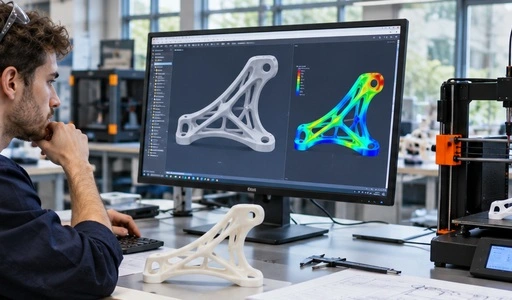
With additive manufacturing, you have more freedom in the design of things. The course employs multi-part integration and assembly-free architectures to assist students in reducing part numbers and facilitating assembly. They also include lightweight strategies such as topology optimisation, lattice structures and weight-reduction holes, and workouts that provide a specific weight objective. The aim is simple, lose the additional weight, but keep the portion working. These technologies may be used for products in aerospace, automotive and robotics sectors. The selection of the rib, shell and fillet is equally crucial, since it influences the strength and the print quality. A student is ready for a true design assessment when they can describe how each element functions, not how it appears.
Motion Simulation Before the First Print
A lot of printed stuff moves. I verify motion in software before I drop money on material. The lesson explains how to assemble mechanisms such as belt drives, gear drives, linkage drives, and how to add restrictions and motion pairs. Students calculate gearbox ratios, match speeds and conduct virtual motion simulations to ensure that the mechanism performs as intended. Then they export motion animations that illustrate how the product operates. This is a talent that may be useful in design reviews and project presentations. Simulation and construction analysis may also identify risks relating to structure, heat, deformation and support. It is significantly cheaper and less time consuming to discover a collision in software than on a piece produced.
Selecting 3D Printing Technology, Materials, and Post-Processing
FDM, SLA/LCD, and SLM Compared
Innovative design and 3D printing for additive manufacturing covers FDM (material extrusion), one of the three basic methods in the course. The other two are SLA/LCD which is vat photopolymerization and SLM which is powder bed fusion. FDM is good for affordable prototypes and fittings and massive, unimportant pieces. SLA and LCD resin printing can provide smooth surfaces with precise features suitable for visual or practical prototypes. SLM metal printing works well for objects that must be sturdy, heat or corrosion resistant, or have interior channels. But generally the pieces have to be heated, the supports removed and the examination done more thoroughly. SLS and MJF can also print complex polymer pieces without supports. A process-selection matrix is a good approach to compare these elements and I advise my students to build one for every project.
Matching Materials to Operating Conditions
The choice of materials depends on where the component will function, not on how the prototype appears on a desk. We have to consider the strength, rigidity, toughness, temperature resistance, chemical stability, UV exposure, moisture, vibration, abrasion and service life of the metal and polymer alternatives. For regulated usage, biocompatibility, food Contact compliance, electrical performance or traceability may need to be incorporated. FDM parts also show anisotropic behaviour, i.e. the strength depends on the building direction and layer direction. Therefore, the construction orientation should be considered throughout the design phase. For FDM, the training explains how to adjust settings depending on material. For SLA/LCD it is about resin characteristics and post-curing. Sustainable design also puts another filter on top: material efficiency, capacity to recycle, ability to mend, and the product’s lifetime.
Post-Processing and Assembly
Almost seldom does a printed part exit the machine clean. Next stages are to remove the support, sand, join, patch and finish the surface. Metal parts may require machining, heating or bead blasting additionally. Coating, polishing, vapour smoothing and dying may all improve the appearance and performance of anything, but each procedure might modify the size, cost and mechanical qualities of the object. Learners must intend to complete while they are creating not after they have printed. Careful planning keeps tolerances the same. The final section of the course covers surface finishing, putting the pieces together, adjusting them, verifying for correctness and making sure they function. Thus, students complete the full procedure, from printing the pieces to testing the assembly. They also learn proper methods of using tools and measuring gadgets and keeping equipment secure.
From Prototype to Qualified Production Part
A Controlled Design-to-Production Workflow
A controlled process reduces technical risk and avoids costly and unnecessary rework. It begins with a list of all the requirements to be satisfied in terms of performance, compliance, quantity, cost, delivery and supply chain. The engineering, production, quality and procurement departments review the CAD model. Version control prevents old files from going to production. Next phases include simulations and construction analyses, then inspections and testing of representative prototypes before any pilot runs. Each handoff has a separate owner responsible for it . All materials, parameters, post-processing, inspection plans, packaging and engineering-change processes are reviewed for approval before proceeding to production. The course is structured in the same sequence: analysis of needs, design of structures, simulation of motion, planning of processes, printing, assembly and testing.
Quality Checks and Risk Control
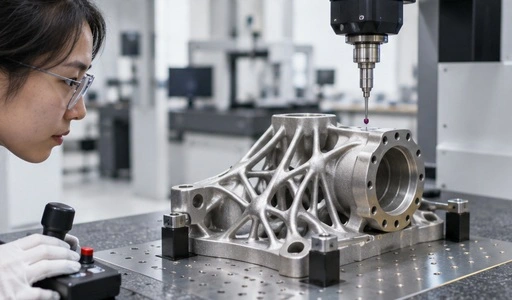
Known concerns associated with any additive process include warping, shrinkage, porosity, inconsistent strength, dimensional variations, surface imperfections, and incomplete support removal. Quality teams are responsible for them with inspections which can be measured. Coordinate measurement equipment verify sizes, surface roughness tests check finish and industrial CT scanning may discover holes or particles trapped within. Opinions are evidence, with these checks. Tensile testing to ASTM E8/E8M standards is used to confirm mechanical qualities. Hot isostatic pressing may result in less porous metal pieces. Pilot orders and initial item inspections reduce the exposure risk before going major. When buying from outside suppliers, individuals also need to make sure that the equipment, calibration, material control, operator certifications, quality systems, Incoterms, data security and after-sales assistance are all covered.
Verification, Release, and Continuous Improvement
The buyer and seller should agree on criteria to test acceptability for size, fit, function, appearance, mechanical characteristics and environmental performance before approval is given. Then we have a comprehensive record of inspection reports, test findings, pictures and authorised samples. This documentation also serves to protect the engineering, quality and buying teams in case of issues in the future. The first-article and pilot-batch validations verify that the design behaves the same on multiple builds and parts. After the product launch, teams track failure rates, delivery performance, dimensional stability, material utilisation and feedback from consumers. There are signals of progress: fewer support, shorter cycle time, fewer material, less finish work. When students write each step down like this, they build habits they can utilise in any production environment.
How to Choose an Additive Manufacturing Course Partner?
A Project-Driven Curriculum Built on Skill Standards
The E.C.R. Academy's course on innovative design and 3D printing for additive manufacturing combines theory and project-based, hands-on learning via practical design and printing jobs. It offers 10 learning modules that cover the foundations of product design, mechanical transmission, 3D digital modelling, motion simulation, additive processes and post-processing. The design is based on worldwide standards for additive manufacturing abilities and criteria for best practices in the sector. This encourages the growth of skill in several professions. After our students are done, they may design digital products, integrated structures, lightweight design, simulation verification, and produce printed parts. This course is for those who are new to product design since it begins with the fundamentals and then goes on to requirement analysis, structural design and printing.
Joint Instruction by Enterprise Engineers and College Experts
Faculty is as vital as tools. The course uses joint teaching. Business engineers have project experience and college lecturers have prepared teaching. This pairing allows businesses and schools to connect what students learn in the classroom to what they do in the real world. If you are a newbie, you may obtain guidance from corporate mentors, who will answer questions and guide initiatives. In 2010, E.C.R. Academy trained and tested approximately 500,000 individuals in China and 28 other countries. It also works with 3300+ specialists and 500+ enterprises. It has also developed more than 60,000 learning items, including test banks, courseware, standards and case studies. These figures are for all of our programs and I am offering them to you so that you may analyse our experience for yourself.
Learning Platform and Planning for Your Institution
The learning platform is built on 3D CAD software and includes numerous printing methods including FDM, SLA/LCD resin and SLM metal equipment. Teaching tools, including micro-lesson videos, operation demos and project examples, may be utilised for online and offline learning. Windows can run applications like Solidworks or CATIA or slicing software. Licenses may be offered by schools and training institutions or cloud platforms. The online simulation capability allows students to practise motion simulation without needing to utilise software on their own PCs. Buying and maintaining SLM metal systems is costly, therefore program directors might divide their strategy into phases, beginning with the design workflow and process rules. Firstly, set the scene, then examine the technology, materials, deliverables and support from each supplier. Tell me what your objectives are and we can chat about a decent strategy.
Conclusion
Making the switch from CAD modeling to production in innovative design and 3D printing for additive manufacturing depends on choices made a long time before the printing starts. Additive manufacturing can make internal channels, lattice structures, and parts that fit together better, but when it's better than CNC machining or injection molding depends on cost, quantity, tolerance, and certification. A print-ready model follows the process rules and functional requirements, and motion simulation finds problems with the mechanism early on. Different needs can be met by FDM, SLA/LCD, and SLM. The final performance is also affected by the material used and any post-processing that is done. A prototype is turned into a qualified part with the help of controlled workflows, inspection methods like CMM, CT scanning, and tensile testing, and agreed upon acceptance criteria. Learners get skills that are useful in the workplace when they go through this full sequence of training, which includes project work and lessons taught by both business engineers and college experts.
FAQ
1. Can beginners take this course?
Yes. In this course, you will learn the basics of product design. Later, you will move on to requirement analysis, structural design, motion simulation, and 3D printing. People learn new things one step at a time. Micro-lesson videos, operation demonstrations, and business mentors all help people who are just starting out.
2. Which printing processes does the course cover?
It talks about FDM, SLA/LCD resin printing, and SLM metal 3D printing. Learners also practice post-processing, putting together, and testing, so they can follow a design from a digital model to a finished product that has been checked.
3. Does the course use real engineering projects?
Yes. Students learn through projects that are based on real design and printing tasks for additive manufacturing, and enterprise engineers help with the projects.
4. What jobs can learners prepare for?
People who want to learn can get ready for jobs like industrial designer, product structure designer, mechanical designer, reverse engineering engineer, 3D modeling engineer, and additive manufacturing process engineer.
5. Is professional software required?
Yes. For the course, 3D CAD software like SolidWorks or CATIA plus slicing software for Windows is used. Licenses can be given out by schools or training centers, and the online simulation feature lets you practice even if you don't have any local software.
Plan Your Innovative Design and 3D Printing for Additive Manufacturing Program With E.C.R Academy
Ready to make a program that will take your students or technicians from CAD to production? As an innovative design and 3D printing for additive manufacturing company, E.C.R Academy offers project-based courses that meet international skill standards and are taught by both business engineers and college experts. Send an email to ecr2008@enteredu.com with your course information and the number of students you want in the class.
References
1. ISO/ASTM 52900: Additive Manufacturing — General Principles — Fundamentals and Vocabulary, 2021
2. ISO/ASTM 52910: Additive Manufacturing — Design — Requirements, Guidelines and Recommendations, 2018
3. Additive Manufacturing Technologies: 3D Printing, Rapid Prototyping, and Direct Digital Manufacturing (Gibson, Rosen, Stucker), 2021
4. CIRP Annals: "Design for Additive Manufacturing: Trends, Opportunities, Considerations, and Constraints," 2016
5. Computer-Aided Design: "The Status, Challenges, and Future of Additive Manufacturing in Engineering," 2015
6. Composites Part B: Engineering: "Additive Manufacturing (3D Printing): A Review of Materials, Methods, Applications and Challenges," 2018