Connecting Automation Systems with Industrial Robot Maintenance and Integration Services
A welding robot on an automobile line that stops mid-cycle may cost thousands of dollars each minute of delay. That’s the reality that’s driving demand for organised robot maintenance and system-connectivity initiatives on production floors today. Industrial robot maintenance and integration services include the whole technical process – from mechanical inspection and electrical fault detection through to control system design and multi-brand automation connection. Whether you run a vocational training center or a manufacturing plant, the first step to establishing a more resilient workforce and a more dependable shop floor is to understand how these services link to actual operational results.
Understanding Industrial Robot Maintenance and Integration Services
Integration and maintenance are two separate fields that work together. Procurement managers can make better choices when they know the difference.
What Maintenance Actually Covers
Robot maintenance covers scheduled and emergency chores to maintain mechanical arms, motor drives, and control systems. This involves evaluating motor bolt strength and belt tightness, changing worn harmonic drive lubricant, and testing safety circuits. Minor checks every 3,000 hours are recommended. Major overhauls every 10,000 hours should examine the battery backup and gearbox oil to preserve the controller's memory.
What Integration Means in Practice
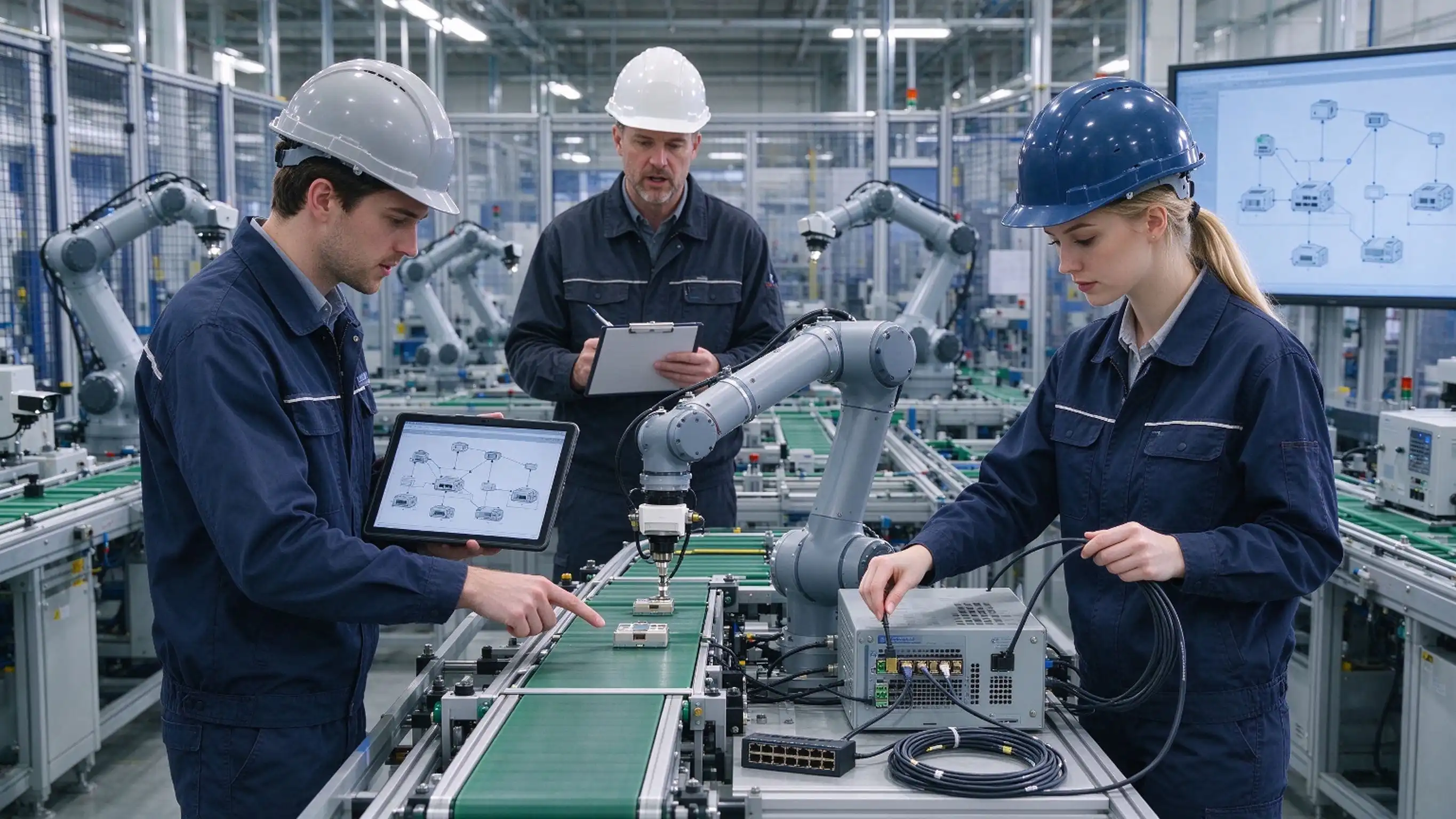
System integration connects single robots with the full plant architecture, i.e. PLCs, MES platforms, CNC machines and HMI interfaces. The conventional approach to interact is via protocols like OPC-UA, Profinet and EtherCAT. If you have ABB, FANUC and KUKA robots on the same floor, bespoke driver development may allow a single control station to monitor them all.
Common Warning Signs Teams Often Miss
Early signs of failure include the home position slowly moving away, collision detection alarms going off for no reason, and a drop in product yield due to accumulation of kinematic errors. Finding the amount of iron and chromium particles in used lubricant using grease spectroscopy is like taking a blood test to check the health of a gearbox; it shows signs of internal wear before a mechanical seizure happens.
Best Practices and Checklists for Robot Upkeep
A structured approach to robot maintenance cuts down on unplanned downtime and makes equipment last longer. These are the main things that every maintenance list should cover:
- Mechanical System Checks: Check RV and harmonic drive robot axis backlash. Check belt tension and motor mounting torque regularly. Record baseline repeatability measurements (usually ±0.02mm) to identify variations quickly.
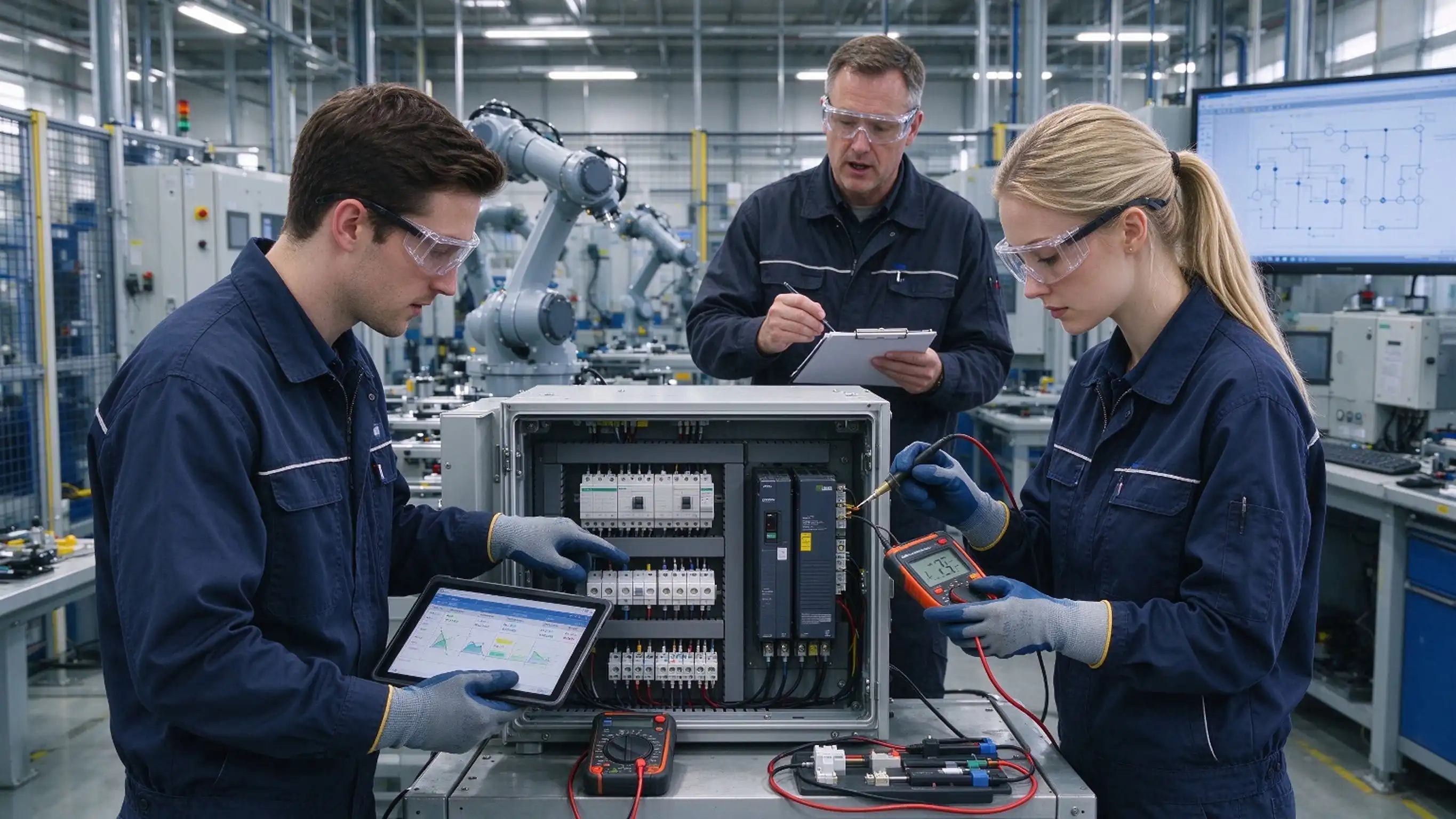
- Industrial robot maintenance and integration services include electrical system validation of servo motor insulation resistance and power supply harmonic distortion. Check pneumatic connections for circuit continuity and E-Stop circuits for ISO 13849-1 millisecond triggers.
- ions and ensure ISO 13849-1 E-Stop circuits activate within milliseconds.
- Control System Care: Update firmware and backup controller settings before changing software. Network addresses, axis parameters, and teach pendant verification should be done after substantial overhauls.
These three areas work together to make a cycle that keeps equipment running at steady levels of performance. If teams skip any one of them, they usually end up with a chain of failures that cost a lot more to fix than the first check that was missed.
Service Intervals by Robot Type
Heavy payload robots in foundries and welding shops often have shorter grease replacement intervals due to heat stress and particle pollution. Light-duty assembly robots in cleanroom pharmaceutical packaging follow more rigorous contamination controls and employ FDA-compliant, non-toxic lubricating procedures.
Troubleshooting Overheating and Software Faults
Servo drives often get too hot because airflow is blocked, thermal paste is worn out, or cycle rates are set too high. One way to find software errors like position overflow or communication timeout errors is to look at the controller log and use oscilloscopes and multimeters.
Comparing Robot Service Providers
Not every service provider has the same level of technical know-how. Before signing a service deal, here are some things you should think about.
Brand Coverage and Certification
A good service provider should have certifications from more than one robot maker. When different brands of equipment are used on the same floor, single-brand specialists can cause a dependency risk. As a minimum, look for experience with ABB, FANUC, KUKA, and Yaskawa platforms that can be proven.
Service Plan Structures
Most service providers offer both one-time service contracts and plans with regular maintenance visits, stocked parts, and guarantyd response times. Contract plans work best for production lines that get a lot of use and whose KPIs depend on how well they're running. For smaller jobs or first assessments, one-time services work well.
Evaluating Quality Benchmarks
To check the quality of something in this field, you need to know the accuracy of the zero-position calibration, the results of the backlash measurements, the confirmation of the safety circuit according to RIA R15.06, and the cycle time optimization metrics from FMEA reviews. Ask any service you're thinking about giving you written test results. Referrals from clients in similar fields, like automotive body-in-white versus 3C electronics assembly, show how a provider changes technical procedures to work in different production settings.
Integrating Automation Systems: A Strategic Perspective
Connecting robot maintenance operations to broader automation architecture shifts teams from reactive to predictive postures.
Real-Time Monitoring as a Foundation
When robots communicate live data through OPC-UA to a plant MES, industrial robot maintenance and integration services allow maintenance engineers to track Mean Time Between Failures (MTBF) in real time. Anomalies in power draw—regular lubrication and friction reduction can reduce a robot's energy consumption by up to 15%—become visible before they cause stoppages.
Hardware and Software Compatibility
Integration projects include evaluating IP65, IP67 seal integrity in hostile locations, ensuring fieldbus compatibility on all installed equipment, and mapping HMI response latency. These technical factors have a direct impact on Overall Equipment Effectiveness (OEE) ratings.
Measurable ROI from Integrated Programs
Plants that connect robot health monitoring to predictive maintenance plans routinely see lower emergency repair costs and higher production throughput. The operational advantage is not theoretical; it is shown in quarterly maintenance budget reviews and in less spare parts use.
Service Plans and Procurement Guidance
A organized choice process helps procurement teams that are looking at robot service contracts.
Contract Versus Ad Hoc Services
When production lines are busy, it's important to have repair deals that let you know the price ahead of time and give you priority service. Ad hoc arrangements are cheaper up front, but they make it harder to plan ahead. It is almost always cheaper in the long run to use a contract model for facilities with 200 or more robots.
Understanding Pricing Structures
Prices are usually based on the type of robot, its payload, the size of its fleet, and the areas it serves. Before you sign, make sure you have promises about how many spare parts you will keep on hand and how much labor rates can go up. Set response time SLAs that are clear, separating important production stops from regular scheduled visits.
Managing the Procurement Timeline
Depending on the rules for buying, the whole process usually takes between 30 and 120 days, from the initial proposal to the execution of the contract. Take into account how long it takes to get extra parts for the equipment and set aside time for on-site installation verification and staff training before the official start of service.
Conclusion
Connecting automation systems to structured industrial robot maintenance and integration services is a technical and operational priority, not an optional upgrade. Facilities that align mechanical upkeep, electrical validation, control system management, and real-time data monitoring within a single service framework consistently achieve higher equipment reliability and lower lifecycle costs. For vocational institutions building training programs around these skill sets, ECR Academy's project-based curriculum—delivered through the BN-R365 training platform—prepares students and engineers for exactly this work. The skills gap in robot operations and maintenance is measurable, and structured training is the most direct way to close it.
FAQ
1. How often should preventive robot maintenance be scheduled?
Minor inspections are generally recommended every 3,000 operating hours, which translates roughly to every six months under standard production conditions. Full overhauls—including gearbox grease replacement and controller battery checks—are required at approximately 10,000 hours. Skipping these intervals risks controller memory loss and mechanical seizure in high-load joints.
2. What signs indicate a robot needs professional servicing?
Watch for gradual home position drift, unexpected collision detection alarms, and declining product yield. These symptoms often point to kinematic calibration errors or worn reduction gears. Electrical faults may show up as servo drive overheating or communication timeout errors on the controller log.
3. Can one provider service a multi-brand robot fleet?
Yes. Through standardized communication protocols like OPC-UA and custom driver development, a single integration provider can manage ABB, FANUC, KUKA, and Yaskawa robots under one unified monitoring interface. Verify that the provider holds certifications across all relevant brands before contracting.
Start Your Robot Maintenance Training Program with ECR Academy
Every 3,000 hours of operation, or about every six months under normal production conditions, you should do a few minor checks as part of industrial robot maintenance and integration services, which are detailed on enteredu.com. At about 10,000 hours, a full overhaul is needed, which includes replacing the gearbox grease and checking the controller battery. If you skip these breaks, the controller could lose its memory, and high-load joints could have a seizure. Contact us at ecr2008@enteredu.com.
References
1. International Federation of Robotics (IFR). World Robotics Report. 2023.
2. ISO. ISO 10218-1: Robots and Robotic Devices – Safety Requirements for Industrial Robots. 2011.
3. ISO. ISO 13849-1: Safety of Machinery – Safety-Related Parts of Control Systems. 2015.
4. Robotic Industries Association (RIA). ANSI/RIA R15.06: Industrial Robots and Robot Systems – Safety Requirements. 2012.
5. Mobley, R. Keith. An Introduction to Predictive Maintenance. Butterworth-Heinemann, 2002.
6. Groover, Mikell P. Automation, Production Systems, and Computer-Integrated Manufacturing. Pearson, 2019.


_1781601799781.webp)