Can Intelligent Security Monitoring Technology Prepare You for Jobs?
Yes, intelligent security monitoring technology can prepare you for jobs, as long as the training is hands-on and tied to real equipment. Employers hire people who can install cameras, wire alarm panels, configure sensors, and keep connected systems running. This field adds video analytics, IoT sensors, and data review to those tasks, so the skill set goes beyond basic CCTV work. A course cannot guarantee a job, and state licensing rules for alarm and security installers still apply in the United States. Still, project-based practice on real devices gives you proof of ability that hiring managers can see.
Understanding Intelligent Security Monitoring Technology
What the Technology Includes
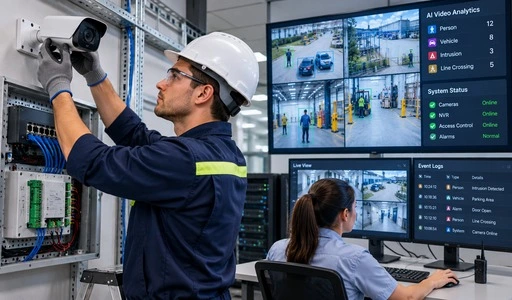
Sensors, networked video, and software that makes sense of what the devices record are the three parts that make up intelligent security monitoring technology. Sensors that read temperature, pressure, gas, or sound are some examples of sensing devices. So are infrared monitors, magnetic door Contacts, and cameras. In networked video, switches and digital video cameras can be used to move pictures around. The software layer can tell people from cars using AI-based video analytics. It can also let you know if a machine gives you a strange reading. This is why a technician needs to know more than just how to wire things: all of these parts work together. You can find a problem faster if you know how each step works, whether it starts with a lens, a wire, or a setting.
How a System Works From Camera to Alert
When an event is caught by a camera or monitor, the normal chain of events begins. Recorders or servers receive data over a network and have software compare it to rules that have already been set. If someone goes into an area that isn't supposed to be there, the device can sound an alarm and call for help. Some units do analytics at the edge, which means they do it in the camera itself. It's not as busy on the network now. Then the operator checks the alert, and finally, the technician checks to make sure the rule worked as planned. Every step of the job, from setting up the device to changing the rules and reading the logs, is a task.
Where Employers Use It
Security companies aren't the only ones who want it. In workplaces, monitoring is used to keep an eye on areas that could be dangerous and to check on the machinery. People who own property use video and access control to keep it safe. Industrial parks use boundary detection and sometimes hat or vest detection to make sure people follow the safety rules. Teams in charge of emergencies use data from monitoring to figure out what happened. The U.S. Bureau of Labor Statistics says that installing fire and security alarms is a different job. This shows that setting up and taking care of these tools is a common job. Graduates don't have to focus on just one type of employer because there are so many places to work. Integrators, factory safety departments, or facility teams are all people they can go after.
Job Preparation Through Intelligent Security Monitoring Technology
Roles That Use These Skills
People who have learned intelligent security monitoring technology can do a lot of different jobs. People who go through the E.C.R Academy program can learn how to become a technician for installing and maintaining security systems, a worker for monitoring and controlling safety in production, an engineer for operating and maintaining intelligent monitoring systems, a technician for fixing bugs in security systems, or a safety data analyst. It's not always the same thing that each job does, but they all work with tools, networks, and data. There are people who install things on-site, people who fix bugs and change system settings, and people who look at tracking records to find strange trends. You can use these differences to pick a school that will help you get the job you want.
Skills Employers Look For
Most of the time, you need to be able to read drawings, work with electricity, set up IP cameras, and fix network issues to get this job. As per the World Economic Forum's Future of Jobs Report 2023, 44% of workers' skills will become useless in just five years. If you want to learn something technical, you need to keep your skills up to date. For this job, that means learning more than just how to code. You also need to know how to work with data and networks. We teach CAD and technical drawing, as well as electrical and sensor application technology. It also goes over how to put systems together and program PLCs and microcontrollers to do tasks like monitoring and controlling them. From making plans to fixing things, that mix shows what a working expert does.
Project-Based Training and Joint Instruction
You can't not read about a camera and then set it up, aim it, and fix a recording that didn't work. Students at E.C.R Academy learn through projects and real-life situations that help them use what they learn in school in their future jobs. When enterprise engineers and college experts teach together, they use both the skills they've learned in school and the ones they've learned on the job. You will learn how to pick out tools, plan wiring lines, set up and fix issues with systems for video surveillance, intruder alarms, and access control. They can build and maintain a small security system on their own after fixing bugs together. You should finish a project because it shows employers that you can do the job and gives you something real to talk about in an interview.
Comparing Intelligent Security Monitoring with Traditional Security Methods
Manual Monitoring and Standard CCTV
In most setups, people watch things on screens and cameras record videos that they can watch later. As per the U.S. Bureau of Labor Statistics, security guards move around, keep an eye on tracking equipment, and handle issues. This means that someone has to keep an eye on the method at all times. It's hard to pay attention during long shifts, and a device only helps after something happens. A lot of older cameras are still being used for simple CCTV, especially in small spaces. Hybrid recorders and encoders can add analytics to older coaxial cables when they are used with ONVIF protocols. Technicians who can work with people of all ages are in high demand.
Accuracy and False Alarms
Some things that can cause motion sensors to go off are shadows, plants being blown around by the wind, and small animals. This wastes time and energy. Deep learning systems put things into groups based on how they move and how they are shaped. This way, they can avoid many of these triggers and only look at people or cars. The camera angle, brightness, and rule settings all affect how well it works, along with how it was setup. This is why tests and practicing on real equipment are important. Technicians who can fine-tune a detection zone and test how well it works in different lighting are good for both the system and the company.
Cost, Workload, and Skill Demand
Software labels events as useful data, so intelligent security monitoring systems can cut down on the time needed to watch screens and look through video after an event. I can't give you a price number because it depends on how big the place is, how many cameras there are, and how many people work there. The work does change. It takes more work to make sure the rules are followed, the data is looked over, and the installation is good. Those jobs need technicians who have been trained. For a school or training center, it's helpful to teach more than just how to mount things. For example, maintenance and data analysis can be taught along with installation.
Procurement Considerations for Intelligent Security Monitoring Technology Courses
Check the Training Platform
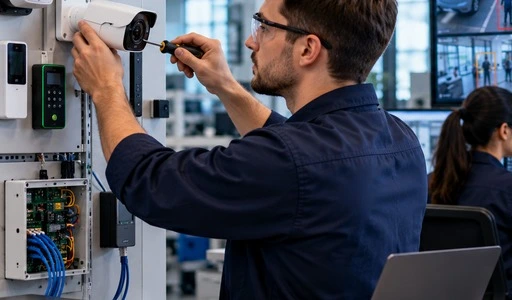
Before you teach with slides, you should do some work in the lab to get people ready for the job. A room on the E.C.R Academy platform is used to teach people how to use devices to measure things like temperature, pressure, gas, and sound. To keep videos safe, there are cameras, digital video recorders, and switches in a different room. Infrared detectors, magnetic door contacts, and alarm control screens are used in the room for intruder warnings. There is also a room for network and structured wires. Sensors, video surveillance, intrusion alarms, and putting systems together are some of the things they talk about. When you look at different service providers, find out what kinds of technology their students use and whether they do things like setup, bug fixing, and acceptance.
Match the Curriculum to Your Learners
Look at the map and see which parts of the course you want to use. You will learn four skills in our program: how to use microcontrollers and PLCs, how to integrate intelligent security systems, and how to use intelligent security monitoring technology and systems for intelligent monitoring. The first one talks about how to process video images and how to build, install, fix bugs, accept, and test video surveillance systems. The second one demonstrates how to integrate video security, an intrusion warning, and access control into a single system that can be fixed, used, and kept up to date by the same person. Basic ideas in electronics, computers, and sensors are taught at the beginning, so even people who have never done this before can start. It's helpful to know the basics of science and math.
Ask About Faculty, Updates, and Fit
People who buy things often worry about three things: teachers who don't have enough experience, tools that break down quickly, and standards that change. For the first issue, having business developers and college experts teach together solves it. To find out about the other services, ask them how they review course materials and replace devices, and ask to see the training rooms. Most of the people who have been trained and tested by E.C.R Academy in 28 countries and China since 2010 are now adults. It also works with over 500 companies and 3,300 experts. You shouldn't just compare the prices of the tools; you should also compare the prices of the classes, the tools, and the training for teachers.
Future Trends and Challenges in Intelligent Security Monitoring Technology
Edge Computing and Smarter Analytics
When the system needs to move, it doesn't have to send each frame to a central computer. Instead, edge computing does the work in the camera or a nearby device. Also, cameras use H.265 compression and sensors that work in low light to make pictures usable at night while taking up less space. IoT sites and smart towns are getting a lot more sensors, which means there is more data to look over. There are two ways for learners to get better: they can learn how to set up and start up devices in the field and how to read monitoring data in the lab. IoT (Internet of Things) sensors, data analytics, and other technology are used in our program to help students learn and get better at going both ways.
Privacy and Cybersecurity
Since every camera that is linked is also a network device, technicians need to know how to keep things safe. To protect your devices, you should keep the software up to date, change the default passwords, and keep them separate from other office networks. Business buyers look for encryption like AES-256 and audits against standards like ISO/IEC 27001 to make it less likely that someone will get into the stream without permission. In the United States, privacy rules like the California Consumer Privacy Act can change how individuals and videos are saved and shared. GDPR is also something that projects with clients in Europe need to think about. Industrial sites can find out how to keep their working technology safe in NIST Special Publication 800-82. Talk to a lawyer about the rules for each job.
Keeping Skills Current
Products and rules change all the time, so a good software always makes changes to itself. In the same way that ONVIF standards and IEC 62676-1-1 system requirements help technicians choose and test equipment, they also help them choose standards for interoperability. It is also important for hardware installed outside to be able to handle heat, cold, water, and energy. When they finish school, I tell my students that they should always read standards and product papers. Technicians who are always learning are in high demand. To keep up with changes, you can work with a training partner who has ties to the field.
Conclusion
Intelligent security monitoring technology can help students get ready for work by combining classroom learning with hands-on work with real tools. This technology combines sensors, analytics, and video that is networked. Security firms, workplaces, and building teams need people who know how to set these systems up, fix them, and read their data. Intelligent systems are better than human tracking and regular CCTV because they cut down on false warnings and normal screen watching. But they need more skilled people to set up, work on networks, and look over data. People who want to buy training should think about the lab platform, the course material, the teachers' experience, and how often the software is updated. Technicians also need to keep learning after they graduate because of hacking, privacy issues, and standards that are always changing. A course helps people get ready for work, but it doesn't get rid of the need for licenses in the area.
FAQ
1.Can beginners study intelligent security monitoring technology?
Yes. The E.C.R Academy program starts by teaching the basics of sensors and electrical and electronic technology. Next, it slowly moves toward intelligent monitoring. You should be interested in the subject and know the basics of physics and math.
2.What jobs can this training lead to?
People who are learning can get ready for jobs like IT engineer for installing and maintaining security systems, engineer for operating and maintaining intelligent monitoring systems, helper for fixing security systems, worker for monitoring and controlling production safety, and safety data analyst.
3.What equipment do learners study?
The class goes over a lot of different kinds of systems, such as alarm control panels, access control devices, PLC controllers, microcontroller development boards, and sensors.
4.How is intelligent monitoring different from conventional CCTV?
Most of the time, normal CCTV takes video to watch later. When AI analytics are added to intelligent systems, they can sort things into groups and send alerts in real time. This can cut down on false alarms that are set off by shadows or small animals.
Build Job-Ready Skills With E.C.R Academy Today
Want to get a job? Are you ready to learn how to use intelligent security monitoring technology? Business engineers and college experts teach project-based classes at the E.C.R Academy in rooms with real-world tools. If you want to talk to our team about your needs, you can email ecr2008@enteredu.com or go to enteredu.com. We can help you find an intelligent security monitoring technology provider for course licensing or a custom training program.
References
1. U.S. Bureau of Labor Statistics, Occupational Outlook Handbook: Security and Fire Alarm Systems Installers, 2024.
2. U.S. Bureau of Labor Statistics, Occupational Outlook Handbook: Security Guards and Gambling Surveillance Officers, 2024.
3. World Economic Forum, Future of Jobs Report, 2023.
4. National Institute of Standards and Technology, Guide to Operational Technology (OT) Security, NIST Special Publication 800-82 Revision 3, 2023.
5. International Electrotechnical Commission, IEC 62676-1-1: Video Surveillance Systems for Use in Security Applications, 2013.
6. International Organization for Standardization, ISO/IEC 27001: Information Security Management Systems, 2022.