Industrial App Development Training: Transform Domain Knowledge into Software
Industrial App Development Training represents a specialized educational pathway that bridges operational technology expertise with modern software engineering, particularly within the context of Industrial IoT (IIoT) Technology. This training equips professionals to translate complex manufacturing challenges and domain-specific knowledge into functional software applications that drive efficiency, predictive capabilities, and digital transformation. By leveraging comprehensive curricula covering data acquisition, edge computing, and platform integration, learners develop the technical proficiency to design, test, and deploy industrial applications that respond directly to real-world production environments and business requirements.
Understanding Industrial IoT Technology and Its Impact on Industrial App Development
It is important to know how interconnected systems work in manufacturing and industrial settings in order to develop useful industrial applications. Sensors, machines, and cloud-based analytics are all part of Industrial IoT (IIoT) Technology. This technology optimizes production processes and lets people make decisions based on data across complicated supply lines.
Unlike internet technologies that are aimed at consumers, industrial implementations put reliability, security, and the ability to work with a wide range of hardware and legacy systems at the top of their list of priorities. The first thing that sensors do is collect data. In real time, sensors collect data on machine performance, environmental factors, and operational measures. Communication methods like OPC UA and MQTT make sure that devices and platforms can share data in a standard way. Edge computing, on the other hand, lets work happen locally, which cuts down on delay and bandwidth needs.
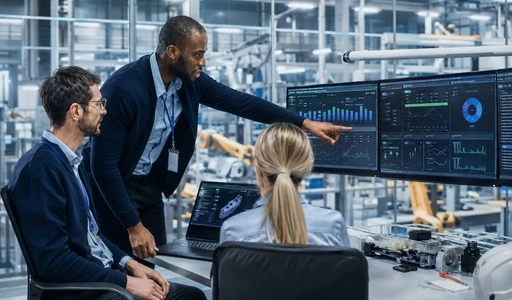
Developers can make apps that work with real-world situations instead of just academic models if they understand these technological parts. Asset tracking systems, quality control screens, and predictive maintenance apps can't work without correct data flows and flexible designs. Companies that use these methods say that their equipment works better generally, is up and running more often, and produces less waste.
As we move toward Industry 4.0, there is a greater need for people who can make software that works well with manufacturing execution systems, enterprise resource planning platforms, and supervisory control systems. Learning the basics of how industrial networks work, how data moves from the shop floor to the cloud, and how security protocols protect important infrastructure is what you need to know to make applications that have a big impact.
Essential Skills and Knowledge Areas in Industrial App Development Training
Creating business applications needs a special mix of technical know-how and subject knowledge. Training programs need to cover both the operational problems that are unique to manufacturing and the software engineering ideas that make solutions scalable and easy to maintain.
The most important skill is being able to turn problems in the real world into precise software requirements. Engineers and operations managers know a lot about problems with quality control, production, and maintenance, but they don't always have the expert language to tell development teams what they need. Training that focuses on creating user stories and getting requirements together with others can help close this communication gap.
Another important area is knowing how to use protocols. Communication standards for industrial networks are specially made for harsh settings and mission-critical activities. When developers know how OPC UA supports cross-platform interoperability, MQTT supports lightweight messages, and EtherNet/IP supports real-time control systems, they can choose the right technologies for each use case.
When it comes to cybersecurity, industrial settings are very different from business IT settings. You need to know a lot about air-gapped networks, old systems that don't have modern security features, and the physical effects of a system being hacked. Strategies for "defense in depth," safe boot processes, certificate-based identification, and following standards like IEC 62443 should all be part of training programs.
Data analytics and visualization tools turn raw sensor data into insights that can be used. Developers can make apps that help with making decisions in production if they learn statistical methods, data cleaning techniques, feature extraction, and panel design. Exposure to the systems and tools that leaders in the field use puts academic ideas into a real-world context.
Understanding platform design completes the list of necessary skills. Industrial IoT (IIoT) Technology applications don't usually work on their own; they need to be able to connect to existing infrastructure, work with multiple tenants, and grow as the amount of data they need to store increases. Developers can make solutions that fit into larger digital transformation efforts if they know how to use platform functional modules, handle tenants, and manage applications throughout their entire lifetime.
Step-by-Step Industrial App Development Process for IIoT Solutions
Industrial application development that works well follows an organized process that keeps risks to a minimum and makes sure that professional skills and business goals are aligned.
Collaborative topic study is the first step in the process. Cross-functional teams made up of operations staff, repair technicians, quality managers, and software writers figure out where the problems are and how much they would hurt the business. During this phase, clear success measures are set up, and features are prioritized based on how much value they give.
When you define requirements, you turn domain knowledge into technical specifications. It is the job of developers to write down information about data sources, points of integration, user roles, performance needs, and security limits. Mockups and prototyping tools help people see how proposed solutions might work before a lot of money is spent on development.
The technical base is set by architecture design. Careful consideration of operating limitations and anticipated future growth leads to decisions about edge vs. cloud processing, database choice, API design, and scaling strategies. Iterative development is easier with modular design principles because they let parts change on their own.
Focused development sprints are used to move implementation forward. Core features like data loading, processing logic, and user interfaces are created by repeatedly writing code, trying it, and making changes. Continuous development techniques make sure that the code is good and make it easy to find bugs quickly.
Integration testing makes sure that applications work properly with the machinery that is already in place in an industry setting. Developers make sure that the data is correct, that communication protocols work in different network situations, and that security measures do what they're supposed to do. Simulation settings that look and feel like working environments let testing go on for a long time without stopping operations.
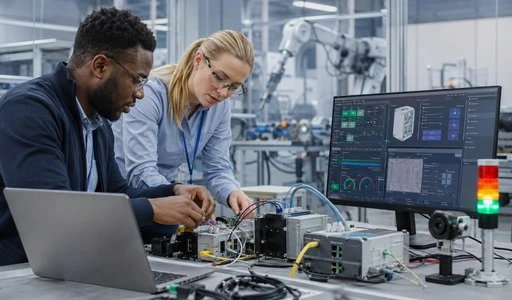
Pilot rollout lets software be used in limited production settings. Edge cases, performance problems, and usability issues that testing environments can't fully capture are shown in real-world use. Feedback loops that connect end users with development teams let changes be made quickly, and the product keeps getting better.
Full deployment spreads the results of successful pilots to bigger operations. Training materials, manuals, and help systems make sure that users can effectively use new features. Monitoring systems keep an eye on how well an app works, how many people use it, and how it affects the business. This information is used to keep improving the app.
Choosing the Right Industrial IoT Solutions and Partners for Your Project
Selecting the correct tools and collaborators affects project success. Procurement professionals must evaluate technical competence, vendor reliability, and the company's long-term plan.
Many variables should be considered while assessing a platform. Scalability indicates whether a system can expand with your organization without costly migrations. Security features must match corporate demands and regulatory requirements. Performance issues, including latency, throughput, and reliability, affect operations. Integration determines how readily new solutions interface with current systems and data sources.
Successful industrial platform firms support several ecosystems. Siemens MindSphere, Rockwell Automation's FactoryTalk, and Bosch IoT Suite are established, industry-wide systems. Case studies, reference users, and technical documentation help determine whether an Industrial IoT (IIoT) Technology is suitable for a use case.
System reliability and long-term expenses rely on the hardware supplier. Industrial-grade sensors, gateways, and computers must withstand temperature fluctuations, vibrations, dust, and electromagnetic interference. ATEX and IP67 certifications for explosive settings and ingress protection are tough enough.
Training and assistance distinguish strategic partners from transactional providers. They need defined learning courses, real-world experience, and technological support to improve. Full-service training partners, including instructor-led courses and virtual exercise platforms, reduce execution risks and expedite skill development.
Businesses creating solutions or dealing with ecosystem partners need customisation and "white label" features. Training providers and platform suppliers that provide branding customisation, content adaptation, and co-development partnerships help firms remain ahead by utilising proven technology.
Project-based industrial app development training from E.C.R Academy blends theory and practice. We provide "Foundations + Core + Applications"—data collection, identifier resolution, edge computing, data analysis, platform operations, and lifetime app development. Enterprise engineers and academics update knowledge. To avoid infrastructure issues, practise on normal PCs with the full-process virtual simulation program. We educate marketable, industry-standard skills. Students may apply these abilities in data collection engineering, edge computing, industrial data analysis, platform administration, and app development.
Our white-label course delivery and co-development options let organisations educate their own workers or partner with industrial education providers. Flexible collaboration models may enable ecosystem partners to design academic programs according to corporate needs. We've helped approximately 500,000 students in 28 countries for 16 years, proving we can work in diverse cultural and operational environments.
Future Trends and Continuous Learning in Industrial IoT and App Development
Industrial technology is developing quickly with AI, edge computing, and digital twins. Learn and change methods to stay ahead.
AI-driven analytics are changing industrial data use. Machine learning systems recognise small equipment failure trends, improve process parameters in real time, and discover quality concerns before customers get faulty goods. After training in AI concepts, model construction, and deployment, professionals may use these technologies effectively.
Without halting production, digital twin technology builds asset copies for simulations, optimisations, and predictive models. As digital twins advance from pilot projects to corporate operations, simulation designers, builders, and analysts will be needed.
Data sources becoming increasingly complex with next-generation edge computing. Microservices, orchestration systems, and containerised applications provide flexible release models that balance latency, bandwidth, and compute efficiency. Engineers may build responsive and scalable systems by understanding these architectural principles.
Worldwide, Industry 4.0 projects are changing manufacturing processes. Technology and manufacturing experts must be hired by smart factory companies. As the digital revolution progresses, operations, information, and business planning skills become more vital.
Professionals learn new technologies and best practices via continual learning. Business certifications, hands-on projects, structured training, and group learning may improve your skills. More people mean more ideas, faster technology adoption, and better operations.
Strategic workforce planning matches company goals with skill development. Determine skill gaps, define career paths, and work with training providers to build long-term talent streams. Businesses may work with schools and trainers to create the curriculum and guarantee that graduates have marketable skills.
Conclusion
Industrial IoT (IIoT) Technology fills the important gap between domain expertise and software engineering, letting professionals use what they know about manufacturing to make useful apps. Learners who complete programs that cover data acquisition, edge computing, analytics, and full-lifecycle development are ready for jobs that are in high demand and are driving digital change. As more industrial operations use automation, connectivity, and data-driven decision-making, the skill of making custom software solutions becomes more valuable. When companies put money into structured training pathways, they set themselves up to take advantage of opportunities in Industry 4.0 while also building long-term competitive advantages through the development of their own skills.
FAQ
1. What prerequisites do learners need before starting industrial app development training?
It is recommended that learners have simple computer skills and basic math knowledge. It's good to know some basics about computing, but it's not necessary. Comprehensive programs start with basic ideas and then move on to more advanced topics. The progressive curriculum structure works for students from a range of educational backgrounds. It gives beginners the tools they need to build their skills in a structured way, while more advanced material challenges professionals who already know a lot.
2. How do virtual simulation platforms compare to physical lab environments for industrial training?
Virtual simulation systems have many benefits, such as the ability to practice as much as you want, no risk of damaging tools, and access from anywhere with an internet connection. Learners don't have to wait to do tasks again and again until they learn them. Real-world context and tactile feedback are provided by physical tools. High-fidelity simulations, on the other hand, accurately mimic operational situations to help people learn new skills, especially when combined with jobs or site visits in the field.
3. What career advancement opportunities exist for professionals completing industrial app development training?
People who graduate can work as an Industrial Data Acquisition Engineer, an Edge Computing Operations Specialist, a Platform Integration Consultant, or an Industrial Application Developer. The high pay for these jobs reflects the level of specific knowledge needed. As a career progresses, people usually end up working as architects, in technical leadership roles, or in specialized consulting firms. Strong demand exists across all manufacturing sectors because there aren't many workers with both industry subject knowledge and current software development skills.
Partner with E.C.R Academy for Industrial Training Excellence
E.C.R. Academy is ready to help your company improve its industrial capabilities by providing complete training programs that are in line with industry standards and the needs of the workforce. Our Industrial IoT (IIoT) Technology curriculum covers everything from basic ideas to building complex apps. It is taught through virtual reality platforms that can be accessed from anywhere. Our flexible partnership models can help a wide range of organizations reach their goals, from industrial platform providers looking for ecosystem partners to educational institutions building technical programs and manufacturing companies growing their own talent. Get in touch with our team at ecr2008@enteredu.com to talk about how our tried-and-true training methods, which we've developed over 16 years of working with clients around the world, can help you reach your workforce development goals faster and stay competitive in a world where industries are always changing.
References
1. Anderson, J. (2022). Industrial IoT: Architectures, Applications, and Implementation Strategies. Technical Publishing House.
2. Chen, M., & Roberts, K. (2023). Bridging OT and IT: A Practical Guide to Industrial Digital Transformation. Manufacturing Technology Press.
3. European Commission Directorate-General for Industry. (2021). Skills for Industry 4.0: Training and Education Requirements. Brussels: EU Publications Office.
4. Industrial Internet Consortium. (2023). IIC Vocabulary Technical Report: Industrial Internet of Things Terms and Definitions. Needham, MA: Object Management Group.
5. Martinez, L., Thompson, P., & Zhang, W. (2022). Edge Computing in Industrial Environments: Architectures, Security, and Best Practices. Journal of Industrial Information Integration, 28, 100-118.
6. National Institute of Standards and Technology. (2023). Framework for Cyber-Physical Systems: Industrial Control Systems Security. Gaithersburg, MD: U.S. Department of Commerce.

_1781601799781.webp)