How AI-Driven Interactive 3D Digital Product Design Is Reshaping Industry
AI-driven interactive 3d digital product design is transforming the business by converting static product files into models customers can rotate, see inside, customise, and test on the web, mobile devices, and in augmented reality (AR). AI is able to speed up idea drawings, apply materials and create variations, but you still need designers and engineers to make sure everything is right. This results in reduced manufacturing times, better sales discussions and product visualisations that are helpful from the start of the design process to after the sale. This article covers the technology, where it creates value, the hazards to be aware of and the abilities creative teams need to bring it to life.
This tutorial is aimed for creative directors, visualisation leaders and technical managers looking to work on projects such as product configurators, virtual showrooms or exhibits. AI, 3D modelling, real-time rendering, structured product data, and interactive interfaces are included in this discipline. A McKinsey worldwide study in 2024 revealed that 65% of respondents said their organisations employ generative AI consistently in at least one business function. That means interest is going up.

From CAD Files to Interactive 3D Experiences
From Traditional CAD to AI-Driven Interactive 3D Product Design
For engineering accuracy, production paperwork and technical verification, conventional CAD is still the gold standard. I still think it's true. The difficulty occurs when a company wants to present the identical item to a customer via a browser. - A CAD file is huge and includes a lot of information that the client does not require. It’s hard to transform them into light, attractive visualisations, particularly for items with a lot of pieces or alternatives. AI assists tools to automatically identify geometry, assign materials, render and update designs. They also connect technical data to sales and marketing efforts. We still need engineering evaluation and production feasibility. It creates a lot of confusion when you have a great looking model that violates a tolerance and spends a lot of money.
How AI-Driven Interactive 3D Product Design Works
The common items required to get a project started include CAD files, specifications, bills of materials, reference pictures, material libraries, and configuration rules. AI assists in creating models, lowering the amount of meshes, detecting sections, mapping textures, and creating new versions. Then someone validates the size, scale and technical correctness before anything goes online. Complete models may be used to drive browser-based configurators, where you can see everything from all angles, choose choices, see components, acquire technical information and request quotations. GLTF 2.0 (ISO/IEC 12113:2022) is a popular format for delivering 3D assets at runtime for the web, while KTX 2.0 textures make the downloads smaller for mobile devices. Customer choices continue to assist the company, as they are connected to PIM, ERP, CRM, CPQ, and e-commerce platforms.
AI 3D Product Design vs. Traditional CAD and Static Images
AI-driven interactive 3D digital product design is not the same as CAD. It feeds engineering data into channels that interface with consumers. CAD is about creating precise drawings and documentation for production. Interactive 3D is about visualisation, organization and collaboration. Static photos are OK for basic catalogue goods, but they don’t work well for equipment that may be customised, modular systems, furniture, building materials, or car parts that consumers want to compare. When I look at delivery techniques, I compare five things: how complicated the product is, how accurate it has to be, how integrated it needs to be, the budget, and what talents we have in-house. Desktop software provides you the greatest control, cloud platforms make sharing quicker. Custom development works with unusual rules, and outside production services aid teams who need to get things done quickly. Ideas created by AI are useful for early brainstorming, but not for final planning.
Where Industry Value Is Changing?
How AI-Driven 3D Design Changes Industry Value Chains
Interactive 3D provides value to a product at every point of its life – from early concepts to assistance after the sale. Product teams may test several versions before building genuine prototypes. OEMs, suppliers and contract manufacturers may utilise one model. This makes it easy for everyone to comprehend the specifications during remote evaluations. The purchasing and selling teams are able to compare goods more clearly, view them quicker and get estimates in a more organised fashion. Distributors can show clients complex items without having to keep them all in stock and e-commerce teams can assist buyers understand the products’ qualities before they purchase. The same models may be utilised for installation manuals, training, maintenance, spare parts locating and technical communication in many languages. This indicates that one asset may be utilised by more than one department. <br/><br/> So if you reuse anything like this the cost of it goes down and down each time you use it.
Key Business Benefits of AI-Powered 3D Product Design
The business value extends deeper than the skin. Automated modelling, rendering and variation production for speedier launches and reduced content creation time. Interactive displays allow non-technical people to understand the materials, setups and use cases before requesting a price. Rules-based configuration reduces errors in selection and allows customers, sales teams, engineers and suppliers to work collaboratively. I believe the team should assess success by the number of qualified leads, finished configurations, conversion rates, quotation speed, time saved on content production, less errors and ability to reuse assets across locations. “Engagement numbers, clicks, time on page, they don’t tell you whether a business is having an impact on the world. “Be sure to establish a baseline before you launch so you can fairly compare results.
Applications in Product Visualization, Cultural Tourism, and Science Education
The clearest usage is to display the product. Industrial design companies are building virtual showrooms and configurators that enable users check out a product before it ever hits the real world. Teams working on cultural tourism use similar techniques to construct virtual galleries and interactive tours to sites. Science education teams, in contrast, employ these talents to translate complex concepts into interactive models for visitors. All of these areas have the same production needs: assets need to look beautiful, load fast, and be usable on the web, mobile devices and AR gear. E.C.R. Academy employs the same three scenarios throughout the course so students may practise on real world project types. Having abilities in modelling, UI design and XR programming makes it simpler for small teams to perform a broad variety of jobs.
Building High-Performance Interactive 3D Product Experiences
Practical Guidelines for Performance, Accuracy, and Access
A good project begins with a defined business objective, such as educating people about a product, generating leads, converting online shoppers to customers, or providing a quotation. Having the same exact product data, version control, authorised specs and unambiguous ownership means CAD, PIM, ERP and marketing platforms function together seamlessly. Teams employ level of detail techniques, reduced geometry and compressed textures to strike a suitable compromise between visual quality and loading speed. Accessibility is also vital. WCAG 2.1, a standard published by the W3C, provides guidelines for online content; where possible, 3D sites should have text and keyboard controls. Design multi language text, regional units and currencies, analytics, user permissions and data protection from the start. Each solution has different costs and delivery timeframes so make your pick early.
Common Risks and How to Avoid Them
The biggest mistake is thinking that generated models for AI-driven interactive 3D digital product design are ready for production. Geometry errors, improper materials, missing parts and incorrect measurements are a problem for engineering, sales and support. If a model has too many features, it will be slow to load. And even the most beautiful configurator will not operate if its choices do not follow practical standards for production, price, inventory or delivery. I would recommend seeking engineering clearance before releasing, testing the performance on a variety of various sorts of devices, and ensuring that the setup logic works. Contracts with outside providers should specify data ownership, allow export, provide access to APIs, and allow departure. We also need to watch out for copyright: The U.S. Copyright Office’s 2025 assessment on AI copyrightability determined that prompts do not offer users enough power to be deemed writers. This is why teams should maintain track of the human design effort that went into each item.
Quality Checks Before Launch
I go through a quick checklist before launch. First, validate files for structural issues using the Khronos glTF Validator. Second, consider the frame rate and load time on old and new phones, as well as the AR devices you want to support. Third, make sure all the interactions (triggers, UI reactions, option logic) function as you want. Fourth, look at language variants and accessibility. Fifth, consider how confidential CAD files are protected via the data pipeline, particularly if you’re using AI technologies from outside the firm. Writing down these checks will provide you and your client's technical lead a clear record of acceptance and reduce the approval conversations.
Choosing and Adopting a Solution
How to Choose an AI-Driven 3D Product Design Solution?
You can't merely compare features. First, you need to know what you want: AI 3D modelling, a configurator, a complete visualisation platform, bespoke programming, or a long-term content partner. Then look at the file formats supported, the AI capabilities, the variation management, the APIs, the analytics, the e-commerce compatibility, the mobile performance, the localisation and the hosting. Pricing models vary and include subscription, project-based, per-model, usage-based and enterprise licensing. Know what each covers. Add to the list commercial usage rights, data privacy and cross border data agreements for customers in the US and other countries. Ask for relevant case studies, support terms, and a pilot based on a single product you believe symbolises the total.
Implementation Plan for Enterprise Adoption
Don’t digitise all your items at once. Do it in phases. Phase 1: Business objectives, prioritised goods, consumers, markets, internal decision makers, current assets and integration requirements. The second phase defines standards for the product, rules on how it should be configured, user flows, accessibility demands and performance targets. The third step consists of a pilot test using a representative product to verify the correctness of the model, user satisfaction, the interoperability of the system and the commercial value. Phase four is when production begins, training of the team takes place, analytics are applied and things only grow better and better. For most creative studios, the purchasing process often goes like this: needs evaluation, platform demo, proof of concept, contract discussions and team training. It reduces risk and increases support in the firm.
Why Team Skills Decide the Result?
People, not tools, finish projects. To be a 3D artist, you need to know how to model, UV map, and use PBR materials. A UI designer needs to know how to lay out an interface and how to make it work with 3D scenes. An interaction developer needs to know how to test and use XR logic. An art director has to see how all of these parts fit together so that deadlines are met. Every pilot is slowed down by steep learning curves. That's why a lot of teams look for no-code and low-code tools that make things easier on the technical side. When you train your team using real production steps, from idea to deployment, you get work ready for clients faster and keep knowledge within the company instead of with one freelancer.
The Future of the Field and Training Your Team
The Future of AI-Driven Interactive 3D Digital Product Design
Then we introduce the next level, generative design, real-time personalisation, digital twins, shared XR collaboration, and linked product data. Artificial intelligence can help engineers explore additional choices, within the constraints of technology and business, and configurators might offer items depending on things like usage, budget, industry, geography, or user role. Over time interactive models may link to sensors and service data. But beware: a marketing visualisation is not a true digital twin, which requires real-time data and validated behaviour. Similarly, a 2023 Harvard Business Review article on generative AI and creativity finds that the technology enhances people’s creativity rather than detracting from it. To be ready for these developments, a firm requires strong cross-team ownership and standards for reusable product data.
What You Learn in the E.C.R Academy Course?
E.C.R Academy’s AI-Driven Interactive 3D Digital Product Design course includes AIGC creative design, 3D digital modelling, UI interaction design, XR 3D interactive programming, and cross-platform content publication. Learners model in industry-standard tools such as Blender and 3ds Max, before finishing up with UV mapping, PBR materials and rudimentary animation. Next, they build 3D scene interfaces and interaction algorithms. They make sure everything works correctly and then they push it out to the web, to phones, to AR glasses. Projects include drafting proposals and producing creative material and placing it online. Examples include from product development, cultural tourism and scientific education. The training is conducted by industry specialists and adheres to worldwide industry norms.
Platform, Hardware, and Why E.C.R Academy
The training runs on a unique XR platform with industry grade software and high speed hardware. It provides assistance for modelling, user interface design, interaction creation and cross-platform deployment. A built-in digital asset management system integrates what you study in school to real world, and no-code and low-code tools allow designers concentrate on being creative. Since 2010, E.C.R. Academy has educated over 500,000 individuals in China and 28 other countries, held over 150 skill contests, worked with over 500 enterprises, and created over 60,000 learning materials. Some of these resources include standards, courseware, case studies and test banks. Studio executives may utilise that 16-year record to better teach their personnel.
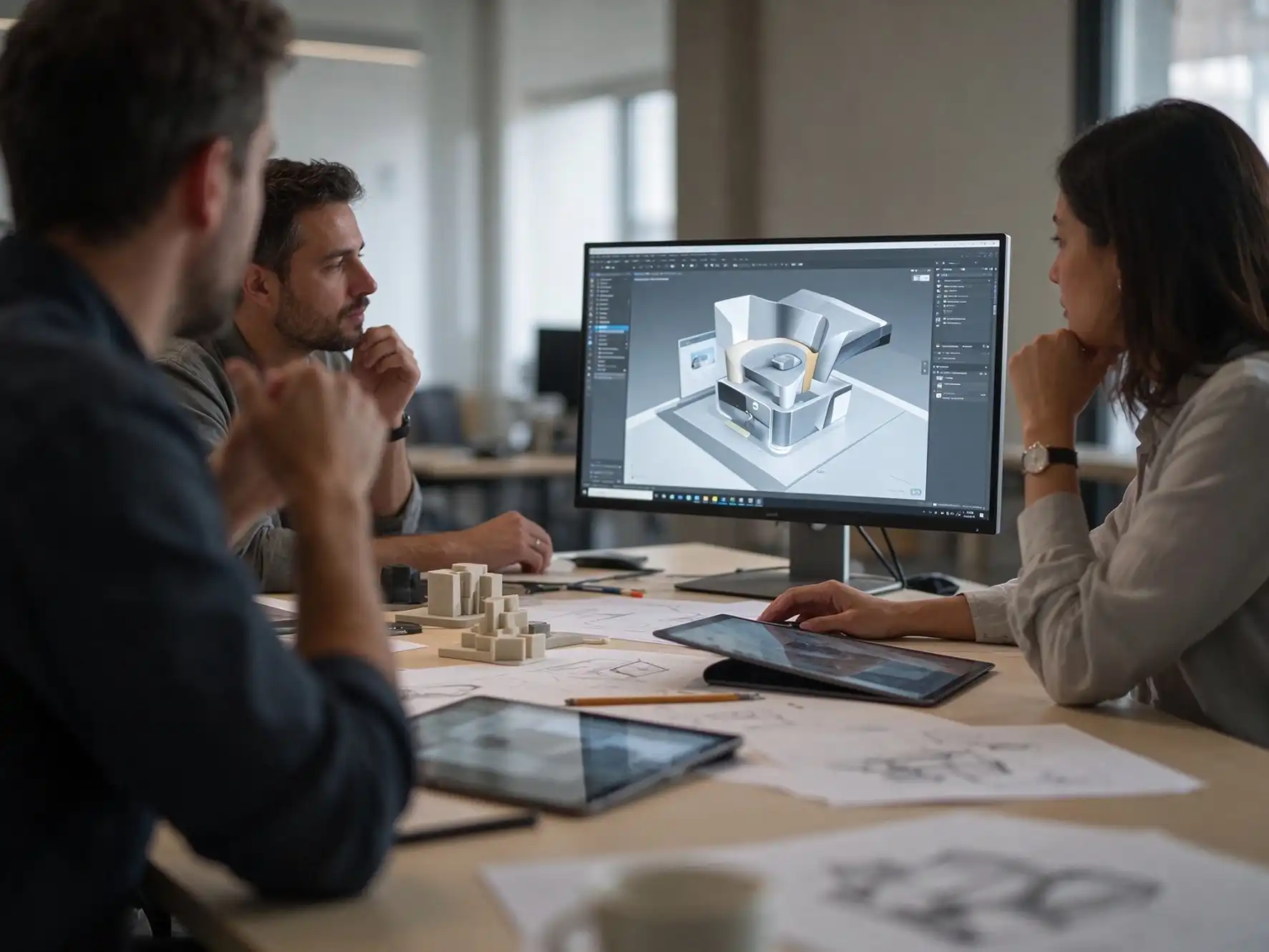
Instead of replacing CAD, AI-driven interactive 3D digital product design adds to it. AI speeds up the process of making models, assigning materials, and making variants, while human review ensures that the dimensions and engineering accuracy are correct. Value shows up at all stages of a product's life, from design reviews and sales demos to training and maintenance. Teams can figure out how much value there is by looking at things like qualified inquiries, quote efficiency, and asset reuse. If a project succeeds or fails, it depends on things like performance, accessibility, copyright documentation, and contract terms. Before they are rolled out to more people, they are tested in a pilot on one representative product. AIGC, modeling, UI design, XR development, and cross-platform publishing skills are still very important because tools only work if people know how to use them well.
FAQ
1. What is AI-driven interactive 3D digital product design?
It uses AI, 3D modeling, real-time rendering, and structured product data to let users rotate, look at, and set up products online. People check the accuracy of AI while it speeds up geometry recognition, texture mapping, and variant creation.
2. Does it replace traditional CAD?
No, CAD is still the best way to get data for engineering and manufacturing. That data is sent to customers, sales teams, and partners in a way that they can understand through interactive 3D. They both work together.
3. What affects project cost?
Number of models, complexity of the product, rules for setting them up, languages, integrations, and delivery method are all important. They can pick software, custom development, or an experienced service provider, and a pilot gives them the most accurate time frame.
4. Where should a team start?
Set requirements, pick a product that represents them all, do a pilot, and then evaluate its accuracy, performance, integration, security, and business results. The pilot stays on schedule because you train your artists and developers at the same time.
Plan Your AI-Driven Interactive 3D Digital Product Design Training with E.C.R Academy
Are you ready to help your team get better? Discuss AI-driven interactive 3D digital product design courses with E.C.R Academy for work in cultural tourism, virtual exhibitions, and product visualization. Send your team size, software needs, and project timeline to ecr2008@enteredu.com if you're looking for an AI-driven interactive 3D digital product design supplier for team training.
References
1. McKinsey & Company, The State of AI in Early 2024, 2024
2. U.S. Copyright Office, Copyright and Artificial Intelligence, Part 2: Copyrightability, 2025
3. ISO/IEC, ISO/IEC 12113:2022 Information Technology – Runtime 3D Asset Delivery Format – Khronos glTF 2.0, 2022
4. World Wide Web Consortium, Web Content Accessibility Guidelines (WCAG) 2.1, 2018
5. Khronos Group, KTX File Format Specification Version 2.0, 2021
6. Harvard Business Review, How Generative AI Can Augment Human Creativity, 2023