What to Look for in New Energy Vehicle Detection & Maintenance Technology Training
Procurement managers and department heads need to go beyond surface-level qualifications when assessing нова технологија за детекцију и одржавање енергетских возила training. The correct software should include high voltage safety procedures, drive motor diagnostics, BMS and VCU systems, and real world fault diagnosis processes. It should meet accepted technical requirements, provide hands-on experience on simulation platform and develop job-ready technicians. Whether you are a vocational school, OEM after-sales division, or fleet operation, the right training program may have an impact on your team’s performance and your organization’s operational results.
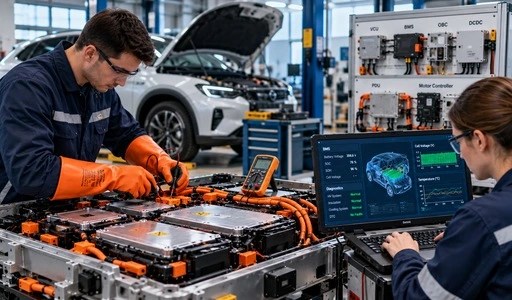
Understanding the Core Challenges in NEV Detection and Maintenance
Standard ways of diagnosing problems with cars don't work on electric cars because their systems aren't the same as those in regular cars with combustion engines. Concerning safety, the issues are technical and have to do with how things are done. No one in a repair company is safe from them.
High-Voltage Safety Risks in Workshop Environments
It is important to stay far away from systems that run at 400V to 800V DC when working on them. It is very likely that technicians will get hurt if they haven't had the right training in high voltage. When it comes to electrical safety standards for cars, ISO 6469-3 says that certain insulation resistance limits and lockout processes must be in place before any work can be done. There is a lot of danger for teams, their companies, and their customers if they don't get the right training.
Fault Complexity Across Integrated Systems
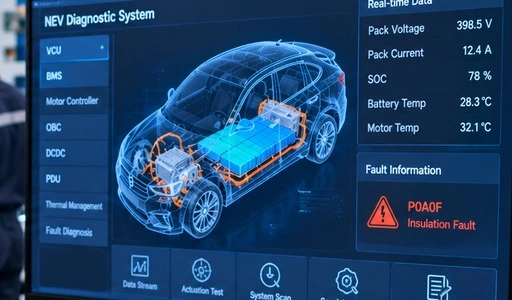
The BMS, VCU, OBC, PDU, and motor control units are all built into current NEVs and are very closely linked to each other. One problem, like a corrector mistake or a broken cooling system, can spread to more than one part of the system. When technicians are only taught how to use traditional OBD tools, they often get these issues wrong or don't even notice them. This makes warranties more expensive and leads to more returns.
Rapid Technology Iteration
It's getting too hard for most in-house training programs to keep up with the changes in batteries, motor control algorithms, and software-defined car designs. Firms and schools that use old lessons could end up with techs who are already behind the times on their first day of work.
Key Components of Effective EV Maintenance Training
A well-run school for diagnosing and fixing electric cars should offer both classroom and hands-on training. Here are the key things that make a program good and a simple one bad.
It's helpful to know why each of these parts is important for the procurement before going over them. There are holes in your training that show up later as repairs that need to be done again, checks that don't work, or safety issues.
- Project-Based Curriculum: Training should be built around real maintenance scenarios — not abstract theory. Tasks such as powertrain disassembly, drive motor zero-position calibration, insulation fault detection, and overtemperature diagnosis should be core modules, not optional extras. ECR Academy's NEV Detection & Maintenance Technology course is structured entirely around these practical workflows.
- Integrated Simulation Platform: Learners in нова технологија за детекцију и одржавање енергетских возила should train on platforms that simulate actual workshop conditions, including fault injection and system-level diagnostics. ECR Academy's eight-in-one electric powertrain training platform covers drive motors, motor controllers, DCDC systems, OBC, PDU, BMS, and VCU — giving learners exposure to every major subsystem in a single training environment.
- Qualified Faculty: Courses delivered by industry engineers with active NEV experience carry more weight than those taught by academic instructors alone. ECR Academy faculty combine engineering practice with instructional expertise, ensuring technical content stays current and applicable.
- Standards Alignment: Look for programs explicitly aligned with international technical skills standards. ECR Academy's curriculum maps to current NEV industry practices and supports institutional compliance with national certification requirements such as the 1+X certificate system.
classes taught by engineers who work in the field and have real-world NEV experience are more reliable than classes taught only by experts. Both of the teachers at ECR Academy are engineers who have also taught before. This means that the basic things they teach are always correct and useful.
Alignment with Standards: Look for programs that are clearly in line with the technical skills standards used around the world. The lessons at ECR Academy are based on what is done in the NEV industry right now. They also help schools follow national certification rules, such as the 1+X system for certificates.
How to Evaluate Training Programs for B2B Procurement
Selecting an EV technician training supplier requires structured evaluation. Procurement teams should apply the same rigor to training acquisitions as they would to equipment purchases.
Curriculum Depth and Task Coverage
Review the full list of training modules. A strong program covers at minimum: powertrain disassembly and assembly, eight-in-one drive controller maintenance, drive motor resolver fault diagnosis, insulation fault detection, overtemperature fault analysis, phase loss fault diagnosis, and cooling system troubleshooting. ECR Academy's course includes all twelve of these task categories.
Platform Deployment and Accessibility
Ask whether the simulation platform supports offline use and flexible deployment. ECR Academy's platform runs on standard Windows 10 devices with 8GB RAM and a dedicated graphics card, making it accessible without specialized IT infrastructure. This matters for institutions in regions with limited network reliability.
Certification and Outcome Accountability
Training providers must be able to show tangible results. For the vocational colleges with 1+X certificate examination sites, the passing rates are straightforward performance metrics. For corporate customers, outcome accountability might be a post-training skill evaluation or technician performance goals.
Emerging Technologies Reshaping EV Diagnostics
As time goes on, NEV diagnosis is getting better at putting together data and making estimates. This kind of training will teach people skills that will come in handy in the future.
AI-Assisted Fault Identification
Diagnostic tools in нова технологија за детекцију и одржавање енергетских возила that look at CAN-bus data streams and find problems before they fail are using machine learning more and more. Every OEM service center needs to hire techs who know how to read AI-generated problem reports and compare them with checks they do by hand.
Дигитал Твин Интегратион
Cloud-based diagnostic models and vehicle systems can talk to each other in real time, so you can plan and keep an eye on repair from away. If you teach people about digital twins, they will be ready for the service settings that the best NEV makers are already using.
Second-Life Battery Assessment
People who know how to do non-destructive tests and state-of-health (SOH) estimation are in high demand for remanufacturing and energy storage when battery packs hit the end of their useful life. Techs who know how to do cell-level testing are finding more and more jobs in this field.
How Quality Training Strengthens Your Supply Chain
Structural EV repair training is good for business in more ways than just helping one mechanic do well. When businesses put together qualified, well-trained technical teams, they can see changes in many areas of their business that can be measured.
Well-trained technicians can find problems more quickly, which cuts down on the number of guarantee claims and their costs. If you know how to do diagnostics and use predictive maintenance methods on your fleet, you can cut down on unplanned downtime by a lot. A study by McKinsey in 2022 discovered that EV fleets with planned maintenance had up to 30% fewer unplanned service events than fleets that fixed things as they came up.
For OEM after-sales networks, the image of the brand is directly linked to how well all service centers train their employees. Customers are more likely to stick with a brand and tell their friends about it if the service is reliable and up to par. Strong pass rates for the 1+X certification affect the number of people who enrolll in vocational schools the following years. In other words, the right training is a direct cause of the growth of an institution.
In 28 countries, ECR Academy has trained over 500,000 people for professional jobs since 2010. More than 300,000 of these people have earned internationally recognized skills credentials. The Academy gives NEV training classes both depth and breadth. It has more than 60,000 learning tools and works with more than 500 businesses.
Закључак
Choosing the right program to teach people how to fix electric cars can have long-lasting effects on your school, business, or service network. The best programs all have structured project-based learning, guidelines that are in line with industry needs, skilled teachers, and modeling tools that are easy to use. This can be done with the нова технологија за детекцију и одржавање енергетских возила training from ECR Academy. It's made for companies, organizations, and partners in the industry that need pros who are up-to-date on the latest technology and ready to work. Take a close look at the programs, ask for information on the results, and give priority to training that mimics what happens in a real workshop.
ČPP
1. Does this course require prior technical knowledge?
The course begins with foundational NEV structures before advancing to drive motor systems and fault diagnosis. Basic familiarity with electrical engineering, mechanical principles, and computer operation is recommended, but the program is accessible to learners entering from adjacent technical fields.
2. Које улоге могу да обављају дипломци?
Graduates qualify for positions including NEV Drive Motor System Testing Engineer, Electric Drive System Assembly and Adjustment Engineer, Drive Motor Fault Diagnosis Engineer, NEV Powertrain Technician, and After-Sales Service Technician.
3. Које дијагностичке алате обухвата курс?
Training includes multimeters, insulation testers, OBD diagnostic tools, data stream analyzers, vernier calipers, depth gauges, and fault simulation platforms for resolver, insulation, overtemperature, phase loss, collision signal, and cooling system faults.
Partner with ECR Academy — Your NEV Training Supplier for Workforce Readiness
ECR Academy offers a proven нова технологија за детекцију и одржавање енергетских возила training program built for enterprises, vocational institutions, and industry associations that need results. With 16 years of experience, 500+ enterprise partners, and a fully integrated simulation platform covering every major NEV drive system, we are positioned to support your procurement goals from curriculum design to certification outcomes.
Reach out to our team to request a course outline, discuss institutional pricing, or schedule a platform demonstration. Контакт нас на ecr2008@enteredu.com или посетите enteredu.com да бисте сазнали више.
Референце
1. International Organization for Standardization. ISO 6469-3: Electrically Propelled Road Vehicles — Safety Specifications. 2021.
2. SAE International. SAE J2910: Safety Standards for High-Voltage Systems in Electric Vehicles. 2020.
3. McKinsey & Company. The Future of Mobility: Electric Vehicle Fleet Maintenance Trends. 2022.
4. International Energy Agency. Global EV Outlook 2023. 2023.
5. Society of Automotive Engineers. EV Technician Training and Certification Practices in the Automotive Aftermarket. 2022.
6. World Skills International. Technical Skill Standards for Electric Vehicle Maintenance and Diagnostics. 2021.