Tööstusrobootika tehnoloogia praktiliste robotprogrammeerimisoskuste jaoks
Tööstusrobootika tehnoloogia for hands-on robot programming skills is about learning to teach, simulate, test and maintain robots working with PLCs, sensors, vision systems and production equipment. Practical skills start with coordinate frames, tool center points, motion commands and input and output logic. They are evolved into offline programming, virtual commissioning, system integration and fault diagnosis. I wrote this guide for engineers, plant managers, colleges and integrators who want to see clear steps not just theory. It also talks about how ECR Akadeemia provides these abilities via project-based training on a virtual simulation platform.
How Industrial Robotics Technology Works and What Programmers Need to Know?
Understanding How Industrial Robotics Technology Works
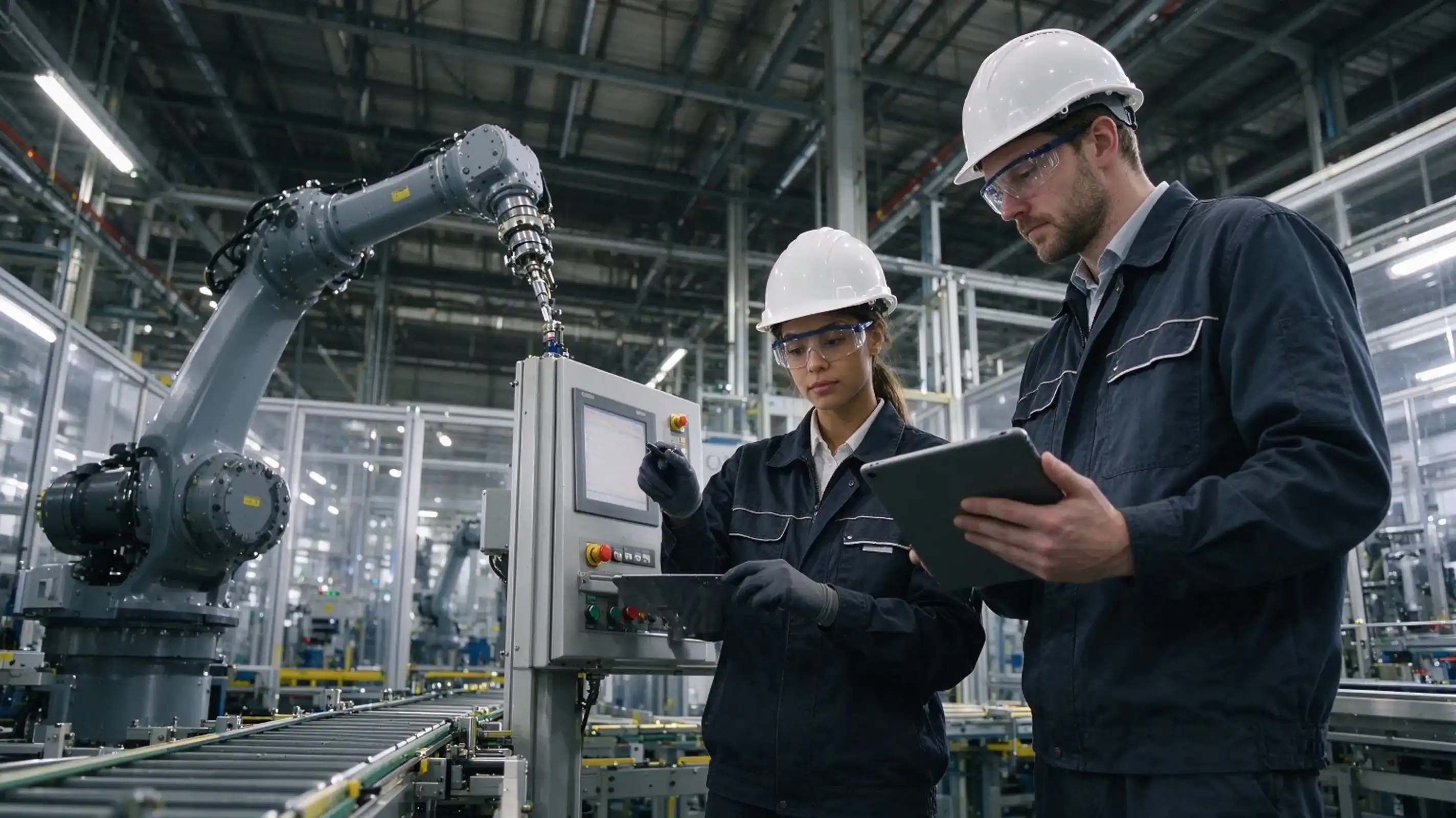
The working robot cell is not only an arm. Includes: Manipulator, Controller, Teach Pendant, End-of-arm tooling, Sensors, PLCs, Conveyors, Machine vision, Operator screens, Safety devices. The robot program ties together these parts by coordinating motion, process actions, inputs, outputs and communication. Understanding joint, linear and circular motion and understanding coordinate frames, tool center points and payload data and signal logic are all required of programmers. These concepts apply for welding, assembly, palletizing, machine tending, packaging, inspection and material handling. The International Federation of Robotics reported about 541,000 industrial robot installations worldwide in 2023, which shows how many cells require skilled programmers.
Core Practical Robot Programming Skills for Manufacturing
Good programs are built on a few habits. I teach position only after I set up the correct world, base, tool and work-object frames. Then I select sensible speeds, blending, accelerating, approaching points and safe retreat points. The input and output logic should check that the grippers, clamps, sensors and conveyors are ready before starting the next step. Code that is easier to reuse has modular subroutines, variables, loops, recipes, and clear comments. In high-mix production, where changeovers are common, what matters most is accurate tool center point data, payload settings and calibration routines. A parameterized changeover program allows a technician to change products without having to rewrite paths.
Common Programming Mistakes and How to Avoid Them
Many failures start with basic planning errors. Teaching positions without understanding coordinate frames creates inconsistent paths and unsafe movement after a tooling or fixture change. Excessive speed shortens the nominal cycle time but adds vibration, defects, tooling wear, and collision risk. Weak handshaking with PLCs causes waiting, missed parts, or uncontrolled sequences. Programs that depend on one engineer become a business risk when documentation, naming, and modular structure are poor. Rigid programs also make product changes costly. Standard templates, calibration checklists, timeout logic, parameterized recipes, training, and revision control prevent most of these problems.
Solving Problems, Tuning Cycle Time, and Keeping Programs Maintainable
A Systematic Method for Solving Robot Programming Problems
I suggest a set troubleshooting sequence because trial and error wastes production time. Indicate whether the issue relates to position, timing, quality, safety, or communication first. Note the software version, operating mode, and impacted product. Incorrect frames, calibration drift, payload errors, sensor timing, PLC communication, tooling damage, and fixture movement are all likely causes. Next, examine the mechanical conditions, input and output states, event logs, alarms, and recent program modifications. Modify one variable at a time so you can determine which change resolved the issue. Lastly, store the updated program as a revision-controlled backup and write a recovery procedure with safe stop positions, timeout logic, and operator guidance.
Improving Robot Program Performance and Cycle Time
Tuning tööstusrobootika tehnoloogia must be based on measured data, not assumptions. Record actual cycle time, robot travel, process time, waiting time, idle time and downtime and compare to takt-time and quality requirements. Common gains are achieved by removing duplicate moves, reducing travel, improving robot-PLC handshaking, and synchronizing motion with fixtures and conveyors. Offline simulation can identify collisions, limits and interference prior to deployment. Any speed or blending change must be checked for repeatability, safety, product quality and tooling life. Pose accuracy and pose repeatability are examples of performance criteria defined in ISO 9283 which provides a common basis for testing for teams. Monitor baseline and after change to show return on investment.
Programming Standards, Safety, and Maintainability
Standard programming speeds troubleshooting and training. I use consistent naming conventions for tools, frames, alarms, variables, inputs and outputs and keep motion, process, safety and operator interface functions separate. Safety-rated signals and access barriers must be consistent with the cell risk assessment. Recovery procedures should be tested at reduced speed. Safety requirements for industrial robots are defined in ISO 10218-1 and collaborative operation in ISO/TS 15066 . Critical parameters should not be alterable without authorization and Operator screens should display clear alarms and corrective steps. Preventive maintenance is improved by monitoring cycle counts, motor loads, tool wear, and recurring alarms. Intellectual property is safeguarded by secure backups and version control.
Selecting, Evaluating, and Launching Robot Projects
Industrial Robotics Technology Selection for Different Manufacturing Needs
The choice must be made on the basis of the application, volume of production, product mix, payload, reach, speed, repeatability, safety conditions and future requirements. Articulated robots are suited to flexible multi-axis work, but SCARA, delta, Cartesian and collaborative robots are better suited to more limited range handling, assembly, packaging or human interaction jobs. For high-mix manufacturers, the focus should be on recipe management, vision guidance, flexible tooling and fast changeovers. For small to mid-sized businesses, it is a good idea to limit risk by starting with one clearly defined bottleneck, and then plan for growth in phases. Integration planning should also include layout, utilities, networks, existing machinery, safety compliance and regional technical support. The total cost of ownership, including training and maintenance, is as important as the purchase price.
Evaluating Suppliers and Integrators
When you select a supplier of industrial robotics technology, it’s more than specs and price. Ask about experience with your process, engineering capability and skill in tooling, PLCs, vision, safety, documentation and commissioning. Manufacturers, distributors, OEMs and system integrators provide different levels of customization, local support, spare parts and project responsibility. Quotation should contain what it contains. Programming. Simulation. Installation. Training. Acceptance testing. Warranty and performance guaranties. Global buyers should validate regional service coverage, language support, regulatory compliance and experience with multi-national sites. A good estimate for return on investment includes integration, maintenance, energy, downtime, labor, quality and expansion costs.
Practical Implementation Steps for Robot Programming Projects
A plan in place mitigates technical, commercial and production risk. Begin with the product attributes, payload, takt time, quality objectives, shifts, changeover requirements, and communication interfaces as per the documentation. Design for layout, reach, tooling, safety zones, operator access, collision risk and simulated cycle time. Programming development includes robot motion, PLC logic, operator screens, input and output signals, tooling and recovery sequences and then factory acceptance testing. Transition on-site from installation and calibration to dry runs and controlled production trials. Finally, train the train operators, maintenance personnel and engineers and hand over full documentation, backups and a plan for tuning after launch.
Future Trends: Simulation, Vision, and Intelligent Maintenance
Future Trends in Industrial Robotics Technology
Tööstusrobootika tehnoloogia is evolving toward simpler simulation, virtual commissioning, AI-assisted programming, vision-guided operation, cloud connectivity and data-driven maintenance. AI may be used for path generation, object recognition and adaptive handling, but the performance, safety and process suitability still need to be verified by the engineers. Connected systems can monitor alarms, energy use, cycle times and equipment condition — but the more devices that are added, the more critical cybersecurity and access control become. Flexible automation will still permit high-mix production via recipe-based programming, quick-change tooling, mobile robots and modular cell designs. These trends favor the programr who understands the physical cell and its digital model.
Digital Twins and Virtual Commissioning in Training
A digital twin is a virtual model of a physical system. Michael Grieves described the concept for manufacturing in a 2014 white paper on virtual factory replication. In practice, teams use the model to test reach, collisions, cycle times, and layout decisions before equipment arrives, and they debug PLC programs against a virtual production line. For learners, this means practice with lower hardware cost and lower physical risk. Virtual practice does not remove the need for final checks on real equipment, so I treat simulation as preparation. Learners arrive at a physical cell already familiar with the logic, the sequence, and the likely faults.
Machine Vision and Intelligent Maintenance
Vision and maintenance data extend what a robot program can do. A vision system with calibrated cameras lets a robot locate parts, sort workpieces, and flag defects instead of repeating fixed positions. Learners practice camera calibration, image acquisition, edge detection, feature matching, and dimensional measurement. On the maintenance side, condition monitoring uses signals such as vibration and temperature to detect wear before a stoppage. Technicians who read this data can plan preventive work, manage spare parts, and diagnose faults remotely. Both skills sit beside programming rather than replacing it, because the robot still needs a correct, well-structured program to act on what the sensors report.
ECR Academy tööstusrobootika tehnoloogia kursus
Project-Driven Curriculum and Joint Instruction
E.C.R Academy built its industrial robotics technology course around project-driven learning that joins theory with practice. The program covers on-site robot programming, programmable control technology, offline programming and simulation, machine vision, digital twin and virtual commissioning, application system integration, and intelligent operation and maintenance. Enterprise engineers and college experts teach together, so learners hear both production needs and academic reasoning. Tasks follow real workflows: point and path teaching for handling, palletizing, and welding; PLC projects such as motor start-stop and conveyor control; and integration of loading and unloading, welding, spraying, and assembly systems. The core skills are robot system integration and intelligent operation and maintenance.
A Virtual Simulation Platform with Seven Modules
The learning platform includes the entire workflow from programming and debugging to integration and maintenance. It has seven platforms, including robot operation and programming, simulation training, PLC control, vision technology, digital twin, system integration, and intelligent operation and maintenance. Learners construct 3D models, run offline programs, detect collisions, establish communication between robots and peripheral devices, and monitor the status of devices using computer-based training terminals. They practice in a highly simulated environment working their way up to the real equipment. The software is intended to operate on computers with the required configuration, including Windows 10, 8 GB or more memory, and a dedicated graphics card.
Career Pathways and Partner Options
The skills align with intelligent manufacturing needs, and they prepare learners for roles in system integration, programming, installation and commissioning, maintenance, technical support, and sales and technical service. Since 2010, E.C.R Academy has delivered training and assessment to nearly 500,000 participants across China and 28 countries, and more than 300,000 learners have obtained recognized skills certifications. We have engaged more than 3,300 experts and partnered with 500+ enterprises. Target partners include enterprises, educational institutions, industry associations, and other organizations. If your college, integration company, or training department wants to discuss a program, the CTA below explains how to reach us.
Järeldus
Praktiline tööstusrobootika tehnoloogia depends on understanding the whole cell, from frames, tool center points, and input and output logic to PLC communication and safety. Systematic troubleshooting, measured cycle-time tuning, consistent naming, and revision control keep programs safe and maintainable, while careful selection, supplier evaluation, and staged implementation reduce project risk. Simulation, digital twins, vision, and condition monitoring extend these skills, though real equipment still needs final validation. The E.C.R Academy course reflects this structure by pairing project-driven learning with a seven-platform virtual simulation environment that covers programming through intelligent maintenance. The main takeaway is that dependable results come from combining programming discipline with system-level knowledge and structured training.
KKK
1. Kas algajad saavad seda programmi õppida?
Yes. The program follows a step-by-step teaching model. It begins with the basic structure and principles of industrial robots, then moves on to programming, PLC control, and simulation design. A basic knowledge of electrical concepts, electronic concepts, mechanical concepts, and computer operation skills are advisable as prerequisites before starting.
2. Milliseid rolle saavad õppijad pärast programmi lõpetamist täita?
Trained learners can be employed as industrial robot application system integration engineers, operation and programming engineers, automation control system installation and commissioning engineers, system maintenance engineers, smart manufacturing technical support engineers, sales and technical service engineers, etc. These roles match the entire workflow that the program teaches, from programming to maintenance.
3. Kuidas platvormi juurutatakse?
The platform uses virtual simulation technology with computer-based training terminals. Learners need computer equipment that meets the configuration requirements, such as Windows 10, 8 GB or more of memory, and a dedicated graphics card. They complete virtual simulation practice through the software.
Alusta oma tööstusrobootika tehnoloogia koolitust ECR Academyga
Colleges, integrators, and training departments seeking an tööstusrobootika tehnoloogia supplier of practical courses can Kontakt E.C.R Academy. Our program combines project-based learning, joint instruction by enterprise engineers and college experts, and a virtual simulation platform covering programming through intelligent maintenance. With 16 years of experience in skills education, we can discuss your goals and course needs. Email ecr2008@enteredu.com või külastage enteru.com üksikasjad.
Tehtud tööd
1. International Federation of Robotics, World Robotics: Industrial Robots, 2024
2. International Organization for Standardization, ISO 9283: Manipulating Industrial Robots – Performance Criteria and Related Test Methods, 1998
3. International Organization for Standardization, ISO 10218-1: Robots and Robotic Devices – Safety Requirements for Industrial Robots, Part 1: Robots, 2011
4. International Organization for Standardization, ISO/TS 15066: Robots and Robotic Devices – Collaborative Robots, 2016
5. Michael Grieves, Digital Twin: Manufacturing Excellence through Virtual Factory Replication, 2014
6. John J. Craig, Introduction to Robotics: Mechanics and Control, 2018